
For fifty years, an Indian school’s reputation rested on three things: results, faculty and buildings. The parents choosing a school today are quietly asking a fourth question — and the schools that answer it well will define the decade ahead.

Learning Does Not Stop at the School Gate
A school has a child for only a few hours a day. But the moments that decide whether a subject is loved or abandoned happen at home — like the evening a child gets stuck on one step of a sum, one word in a paragraph, one "but why?" that nobody is around to answer. These questions arrive at eight in the evening, over a half-finished worksheet. They arrive on the way back home, prompted by something seen around them.
For most of the history of Indian schooling, those moments were simply lost. The child waited for the next class, and by then the question had gone cold — or worse, had been answered badly by the first result on a search page.
Today the child already has a device and is already asking. The only question is whether the school is present in that moment. Parents have started to notice which.
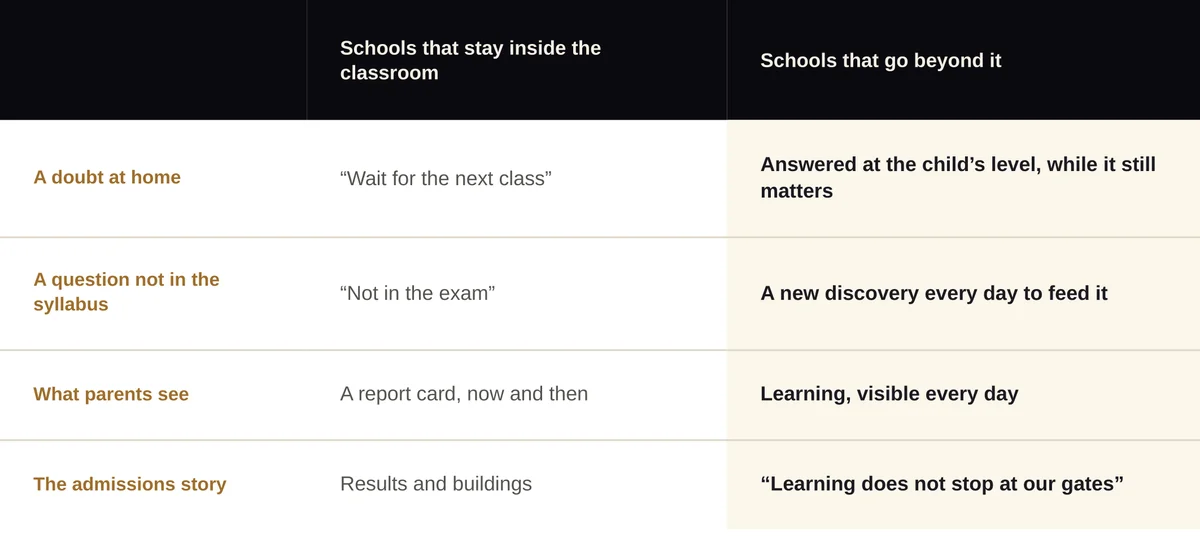

What Changes When Learning Has No Walls
Schools that have taken this seriously report the same three shifts. None of them is about technology for its own sake.
1. The Doubt Gets Answered While It Is Still Alive.
Curiosity has a half-life. A question asked at eight in the evening and answered at eight in the evening reinforces the lesson; the same question parked until Thursday usually dissolves into a shrug. Closing that gap does not replace the teacher — it protects the teacher’s work from evaporating between classes.
2. Questions Outside the Syllabus Stop Being 'Not Important.' They Become the Lesson.
Every teacher knows the question that is genuinely interesting and genuinely off-topic, and every teacher has had to set it aside. When a child has somewhere to take that question, the classroom no longer has to be the only place learning is permitted to happen — and the child learns that wanting to know more is not an inconvenience.


One Line Schools Must Not Cross
Some tools hand over answers. The good ones hand over understanding. The difference is visible the next day: one student copies, the other explains.
Before any digital learning tool reaches your students, insist that it:


The Decade Ahead
The schools that win this decade will not be the ones with the most screens. They will be the ones that understood, earlier than their peers, that their responsibility for a child’s learning did not end at the gate — and then did something practical about it.
That is an admissions story, and it is a far more durable one than a results table. Buildings can be matched. Toppers vary by year. A school that can honestly say learning does not stop at its gates is describing something a competitor cannot buy in a single budget cycle.
The parents in your admissions queue next year are already living the evening version of this problem. The only question is whether your school is part of how they solve it.