Introduction: The Digital Information and Retention Paradox
The rapid digital transformation of global education has fundamentally altered how learning materials are delivered and consumed. Today, students and educators have instant access to vast digital libraries, interactive lectures, and automated study resources. However, abundant access to information has not automatically solved the challenge of long-term knowledge retention.

Modern learners often struggle with cognitive overload, finding it difficult to internalize complex concepts while managing heavy academic workloads. To address this gap, educational technology is increasingly looking toward cognitive science to create more impactful learning environments.
The Pedagogical Science Behind Active Recall and Spaced Repetition
For decades, cognitive psychologists have highlighted the limitations of traditional study habits such as passive re-reading, highlighting text, or copying lecture slides. While these practices create a temporary feeling of familiarity, research shows they fail to build durable neural connections.
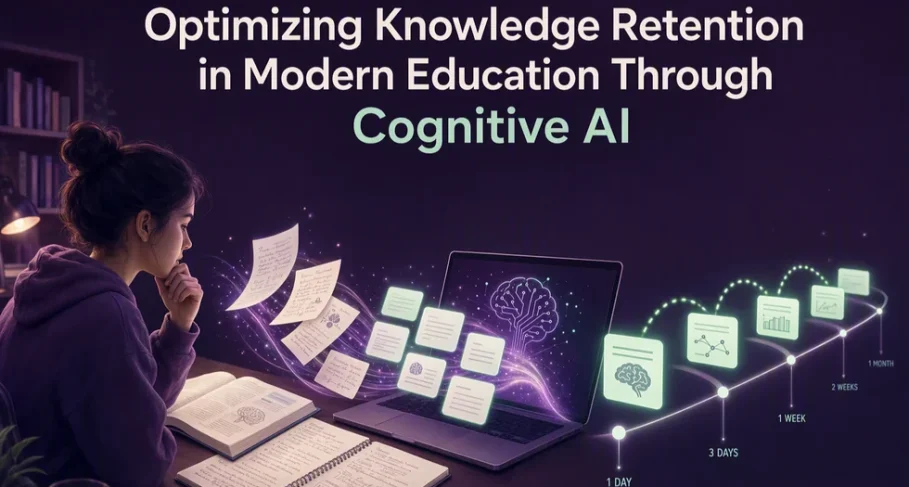
In contrast, evidence-based techniques like active recall and spaced repetition actively strengthen memory retrieval. Active recall forces the brain to retrieve information without looking at the source, while spaced repetition schedules review sessions right before a memory is likely to fade.
Despite their proven efficacy, adopting these methods manually requires significant time and organizational effort. Students must manually draft hundreds of question and answer flashcards and maintain complex review schedules across multiple subjects. In demanding academic environments, this administrative friction often causes learners to default back to passive, less effective study habits.
Automating Cognitive Workflows With AI
Artificial Intelligence is now stepping in to eliminate this administrative burden by combining natural language processing with cognitive algorithms. Advanced platforms utilize Retrieval-Augmented Generation (RAG) and advanced Optical Character Recognition (OCR) to transform static course materials into structured study modules instantly. By parsing uploaded textbooks, lecture slides, research papers, images, infographics and handwritten notes, these systems automatically generate balanced retrieval questions.
An example of this pedagogical integration is the LongTerMemory AI Study Tool, which bridges document management with automated spacing algorithms. Systems of this type analyze raw educational content and construct personalized review queues based on individual user performance.
When a student answers a question correctly, the interval before the next review automatically expands. If a concept proves challenging, the system contracts the interval to ensure timely reinforcement. This dynamic adjustment allows learners to focus their cognitive effort entirely on mastering difficult concepts rather than managing study schedules.
The Evolution of Student-Centric EdTech
As artificial intelligence continues to mature, its role in education is shifting from passive content generation toward active cognitive support. Rather than doing the intellectual work for the student, modern EdTech frameworks are designed to optimize the human learning process itself.
By removing the friction of manual prep work and grounding generated content in verified course materials, AI tools help students and professionals build genuine, long-term mastery. The integration of cognitive psychology and intelligent automation represents a promising step forward for the future of digital learning.