
This website stores cookies on your computer. These cookies are used to improve your website experience and provide more personalized services to you, both on this website and through other media.
Accept
EdTechReviewEdTechReview
  • News
  • Trends
  • Insight
  • eLearning
  • Research
  • Dictionary
  • EdTech Voices
  • More
    • Data & Statistics
    • Reviews
    • AWS for Education
    • Events

    Resources

    • Infographics
    • Reports & Case Studies
    • Videos
    • Books
    • Webinar

    Needs

    • 1:1 Learning
    • 21st Century Education
    • 21st Century Leadership
    • 21st Century Learning
    • 21st Century Teaching
    • 3D Printing
    • More Tags

    For

    • Students
    • Teachers/Educators
    • Administrators
    • Entrepreneurs/Startups
    • Govt. Officials/Policymakers
    • Parents
Explore
Search
Contribute
  • Submit A Post
  • EdTech Trainers and Consultants
  • Your Campus EdTech
  • Your EdTech Product
  • Your Feedback
  • Your Love for Us
  • EdTech Product Reviews
ETR Resources
  • About
  • Mission/Vision
  • Team
  • Services
  • Testimonials
  • Authors
  • Sponsor
  • Partner
  • Advertise
  • Our Clients
  • Media Kit
  • Press Release
  • FAQ’S
Reading: Optimizing Knowledge Retention in Modern Education Through Cognitive AI
Aa
EdTechReviewEdTechReview
Aa
Search
  • News
  • Trends
  • Insight
  • eLearning
  • Reviews
  • Dictionary
  • EdTech Voices
  • Data & Statistics
  • Research
  • AWS for Education
  • Events
  • EdTech Voices
  • Tags
  • About
  • FAQ’S
  • Our Clients
  • Partner
Follow US
Home > eLearning > Optimizing Knowledge Retention in Modern Education Through Cognitive AI
eLearning

Optimizing Knowledge Retention in Modern Education Through Cognitive AI

Alessandro Fuda
Alessandro Fuda Published Oct 1, 2026
Share
4 Min Read
Optimizing Knowledge Retention in Modern Education Through Cognitive AI
SHARE

Introduction: The Digital Information and Retention Paradox

The rapid digital transformation of global education has fundamentally altered how learning materials are delivered and consumed. Today, students and educators have instant access to vast digital libraries, interactive lectures, and automated study resources. However, abundant access to information has not automatically solved the challenge of long-term knowledge retention.

Contents
Introduction: The Digital Information and Retention ParadoxThe Pedagogical Science Behind Active Recall and Spaced RepetitionAutomating Cognitive Workflows With AIThe Evolution of Student-Centric EdTech
AdvertisementWhy this Ad?

Modern learners often struggle with cognitive overload, finding it difficult to internalize complex concepts while managing heavy academic workloads. To address this gap, educational technology is increasingly looking toward cognitive science to create more impactful learning environments.

The Pedagogical Science Behind Active Recall and Spaced Repetition

For decades, cognitive psychologists have highlighted the limitations of traditional study habits such as passive re-reading, highlighting text, or copying lecture slides. While these practices create a temporary feeling of familiarity, research shows they fail to build durable neural connections.

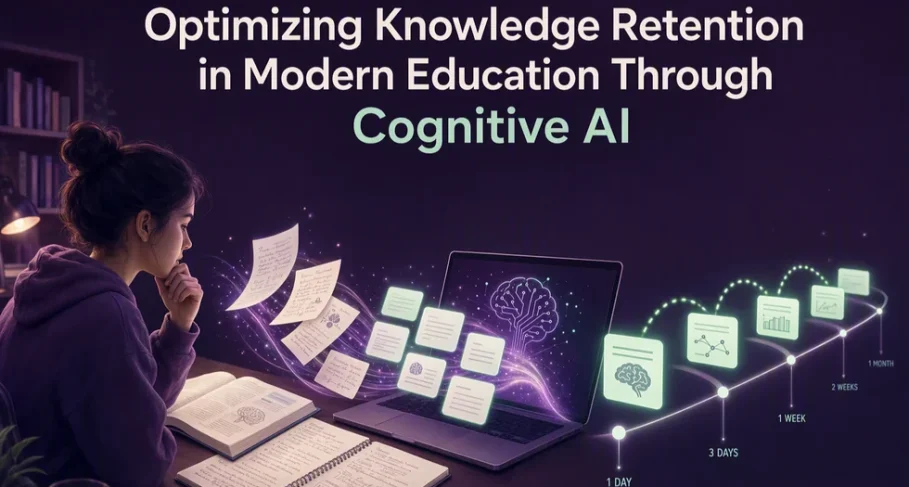
In contrast, evidence-based techniques like active recall and spaced repetition actively strengthen memory retrieval. Active recall forces the brain to retrieve information without looking at the source, while spaced repetition schedules review sessions right before a memory is likely to fade.

Despite their proven efficacy, adopting these methods manually requires significant time and organizational effort. Students must manually draft hundreds of question and answer flashcards and maintain complex review schedules across multiple subjects. In demanding academic environments, this administrative friction often causes learners to default back to passive, less effective study habits.

Automating Cognitive Workflows With AI

Artificial Intelligence is now stepping in to eliminate this administrative burden by combining natural language processing with cognitive algorithms. Advanced platforms utilize Retrieval-Augmented Generation (RAG) and advanced Optical Character Recognition (OCR) to transform static course materials into structured study modules instantly. By parsing uploaded textbooks, lecture slides, research papers, images, infographics and handwritten notes, these systems automatically generate balanced retrieval questions.

An example of this pedagogical integration is the LongTerMemory AI Study Tool, which bridges document management with automated spacing algorithms. Systems of this type analyze raw educational content and construct personalized review queues based on individual user performance.

When a student answers a question correctly, the interval before the next review automatically expands. If a concept proves challenging, the system contracts the interval to ensure timely reinforcement. This dynamic adjustment allows learners to focus their cognitive effort entirely on mastering difficult concepts rather than managing study schedules.

The Evolution of Student-Centric EdTech

As artificial intelligence continues to mature, its role in education is shifting from passive content generation toward active cognitive support. Rather than doing the intellectual work for the student, modern EdTech frameworks are designed to optimize the human learning process itself.

By removing the friction of manual prep work and grounding generated content in verified course materials, AI tools help students and professionals build genuine, long-term mastery. The integration of cognitive psychology and intelligent automation represents a promising step forward for the future of digital learning.


TAGGED: AI Tools, Artificial Intelligence, Cognitive Learning, Learning Science, Personalized Learning, Students, Tools for Students
Share This Article
Facebook Twitter Whatsapp Whatsapp LinkedIn Reddit Telegram Email Copy Link
Previous Article How to Find the Greatest Common Factor GCF Steps and Examples How to Find the Greatest Common Factor (GCF): Steps and Examples
Next Article 6 Human Quality Gates for AI-Generated Learning Videos 6 Human Quality Gates for AI-Generated Learning Videos
AdvertisementWhy this Ad?

Latest EdTech News To Your Inbox

Stay Connected

AdvertisementWhy this Ad?

Latest EdTech News To Your Inbox

Stay Connected

AdvertisementWhy this Ad?

You Might Also Like

6 Human Quality Gates for AI-Generated Learning Videos
eLearning

6 Human Quality Gates for AI-Generated Learning Videos

Oct 1, 2026
How to Find the Greatest Common Factor GCF Steps and Examples
eLearning

How to Find the Greatest Common Factor (GCF): Steps and Examples

Sponsored by
Top 7 AI for Educators Courses in India 2026-27 Edition
News

Top 7 AI for Educators Courses in India: (2026-27 Edition) Fees, Duration, Mode & Certification Details

Sep 28, 2026
How to Enhance Student Project Videos Shot on Phones
Trends

How to Enhance Student Project Videos Shot on Phones

Sep 28, 2026
What Is AI Video Analysis How AI Helps Understand Video Content
Trends

What Is AI Video Analysis? How AI Helps Understand Video Content

Sep 25, 2026
A Student Doesnt Need Another Score They Need to Know What to Do Next
Insight

A Student Doesn’t Need Another Score. They Need to Know What to Do Next.

Sep 25, 2026
One-on-One Doesnt Mean Personalized
Practices

One-on-One Doesn’t Mean Personalized

Sep 23, 2026
Decision-stage content gaps across 2000 education company websites
Insight

What I Learned Scoring 2,000 EdTech Websites on Whether They Can Actually Close

Sep 22, 2026
Show More
EdTechReviewEdTechReview

H433, 2nd Floor, Vikaspuri, New Delhi, India, 110018
Phone: 011 41321030

Follow US

Copyright © EdTechReview. All Rights Reserved.

  • Home
  • Advertise
  • Event Associations
  • Press Release
  • About
  • Services
  • Contribute
  • News
  • Trend & Insight
  • Data & Statistics
  • eLearning
  • Reviews
  • Research
  • EdTech Voices
  • Dictionary
  • Tags
  • Resources
  • Events
  • Courses
  • EdTech Product for Review
  • Sponsored/Paid Post Service
  • Our Clients
  • FAQ’S
  • Contact Us
  • Important Links
  • Sitemap
  • Terms of Use
  • Privacy Policy
newsletter
Join 100K+ subscribers!

Subscribe to our weekly newsletter that brings the latest EdTech news, trends, insights, reports, interviews, etc. for educators, school leaders, entrepreneurs, investors, & others.

loader
Zero spam, Unsubscribe at any time.
Go to mobile version
Welcome Back!

Sign in to your account

Lost your password?