

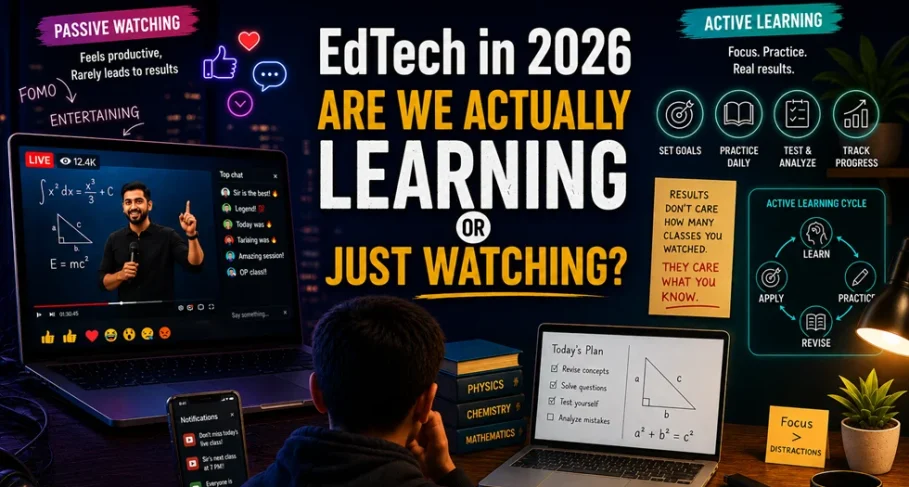
Let me be honest with you. Something feels off about the way we’re doing education online right now, and I think we all quietly know it — but nobody’s really saying it out loud.

The Star Teacher Problem
Open any EdTech platform today and you’ll find them — the star teachers. Charismatic, funny, incredibly watchable. Their live classes feel more like entertainment shows than lectures. Students tune in by the thousands, the comment sections are wild, and everyone’s having a good time.
And look, I’m not here to bash these teachers. Genuinely. Most of them are impressive human beings. The subject they actually specialise in? They explain it beautifully. And when real crises hit — remember the NEET paper leak situation — several of these educators stepped forward, extended support, offered free resources, reassured panicking students. That’s not nothing. That matters.
But here’s the uncomfortable truth that the data keeps showing us.
Out of every 100 students watching those entertaining live sessions, roughly 89 to 91 are failing. Only about 9 students from that same cohort are actually clearing their exams. And if you look closely at those 9 — most of them were either self-studying on the side or were simply bright enough to extract what they needed and fill the rest themselves.
The videos aren’t the problem exactly. The culture around the videos is.
Students aren’t always watching to study. They’re watching because everyone else is watching. Because missing a class feels like missing out on an inside joke. Because the teacher said something hilarious last session and the group chat hasn’t stopped talking about it. That FOMO is real — and the platforms know it, and honestly they’re kind of built around it.
What Parents Think Is Happening vs. What’s Actually Happening
Parents are paying. A lot. EdTech subscriptions, coaching centre fees, test series packages, crash courses — the numbers add up fast, and families are spending serious money believing their child is studying.
But is anyone asking the actual question?
Is your child studying — or is your child watching?
Because those are two very different things, and a screen doing something educational-looking doesn’t mean learning is happening. A student can sit through three hours of video content, feel productive, close the laptop and retain almost nothing — because passive watching is not the same as active engagement with difficult material. And if they’re just playing the video to show a parent “I’m studying” before switching tabs? That’s a problem no subscription fee fixes.
On AI Tools — They’re Good, But Let’s Be Real
ChatGPT. Gemini. Acazen. Yes, they’re genuinely impressive. For clearing doubts at 2am, for checking homework, for getting a quick explanation of a concept you half-understood — brilliant. Use them.
But calling an AI chatbot your main educator is like calling Google Maps your driving instructor. It can guide you, it can answer you, it will never lose patience with you — but it doesn’t actually know you. It doesn’t notice that you’ve been struggling with the same type of question for three weeks. It doesn’t pick up on the fact that you stopped asking questions because you gave up, not because you understood.
There’s something a serious human teacher does that no current AI replicates cleanly — the emotional weight of accountability. When a real teacher looks at you and says “you can do better than this,” something happens in your head that a chatbot response simply cannot trigger.
Where Is This All Going, Though?
Here’s where I’ll give EdTech its fair credit — the trajectory isn’t finished.
Companies like OpenAI, Google, Acazen and others are actively working on making AI that doesn’t just answer questions but actually teaches. Adaptive learning, emotional detection, personalised pacing — these aren’t science fiction concepts anymore. EdTech is one of the fastest growing categories globally right now, there’s real market potential, real investment, and genuinely smart people trying to solve the human-teacher problem through technology.
It’s not impossible. If tech ever manages to genuinely replicate the feeling of a serious, emotionally invested human educator — not just the information delivery but the relationship — then yes, EdTech will be something extraordinary.
Right now though? EdTech is mostly videos and chatbots. Some great, some average, most of it passive.
So What Should a Student Actually Do?
Watch the entertaining teacher if it helps you stay interested. Use the AI for doubt clearing. Fine. Nobody’s stopping you.
But stop lying to yourself that watching is studying. Stop letting a progress bar on a video player feel like preparation. And stop letting your parents believe a ₹50,000 subscription is doing the work that you aren’t.
The exam doesn’t care how funny your teacher was. The result sheet doesn’t care how many live classes you attended. It only cares what you actually know when you sit down alone in that hall with a pen and a question paper.
EdTech is a tool. A good one. But a hammer doesn’t build the house — you do.
And if you’re waiting for technology to care about your future the way a real teacher would — keep waiting. Because right now, it doesn’t. Not yet.
The screen won’t sit in that exam hall for you. The algorithm won’t feel your parents’ silence when the result comes. Only you will. So maybe, just once — close the tab and actually study.