Artificial intelligence (AI) is rapidly transforming education, making learning more personalized and accessible. At the same time, digital education depends on stable connectivity, especially as students increasingly study, travel and work remotely. Solutions like eSIM Plus make it easier to stay connected across countries without switching physical SIM cards or paying high roaming fees. Together, advances in connectivity and AI help shape a more flexible, student-centered learning experience.

EdTech companies are driving this shift by integrating AI into educational platforms. But how exactly do these technologies work, and what challenges come with their implementation?
Why AI Is a Necessity in Education
Modern education faces a number of challenges: overworked teachers, outdated methods, and a lack of individualized approach. AI solves these problems by improving the quality of learning and simplifying administration.
- 24/7 access for students: AI provides 24/7 access to learning: chatbots and virtual assistants are always available, answering questions and helping with study materials.
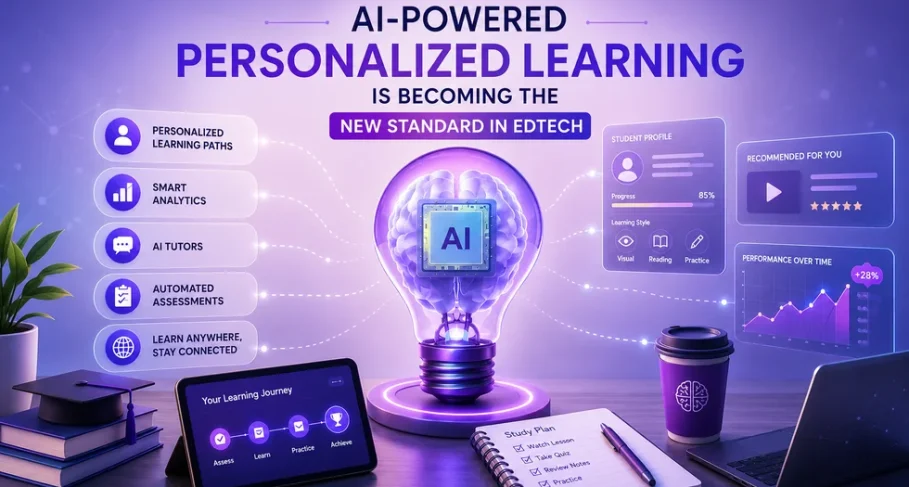
- Personalized learning: AI analyzes data about each student, including academic performance, learning pace, and learning preferences.
- Automating routine tasks: AI frees teachers from routine work by automating grading, progress tracking, and administrative tasks.
- Virtual teachers and chatbots: chatbots assist students at any time of day by answering questions, explaining difficult topics, and providing additional materials.
- Performance analytics and forecasting: AI analyzes student performance and predicts outcomes.
- Creating interactive content: AI helps create interactive courses tailored to students’ needs, making learning more engaging.
How AI Works in Educational Platforms
AI in EdTech is based on several key technologies: machine learning, neural networks, and big data analysis. Let’s look at how this works in practice.
Data collection and processing
AI-based educational platforms start with data — and the more data they have, the better. The system collects data about each user:
- Academic performance and course completion rates.
- Time spent on the platform.
- The number and types of errors in tests and assignments.
- Preferences in learning methods (video, text, interactive activities).
Machine learning and model development
Machine learning is the foundation of AI in EdTech. Algorithms process the collected data and identify patterns that a person may not notice.
Neural networks and deep learning
Neural networks are used for complex tasks such as speech recognition or text analysis.
Big data analysis and predictive analytics
AI-powered educational platforms use big data for analysis and forecasting. This helps identify trends and predict student success or learning difficulties.
Continuous adaptation and self-learning
The greatest strength of AI is the ability to learn based on feedback. The more users interact with the platform, the better the algorithms understand their needs and preferences.
Mistakes in AI Implementation
Despite the advantages, in practice, the process of AI integration is often accompanied by mistakes that can negate all efforts and investments.
- Insufficient data quality and volume — AI depends on data to function and improve. If the data is incomplete, inaccurate, or poorly structured, the AI will not be able to learn and make decisions correctly.
- Ignoring user needs — AI solutions fail to address the real problems of students and teachers. When technology is introduced for the sake of trend rather than real benefit, learning becomes more complicated and inconvenient.
- High development and implementation costs — creating and maintaining AI-based educational platforms requires significant financial and time investment. Not every EdTech company or educational institution is ready to invest in such complex technological solutions.
- Privacy and data security issues — educational platforms store large amounts of personal data: academic performance, behavioral data, and interaction history. Data leakage or misuse can lead to serious consequences.
- Lack of a clear implementation strategy — sometimes EdTech companies implement AI without a clear goal or strategy.
Conclusion
AI is already changing the educational industry, making learning more personalized, accessible, and high-quality. For EdTech companies, this is an opportunity to create innovative products that truly solve users’ problems. If you work in EdTech, it’s time to act — the future is already here.