
What if teachers could practice handling a difficult classroom before ever stepping into one?
With changing technology, there is a need for a change in the requirements expected from educators. Educators in modern times have been assigned multiple roles other than that of a mere facilitator of knowledge. It is not possible to prepare educators using conventional methods alone. In this scenario, Virtual Reality can play an important part.

Rethinking Teacher Preparation in a Changing World
Traditional teacher training usually emphasizes theoretical knowledge, lesson planning, and observation within the classroom. Although important, these methods do not fully address the uncertainty of real-life classes, which include diverse students, behavioral issues, and making decisions quickly.
The difference between theory and practical application may result in teachers feeling insecure about their first teaching experiences.
How Virtual Reality Changes the Training Experience
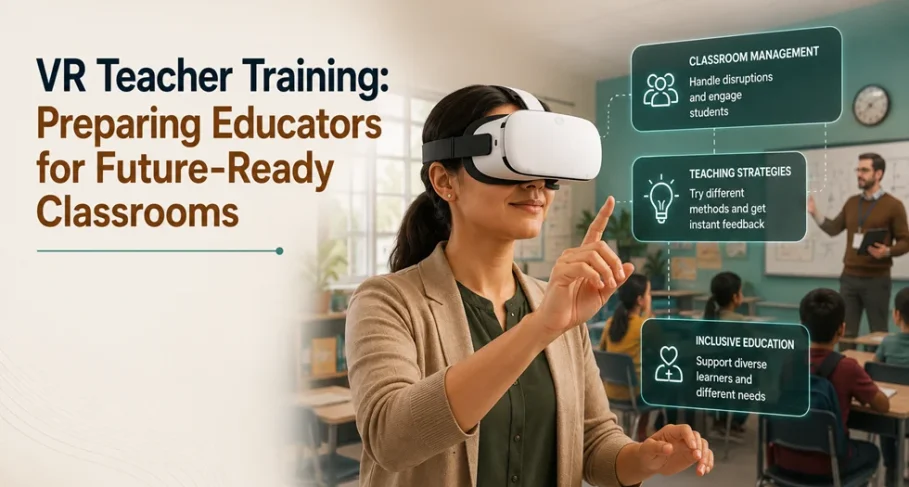
Virtual Reality adds a new dimension to teaching by adding an experience aspect to the training of teachers. Teachers will no longer have to rely on imagining themselves in classroom situations but will be able to immerse themselves in virtual classrooms.
Teachers will be able to:
- Engage with virtual students with different personalities
- Test out different teaching techniques
- Gain instant feedback
Where VR Makes the Biggest Difference
1.Classroom Behavior Management
Distractions, gaining student’s attention, and time management are some of the basic skills that need to be acquired by the teachers. With the help of virtual reality, teachers can undergo the same scenario many times without the feeling of stress.
2. Acquisition of skills in inclusive education
Modern classrooms comprise many different kinds of students. Using VR, one is able to create virtual learners with different needs and attributes. Consequently, this becomes important to the teacher with regard to learning how to teach all kinds of students.
3. Making lessons better
The more you practise, the better you get at explaining difficult ideas clearly. VR gives teachers a safe place to try out new ways of teaching
Beyond Skills: Building Confidence and Readiness
Building confidence is one of the best things about VR-based training. When teachers practise realistic situations over and over again, they are better able to deal with similar situations in real classrooms.
Also:
- Mistakes are chances to learn.
- Training can be done at your own pace and over and over again.
- Before going into real-life situations, teachers feel more ready.
Issues to Consider
Even with the huge potential for VR in educational contexts, there is still much work to be done. The key issues are listed below:
Availability of infrastructure: There are institutions that cannot afford necessary equipment.
Complexity of use: Some instructors will need help in using VR software.
Quality of simulation: For VR to work, high-quality simulations must be developed.
These issues need to be addressed to increase the adoption of VR technology.
Looking Ahead: The Future of Teacher Training
As immersive technologies get better, they will probably play a bigger role in education. VR could become an important part of teacher training programs, working with traditional methods instead of replacing them.
Teachers who are ready for the future will need chances to:
Keep practicing
Get used to new places where you can learn
Improve both your technical and people skills.
Conclusion
Preparing educators for modern classrooms requires more than theoretical knowledge it demand experience, adaptability, and confidence. Virtual Reality offers a powerful way to bridge this gap by transforming how teachers learn and practice their craft.
As institutions explore innovative approaches to training, VR stands out as a promising tool to create more prepared, confident, and future-ready educators.