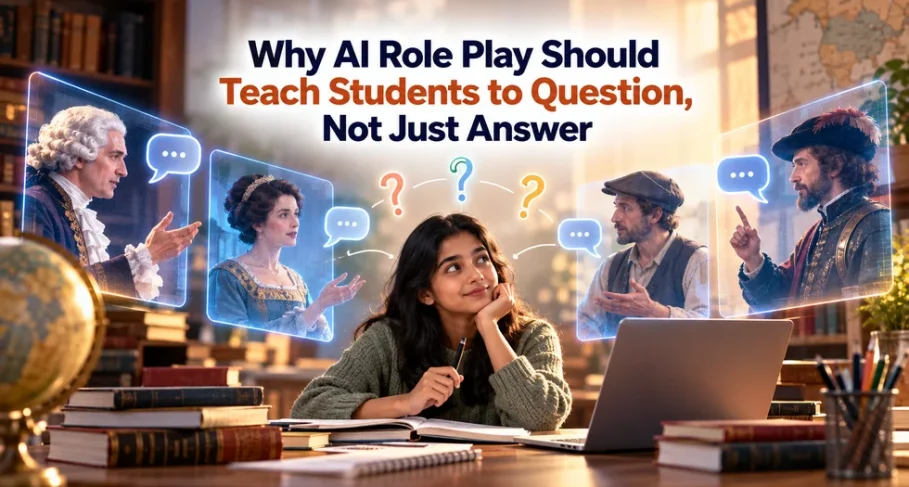
Generative AI has made it very easy for students to get answers. Ask a chatbot why the French Revolution happened and it can give an explanation in seconds. Ask it to compare two figures and it will make a neat list of similarities and differences. But there is a problem with making answers so easy to get: students may become less involved in the process of finding them. The challenge for teachers is not just to make AI explanations more accurate or more interesting. It is to create learning experiences where students stay intellectually active.

Over the past few months, I have been looking into one possible way: letting students explore historical questions by talking to a variety of AI simulated characters. The experience has taught me something. The best use of AI in education may not be its ability to answer questions but its ability to create situations in which students want to ask them.
From Getting Information to Solving a Problem
Think about a classroom activity about a historical event. Students read a document listen to an explanation and answer questions to check what they know. Now imagine another starting point where students are given a mystery. They can ask characters who represent different views look at clues and slowly find out what happened.
Instead of asking an AI assistant to explain an event, pupils could speak to a shopkeeper, a politician or an ordinary person who experienced it first-hand. Each character has a point of view, limited knowledge, and different goals. A student who gets answers must decide what to check next. Why do the stories not match? Which parts can be checked? What is missing? The learning activity becomes less about getting the answer and more about building a reasoned understanding. This difference is important because understanding history is not about remembering facts. It also involves looking at evidence understanding the background seeing points of view and knowing what we know from what we think.
Conversational AI enables some of these skills to be put into practice, provided the activity is carefully prepared.
The Need to Give Students a Reason to Ask Questions
One problem with ended educational chatbots is that students may not know what to ask. A blank conversation window gives a lot of freedom. Freedom alone does not create curiosity. In an activity the student has a clear goal. A character may have information but the student must find the right questions to get it.
The difference is small but important. Instead of asking, "Tell me about the Enlightenment " a student might ask a simulated eighteenth-century thinker why established political power should be questioned. That answer could lead to another question about tolerance, education or the relationship between reason and power. The conversation now has a purpose. Students are not just taking in an explanation; they are leading an investigation.
This does not happen on its own. A planned activity can quickly become a series of random talks. Students need a goal, helpful clues and a way to see if they are making progress. This was one of the important lessons from our first classroom test.
What an Early Classroom Test Showed
I recently made a prototype of an AI based investigation activity and got a chance to see it in a real classroom. The first feedback was good. Students rated the experience an average of 4 out of 5. The teacher wanted to try it with two more classes.
The feedback also showed a big problem. Some students found it hard to understand what they were supposed to do. The overall idea of the activity was not always clear. What was the goal? Which information was important? How would they know if they were getting somewhere? This was a reminder that an interesting idea is not always an easy learning experience.
For the person who made the activity the purpose can seem clear. For a student who sees it for the time it may be confusing. After this feedback I changed the experience to make the goals clearer the steps visible and the talks more guided. That new version is currently being tested in classrooms.
For now, these thoughts do not prove that AI role play improves learning but they suggest an important idea: students need enough structure to understand what they are doing while still having freedom to make important choices.
Why AI Characters Should Not Always Be Trusted
There is also an educational challenge with AI simulated historical characters. Large language models can make statements that seem correct but are not accurate. They may make up events give quotes or present uncertain ideas as facts. In an educational chatbot these mistakes are a big problem. In an investigation they are still a problem but they can also be a chance to teach how to check things carefully—if students are taught how to find and check doubtful statements.
A simulated character should never be treated as a source. It is a computer made version based on a model, not someone who saw the past. Even if its answers match history they are not proof on their own. Students therefore need to use sources: historical documents, letters, images, first-hand accounts or carefully chosen books.
For instance, after asking a philosopher students might be asked to compare what the character said with a real text. Does the source back up the claim? Is the wording, right? Did the simulation make the original idea simpler. Change it? The goal is not to make students distrust everything the AI says but rather build the habit of asking how a statement can be proven.
This idea goes beyond history. In a world where convincing AI content is more and more common the ability to tell an answer from a well-supported one is a key skill.
The Teacher Is Still Essential
AI role play can make it look like learning's on its own and that the teachers’ job is smaller. I would say the opposite. The more open the conversation the more important the learning plan becomes. Teachers choose which historical questions are worth exploring, which views students should meet and which sources are needed to check the answers. They also help students think about what happened during the activity.
A conversation with an AI character may feel interesting at the moment. Being interested is not the same as understanding. The important learning may happen later when the class talks about why some answers were wrong how different groups saw the same event and what proof supports a certain idea. Teachers can also use students’ questions and problems to find misunderstandings that might otherwise stay hidden. In this way conversational AI should not replace the teacher’s explanation or choice. It should offer material for talks.
Creating AI Activities Around Brain Work
My first experience suggests some ideas worth thinking about when making AI based learning activities. First start with a question or problem not just an open chat. Second make the goal clear. Students should use their brain to find out not to understand the system. Third let paths through the activity. If every talk leads to the answer the experience may feel interactive but not require much thinking. Fourth include chances to check claims with sources. AI talks should help with history not replace history. Finally measure learning separately from fun. A good rating from students is helpful. It does not tell if they have better thinking skills or remember more.
These questions need classroom observation and testing.
From Answers to Better Questions
The educational value of generative AI is often described in terms of speed: faster explanations, personal exercises, quick feedback and content that fits individual needs. These can be helpful but school is not just about giving information in the fastest way. Sometimes the hard work of finding an answer is exactly what makes learning useful. A student who has to choose who to ask, see differences, check evidence, and back up a conclusion is doing something important to develop their learning skills.
AI role play is not a fix. It can have problems with history, confusion and shallow involvement. Its success will depend on design and careful testing. Still, it shows a way to think about AI in education. Instead of making systems that always know the answer, maybe we should make more learning experiences that make students curious enough to find the questions.
The best educational chatbot may not be the one that answers every question but the one that helps students find out which questions are worth asking.