
Schools and colleges in India face more cyber attacks than any other sector. That is the finding of two security companies that watch attacks on their own customers' networks.
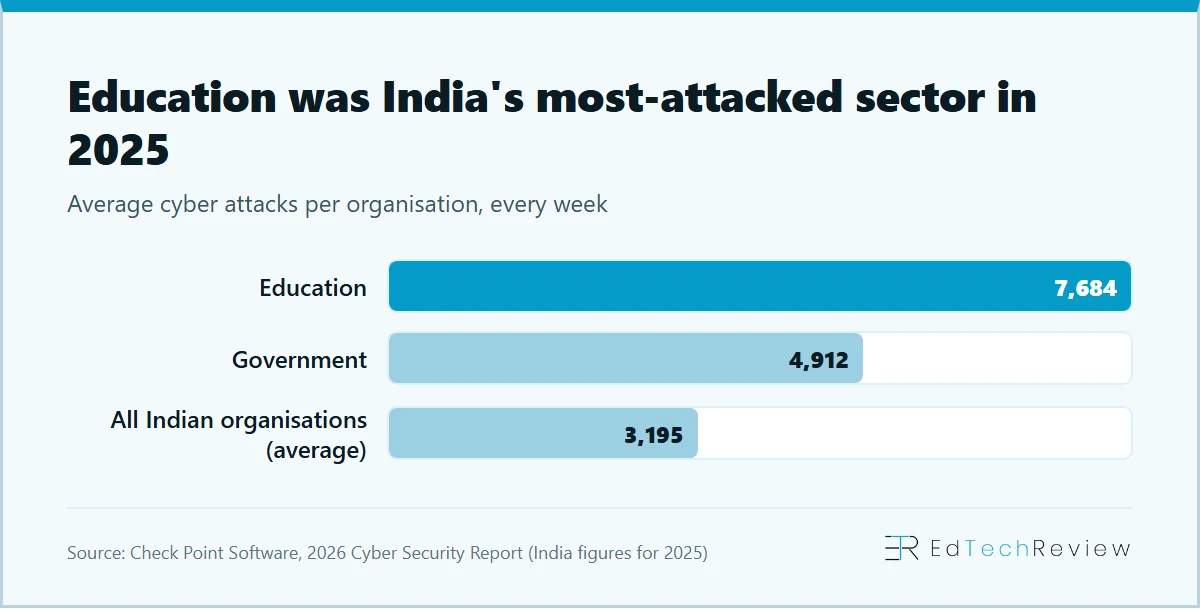
Check Point, a security company, says education was the most heavily targeted sector in India in 2025, with 7,684 attacks per organisation every week. Government came second at 4,912, and the average across all Indian organisations was 3,195 [1]. Seqrite, part of Quick Heal Technologies, ranks education first by a different measure: 4.92 million malware detections, or 18.45% of everything it caught in India [2].
Two companies, two methods, one answer. But it helps to know what these numbers are before deciding what to do about them.
What the Numbers Actually Count
Both figures count what each company's security products saw on its customers' systems: attack attempts in Check Point's case, malware caught in Seqrite's. Neither is a count of damage done.
So the ranking tells you where attackers are aiming, not how many schools were broken into. India has no official national ranking of sectors by attacks, and no public count of confirmed breaches at schools or colleges. Attempts, detections, incidents and confirmed breaches are four different things, and news reports often blur them.
Why Do Hackers Target Schools and Colleges?
Three things make education attractive, and none of them is a secret.
Open networks. A campus is built to let thousands of people connect: students, staff, visitors, researchers sharing data with other institutions. Seqrite says attackers exploited "unpatched systems, shared Wi-Fi networks, and poorly secured research infrastructure" [2].
Valuable data. A school or university holds names, dates of birth, addresses, phone numbers, marks and fee records. Exam bodies and admission portals hold the same for very large numbers of candidates at once. Personal data like this is what attackers look for.
Thin IT teams. A school may have one IT person, or a teacher who looks after the computers on top of teaching. Seqrite links the heavy attack load on education, healthcare and manufacturing to "resource constraints, legacy infrastructure, and open collaboration networks" [2]. Patches wait, old systems stay online and passwords go unchanged.
What Recent Indian Incidents Show
The headline figures are about attempts. These are some of the cases that became public, and what each one turned out to be.
| Incident | What happened | What was confirmed |
|---|---|---|
| CBSE results services portal, June 2026 | Repeated, coordinated attacks over three days after the portal opened | CBSE said no data breach or unauthorised access was detected, and filed a police complaint |
| IIT Roorkee, JEE (Advanced) 2026 | A researcher claimed a large leak of result records | The institute acknowledged a temporary cloud storage misconfiguration and called claims of a mass breach misleading |
| University of Madras, 2026 | Repeated attacks on the university website | The registrar said student data sits on separate servers that the attackers could not reach |
| Two Indian universities, not named, reported October 2026 | One faced an AI-generated password-guessing campaign; at the second, the attacker got in and took a database | Palo Alto Networks' Unit 42 researchers confirmed the intrusion and a database of more than 5,200 records, including students' personal information [3] |
Three lessons stand out. Attacks on public-facing portals are constant, and keeping them up is a job in itself. A storage setting left open by mistake can do as much harm as a skilled attacker. And a single weak administrator password was enough: at the second university, the researchers found the attacker had obtained an administrator account with a weak password [3].
What Is the Most Common Attack on Schools?
Most attacks start with a person rather than a machine. The usual routes are:
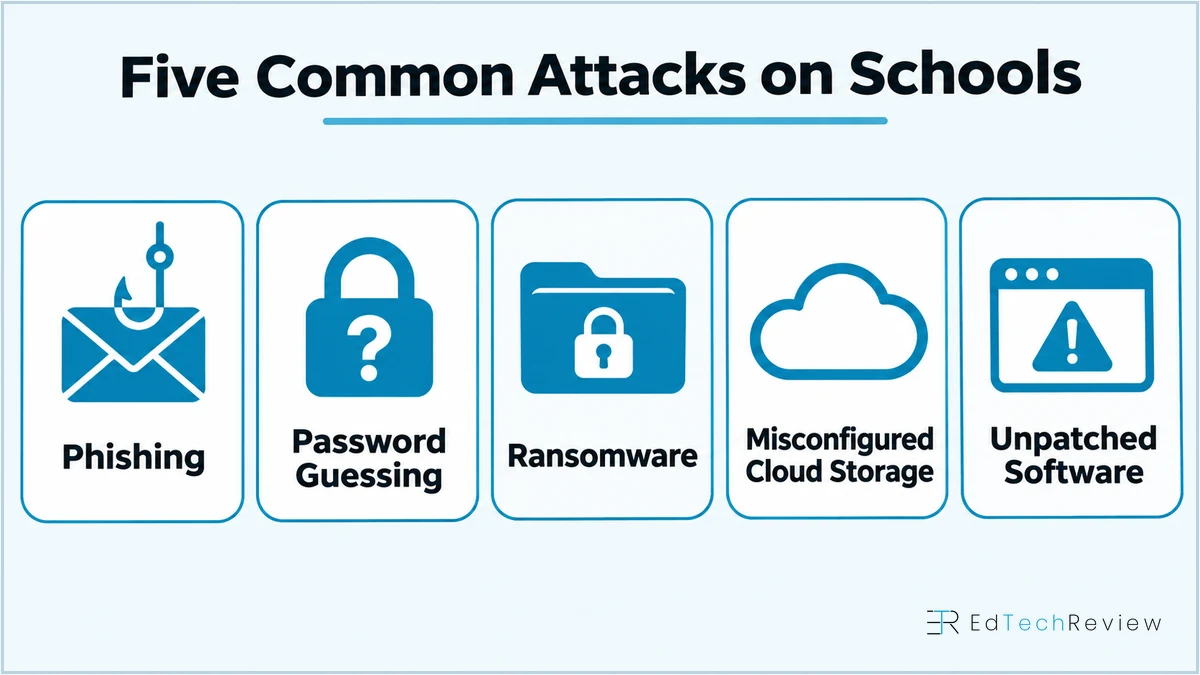
- Phishing: an email or message pretending to be the principal, the board or a vendor, asking someone to click a link or share a password.
- Password guessing: automated tools trying common passwords against staff and admin logins.
- Ransomware: malware that locks files and demands payment to release them.
- Misconfigured cloud storage: files left open to anyone who finds the link.
- Unpatched software: old versions of a website, learning platform or operating system with known holes.
AI is making some of this easier. In the university case above, the researchers concluded that AI "lowers the skill barrier for cybercrime": the attacker used basic tools and AI-written scripts, and still took thousands of records [3].
What the Ranking Should Not Be Used For
The ranking is a useful warning, but a poor guide to spending. It comes from vendors who sell protection, measured on their own customers, and it counts attempts, not outcomes. It says nothing about whether a particular school is safe.
The more useful questions for a school are its own: who can log in to what, whether the admin accounts use a second factor, which systems have not been updated, where student data is stored and who can see it, and who would make the call if something went wrong. Those questions are where a small IT team should start.
Frequently Asked Questions
Which sector in India is most targeted by cybercriminals?
Education, according to Check Point's and Seqrite's figures for 2025. Both are security companies measuring attacks on their own customers. There is no official national ranking.
Why do hackers target universities?
Universities run large, open networks, hold personal data on thousands of students and staff, and often have small IT teams. Seqrite points to unpatched systems, shared Wi-Fi and poorly secured research infrastructure.
What kind of data do hackers steal from schools?
Mostly personal information: names, contact details, dates of birth, marks and fee records. In the university case confirmed by researchers in October 2026, the stolen database held student and faculty records with personal details [3].
Who does a school need to report a cyber incident to?
India's national cyber security agency, CERT-In. Its 2022 Directions require listed types of cyber incident to be reported within six hours of noticing them, by email to [email protected] or on 1800-11-4949 [4]. Whether a particular school or trust is covered depends on how it is set up, so check with its legal adviser. Fraud involving money can also be reported on the national helpline, 1930.
References
[1] Check Point Software's 2026 Cyber Security Report Finds India Sees 3,195 Weekly Cyber Attacks, Up 2% Year on Year: https://cxotoday.com/media-coverage/check-point-softwares-2026-cyber-security-report-finds-india-sees-3195-weekly-cyber-attacks-up-2-year-on-year/
[2] Seqrite, India Cyber Threat Report 2026: https://www.seqrite.com/documents/en/threat-reports/india-cyber-threat-report-2026.pdf
[3] "Next Exploit Opportunities": How a Threat Actor Used AI to Help Plan and Execute Multiple Types of Cybercrime Activities: https://unit42.paloaltonetworks.com/ai-assisted-cybercrime-analysis/
[4] CERT-In, Directions under Section 70B(6) of the Information Technology Act, 2000, 28 April 2022: https://www.cert-in.org.in/PDF/CERT-In_Directions_70B_28.04.2022.pdf