
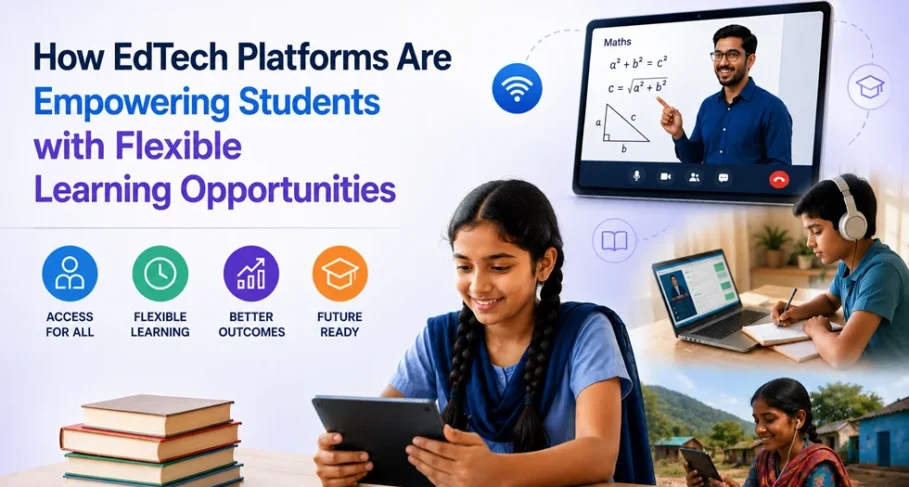
The conversation around EdTech is often framed around technology, but its real significance lies in what it helps enable- access, flexibility, and continuity in learning. For many students in India, especially those in remote and low-income school systems, the challenge is not the willingness to learn, but consistent access to quality teaching.
India’s National Education Policy 2020 recognises this gap and places strong emphasis on the role of technology in bridging inequities in access and learning outcomes. It calls for the integration of digital tools to support personalised learning, teacher development, and wider outreach, particularly for students in underserved regions.
This need is reflected in data as well. As per the Unified District Information System for Education Plus, a large number of schools in the country are facing a shortage of subject teachers, particularly in mathematics and science subjects in upper primary and secondary classes. At the same time, the pandemic has caused massive disruptions, creating a learning gap in the country, as highlighted in several studies, including those done by ASER Center. It is in this backdrop that the role of EdTech is beginning to make a difference.
However, at the same time, flexibility in learning is not just a matter of access but also a matter of relevance. Many students face challenges with access to grade-level appropriate learning due to disrupted educational paths. This is in line with the NEP 2020 focus on competency-based learning and the need to break away from the traditional classroom model of teaching and learning.
Another significant change that EdTech introduces, in terms of time management, is that there is no longer a one-size-fits-all approach to teaching and learning, where students learn at their own rate, and EdTech enables students to learn at a rate that feels comfortable to them. It is argued that this has particular relevance to first-gen students, where there is a need to ensure that students are able to learn additional material outside of school.
In addition, digital learning spaces contribute to the development of critical skills, including self-directed learning, digital literacy, and time management, which are becoming more and more relevant in today’s rapidly changing workforce.
But the role of EdTech is to enhance the classroom. The National Education Policy itself states that the role of technology is to enable, and that is what EdTech is supposed to do, enable the teacher and the outcome.
When integrated thoughtfully by combining teacher-led instruction with digital delivery, contextualised content, and continuous assessment, EdTech can help create a more inclusive and resilient education system.
For many students, especially those in underserved communities, this flexibility is not just an added advantage. It is what ensures that learning continues, adapts, and remains accessible, regardless of their location or circumstances.