
This website stores cookies on your computer. These cookies are used to improve your website experience and provide more personalized services to you, both on this website and through other media.
Accept
EdTechReviewEdTechReview
  • News
  • Trends
  • Insight
  • eLearning
  • Research
  • Dictionary
  • EdTech Voices
  • More
    • Data & Statistics
    • Reviews
    • AWS for Education
    • Events

    Resources

    • Infographics
    • Reports & Case Studies
    • Videos
    • Books
    • Webinar

    Needs

    • 1:1 Learning
    • 21st Century Education
    • 21st Century Leadership
    • 21st Century Learning
    • 21st Century Teaching
    • 3D Printing
    • More Tags

    For

    • Students
    • Teachers/Educators
    • Administrators
    • Entrepreneurs/Startups
    • Govt. Officials/Policymakers
    • Parents
Explore
Search
Contribute
  • Submit A Post
  • EdTech Trainers and Consultants
  • Your Campus EdTech
  • Your EdTech Product
  • Your Feedback
  • Your Love for Us
  • EdTech Product Reviews
ETR Resources
  • About
  • Mission/Vision
  • Team
  • Services
  • Testimonials
  • Authors
  • Sponsor
  • Partner
  • Advertise
  • Our Clients
  • Media Kit
  • Press Release
  • FAQ’S
Reading: Inclusive Education: Identifying Different Types of Learners and How We Can Support Them
Aa
EdTechReviewEdTechReview
Aa
Search
  • News
  • Trends
  • Insight
  • eLearning
  • Reviews
  • Dictionary
  • EdTech Voices
  • Data & Statistics
  • Research
  • AWS for Education
  • Events
  • EdTech Voices
  • Tags
  • About
  • FAQ’S
  • Our Clients
  • Partner
Follow US
Home > Trend & Insight > Insight > Inclusive Education: Identifying Different Types of Learners and How We Can Support Them
Insight

Inclusive Education: Identifying Different Types of Learners and How We Can Support Them

Sponsored by ExtraMarksExtraMarks
Share
4 Min Read
Inclusive Education Identifying Different Types of Learners and How We Can Support Them
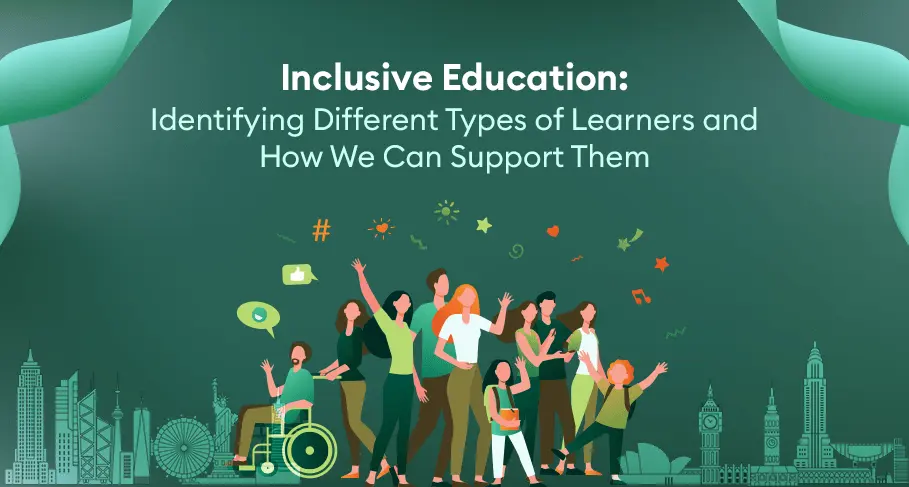
Inclusive Education: Identifying Different Types of Learners and How We Can Support Them
SHARE

In the field of education, inclusive education is a potent idea. It gives teachers the freedom to experiment with different teaching pedagogies and enables students to get personalised instruction.

Contents
Visual LearnersAuditory LearnersReading/Writing PreferenceKinesthetic LearnersLogical and Mathematical LearnersSocial and Interpersonal LearnersIndividual and Intrapersonal StudentsClosing Thoughts
AdvertisementWhy this Ad?

It all comes down to creating an effective learning environment for all students where they can learn together, regardless of their abilities. Ensuring that every student has equal opportunity and a fair shot at an education is the ultimate objective.

To achieve this goal, schools are using smart classroom platforms and instructional applications. These cutting-edge classrooms raise the bar on teaching by utilising digital technology. They add interactivity, engagement, and efficacy to learning.

Let’s dive deep into the world of inclusive education and examine several learner kinds that benefit from it.

Different Learner Types Based on Learning Styles

Visual Learners

Students who grasp information best when it’s presented visually are visual learners. They love charts, maps, graphs, and diagrams. Show them an image, and they’ll understand the concept much better than through written or spoken words. Teachers can cater to visual learners by using graphic organizers or flowcharts to explain complex ideas. For example, a flowchart can be used to simplify a scientific process.

Auditory Learners

Some students are auditory learners. They learn best when information is delivered through listening or speaking. Lectures, group discussions, and talking things through are their jam. These learners often prefer sorting out their ideas by speaking first. To support auditory learners, teachers can share audio recordings of lessons or incorporate group activities where students explain concepts to each other.

Reading/Writing Preference

Reading/writing preference learners thrive when information is presented using words. They’re avid readers and excel in written assignments like stories or book reports. To help them learn, teachers can encourage them to describe diagrams or charts using written statements. Later, they can study their notes to reinforce their understanding.

Kinesthetic Learners

Kinesthetic learners are hands-on. They need to get physical and tactile to grasp new information. They thrive when they can perform activities that involve applying what they’ve learned. For these learners, it’s all about concrete personal experiences, practice, or simulation. Teachers can provide working examples or task them with hands-on experiments to illustrate concepts.

Logical and Mathematical Learners

Logical and mathematical learners are the ones who naturally lean toward careers in programming, accountancy, science, and research. They excel in pattern recognition, are comfortable with numbers, and have a knack for grouping and classifying information.

Social and Interpersonal Learners

Social learners enjoy working with others and do well in group environments. Within a group, they might take on leadership positions. Such learners frequently exhibit extroversion, strong communication skills, sensitivity, and empathy. Significantly, not every social learner exhibits extroversion; some would much rather listen in a group than work independently.

Individual and Intrapersonal Students

Visual, auditory, physical, verbal, or logical learners all fall into solitary learners. They value their solitude, individuality, and contemplation. These learners frequently choose professions like research, writing, authoring, programming, and coding that demand independence and solitary labour.

Closing Thoughts

In the world of education, it’s crucial for teachers to understand these different types of learners. By recognizing and catering to diverse learning styles, educators can create truly inclusive classrooms where every student has the opportunity to shine. Whether through smart classes or traditional teaching methods, the goal remains the same: to empower all learners on their unique educational journey.


TAGGED: Audio Based Learning, Auditory Learning, Digital Inclusion, inclusive classroom, Inclusive Education, Visual Learning
Share This Article
Facebook Twitter Whatsapp Whatsapp LinkedIn Reddit Telegram Email Copy Link
Previous Article Academy of Vedic Vidya Introduces Professional Course in Graphology Academy of Vedic Vidya Introduces Professional Course in Graphology
Next Article Hero Vired Joins Forces With UXDI To Unveil Unique UX Professional Diploma for Aspiring UX designers Hero Vired Joins Forces With UXDI To Unveil Unique UX Professional Diploma for Aspiring UX designers
AdvertisementWhy this Ad?

Latest EdTech News To Your Inbox

Stay Connected

AdvertisementWhy this Ad?

Latest EdTech News To Your Inbox

Stay Connected

AdvertisementWhy this Ad?

You Might Also Like

How to Build Educational Apps That Drive Real Teacher and Student Adoption in 2026
Insight

How to Build Educational Apps That Drive Real Teacher and Student Adoption in 2026

Sep 1, 2026
Why AI Lesson Planning Tools Are Only Solving Half the Problem
Insight

Why AI Lesson Planning Tools Are Only Solving Half the Problem

Aug 31, 2026
The Future Belongs to Children Who Can Change Their Minds
Insight

The Future Belongs to Children Who Can Change Their Minds

Aug 26, 2026
Were Teaching Children for Jobs That Wont Exist Heres What We Should Teach Instead
Insight

We’re Teaching Children for Jobs That Won’t Exist, Here’s What We Should Teach Instead

Aug 15, 2026
Beyond the Examination Crisis Structural Reforms Must Take Precedence in Indias Education Ecosystem
Insight

Beyond the Examination Crisis: Structural Reforms Must Take Precedence in India’s Education Ecosystem

Aug 9, 2026
Education Crisis 2026 Protests Signal a Looming Economic Disaster for Indias Youth
Insight

Education Crisis 2026: Protests Signal a Looming Economic Disaster for India’s Youth

Aug 8, 2026
The Hidden Cost of Always Giving Learners the Answer
Insight

The Hidden Cost of Always Giving Learners the Answer

Aug 7, 2026
Bringing Interactive Smart Boards to Small-Town and Rural Classrooms in India
Insight

Bringing Interactive Smart Boards to Small-Town and Rural Classrooms in India: A Practical Guide for Better Digital Learning

Aug 6, 2026
Show More
EdTechReviewEdTechReview

H433, 2nd Floor, Vikaspuri, New Delhi, India, 110018
Phone: 011 41321030

Follow US

Copyright © EdTechReview. All Rights Reserved.

  • Home
  • Advertise
  • Event Associations
  • Press Release
  • About
  • Services
  • Contribute
  • News
  • Trend & Insight
  • Data & Statistics
  • eLearning
  • Reviews
  • Research
  • EdTech Voices
  • Dictionary
  • Tags
  • Resources
  • Events
  • Courses
  • EdTech Product for Review
  • Sponsored/Paid Post Service
  • Our Clients
  • FAQ’S
  • Contact Us
  • Important Links
  • Sitemap
  • Terms of Use
  • Privacy Policy
newsletter
Join 100K+ subscribers!

Subscribe to our weekly newsletter that brings the latest EdTech news, trends, insights, reports, interviews, etc. for educators, school leaders, entrepreneurs, investors, & others.

loader
Zero spam, Unsubscribe at any time.
Go to mobile version
Welcome Back!

Sign in to your account

Lost your password?