This website stores cookies on your computer. These cookies are used to improve your website experience and provide more personalized services to you, both on this website and through other media.
Accept
EdTechReviewEdTechReview
  • News
  • Trends
  • Insight
  • eLearning
  • Research
  • Dictionary
  • EdTech Voices
  • More
    • Data & Statistics
    • Reviews
    • AWS for Education
    • Events

    Resources

    • Infographics
    • Reports & Case Studies
    • Videos
    • Books
    • Webinar

    Needs

    • 1:1 Learning
    • 21st Century Education
    • 21st Century Leadership
    • 21st Century Learning
    • 21st Century Teaching
    • 3D Printing
    • More Tags

    For

    • Students
    • Teachers/Educators
    • Administrators
    • Entrepreneurs/Startups
    • Govt. Officials/Policymakers
    • Parents
Explore
Search
Contribute
  • Submit A Post
  • EdTech Trainers and Consultants
  • Your Campus EdTech
  • Your EdTech Product
  • Your Feedback
  • Your Love for Us
  • EdTech Product Reviews
ETR Resources
  • About
  • Mission/Vision
  • Team
  • Services
  • Testimonials
  • Authors
  • Sponsor
  • Partner
  • Advertise
  • Our Clients
  • Media Kit
  • Press Release
  • FAQ’S
Reading: Scaffolding Types and What They Mean?
Aa
EdTechReviewEdTechReview
Aa
Search
  • News
  • Trends
  • Insight
  • eLearning
  • Reviews
  • Dictionary
  • EdTech Voices
  • Data & Statistics
  • Research
  • AWS for Education
  • Events
  • EdTech Voices
  • Tags
  • About
  • FAQ’S
  • Our Clients
  • Partner
Follow US
Home > Trend & Insight > Insight > Scaffolding Types and What They Mean?
Insight

Scaffolding Types and What They Mean?

Sudha
Sudha Published Oct 31, 2017
Share
4 Min Read
Scaffolding Types and What They Mean
Scaffolding Types and What They Mean?
SHARE

Scaffolding means ‘a temporary structure which supports a worker in construction’. 

AdvertisementWhy this Ad?

In education, the same word refers to ‘a teacher or an adult who plays the role of a support structure for the student in learning’. 

Vygotsky put forth the terminology of ‘zone of proximal development’ as the distance between achieved and achievable.  This distance is measured through amount of scaffolding the individual receives.  The support and hint received towards problem solving will help the learner receive, understand and apply in its right sense.  He further says that the support structure can be withdrawn once the learner shows attributes of self-achieving.   The process of scaffolding also bridges the gap between ‘know’ and ‘want to know’.  In the process of education, teacher is seen as the person who can scaffold as per the learners needs.

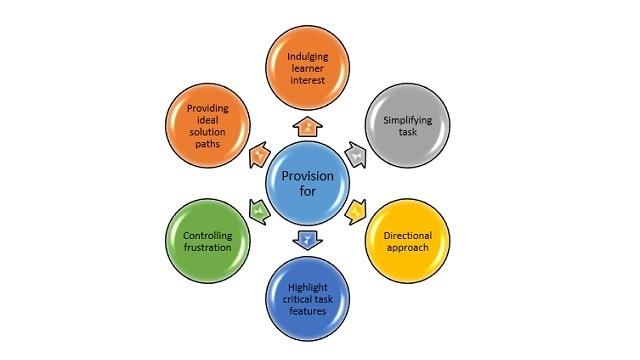
The types of support an adult could provide to the learner is as follows:

In the classrooms today, a teacher handles a minimum of 30 – 45 students, depending on the type of school,  expecting the teacher to support this number of students individually in the allotted time of 40 – 45 minutes is humongous, along with the curriculum time frame.  The support framework of distributed scaffolding as put forth by Puntambekar and Kolodner (1998) helps ease the burden of individual scaffolding through new tools and devices. 

According to Iris Tabak: Distributed Scaffolding are of three types

  1.       Differentiated scaffolding
  2.       Redundant scaffolding
  3.       Synergetic scaffolding

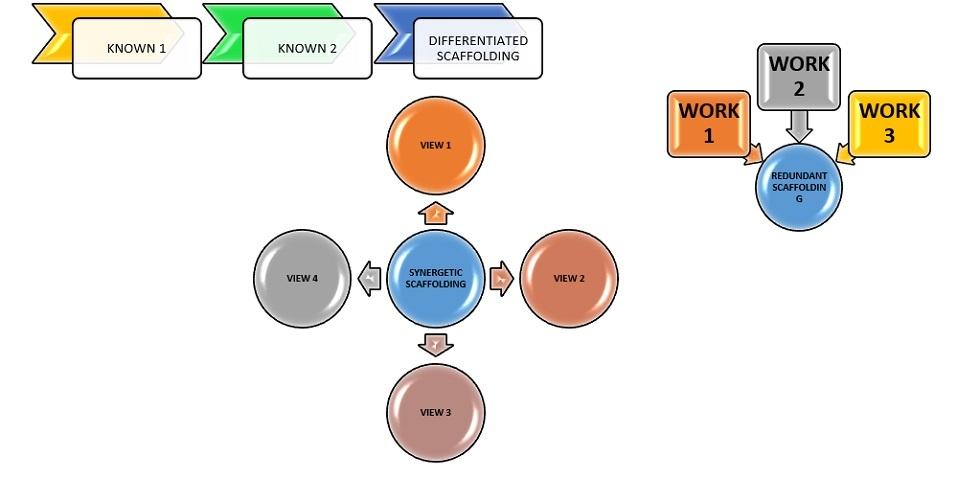
Differentiated scaffolding – The basic type which can be most effectively used to recall the previously learnt or make connections between the previously learnt concepts.  This can be an activity designed which involves all the previously learned or picture based.  Some numeracy games or vocab games, poems or literary activities can also be used in this case.

Redundant scaffolding – The current learning topic or the learning outcome focus should be provided with a number of support work which may include document reference, research work, project work, assignments on the same topic of learning.

Synergetic scaffolding – A complete view of the topic to be provided can be given using different type of approach to the same problem.  Changing variables is one such approach.  Giving problems which may ultimately lead to same solution is also one approach.  For example – Increase in health issues during rain, Change in colour of marble wall, change in drinking water colour, skin burns during rain can all focus on one major issue of Pollution

In simple terms the three types of scaffolding can be represented as follows:
scaffolding-type-2

The right scaffolding gives the right learning experience.  This approach allows student act fearlessly, provides confidence and allows them to extend the learned beyond adult supervision.  Technology support or community support develops a reinforced learning which allows students to visualise beyond self. 

The requirement is for a ladder not a staircase, which should be kept in mind while scaffolding learners.  Adequate support in the learning process can be in multiple ways.  It is for the eyes of the ‘scaffolder’ to determine the scaffolding required in the ‘neophyte’.
TAGGED: 21st Century Teaching, Teachers/Educators, Tips for Teachers/Educators
Share This Article
Facebook Twitter Whatsapp Whatsapp LinkedIn Reddit Telegram Email Copy Link
Previous Article Brea Olinda Unified School District Partners with Informed K12 to Streamline Paperwork Processes Brea Olinda Unified School District Partners with Informed K12 to Streamline Paperwork Processes
Next Article Gamification in the Classroom Beyond Badges Gamification in the Classroom: Beyond Badges
AdvertisementWhy this Ad?

Latest EdTech News To Your Inbox

Stay Connected

AdvertisementWhy this Ad?

Latest EdTech News To Your Inbox

Stay Connected

AdvertisementWhy this Ad?

You Might Also Like

Common Challenges Schools Face When Moving to Digital Assessments
Insight

Common Challenges Schools Face When Moving to Digital Assessments

Jul 14, 2026
Whats Actually Costing Students Their Spot at University The Most Common Rejection Reasons in 2026
Insight

What’s Actually Costing Students Their Spot at University. The Most Common Rejection Reasons in 2026

Jul 10, 2026
How Students Can Turn Learning Into a Job-Ready Resume
Insight

How Students Can Turn Learning Into a Job-Ready Resume

Jul 8, 2026
upEducators Top Choice for Becoming a Nursery Teacher in India
News

Why is upEducators the Top Choice for Nursery Teacher Training (NTT) Course in India?

Jul 7, 2026
What Schools Really Pay Without Language Access Systems in Place
Insight

What Schools Really Pay Without Language Access Systems in Place

Jul 4, 2026
Stop Teaching Students More Apps Teach Them How to Handle Files
eLearning

Stop Teaching Students More Apps, Teach Them How to Handle Files

Jul 3, 2026
Indian EdTech Has Been Solving the Problem It Can Bill For Not the One Children Have
Insight

Indian EdTech Has Been Solving the Problem It Can Bill For, Not The One Children Have

Jul 2, 2026
The Most Important Variable in Education Isnt AI
Insight

The Most Important Variable in Education Isn’t AI – What Building Live Instruction at Scale Actually Taught Me

Jun 26, 2026
Show More
EdTechReviewEdTechReview

H433, 2nd Floor, Vikaspuri, New Delhi, India, 110018
Phone: 011 41321030

Follow US

Copyright © EdTechReview. All Rights Reserved.

  • Home
  • Advertise
  • Event Associations
  • Press Release
  • About
  • Services
  • Contribute
  • News
  • Trend & Insight
  • Data & Statistics
  • eLearning
  • Reviews
  • Research
  • EdTech Voices
  • Dictionary
  • Tags
  • Resources
  • Events
  • Courses
  • EdTech Product for Review
  • Sponsored/Paid Post Service
  • Our Clients
  • FAQ’S
  • Contact Us
  • Important Links
  • Sitemap
  • Terms of Use
  • Privacy Policy
newsletter
Join 100K+ subscribers!

Subscribe to our weekly newsletter that brings the latest EdTech news, trends, insights, reports, interviews, etc. for educators, school leaders, entrepreneurs, investors, & others.

loader
Zero spam, Unsubscribe at any time.
Go to mobile version
Welcome Back!

Sign in to your account

Lost your password?