
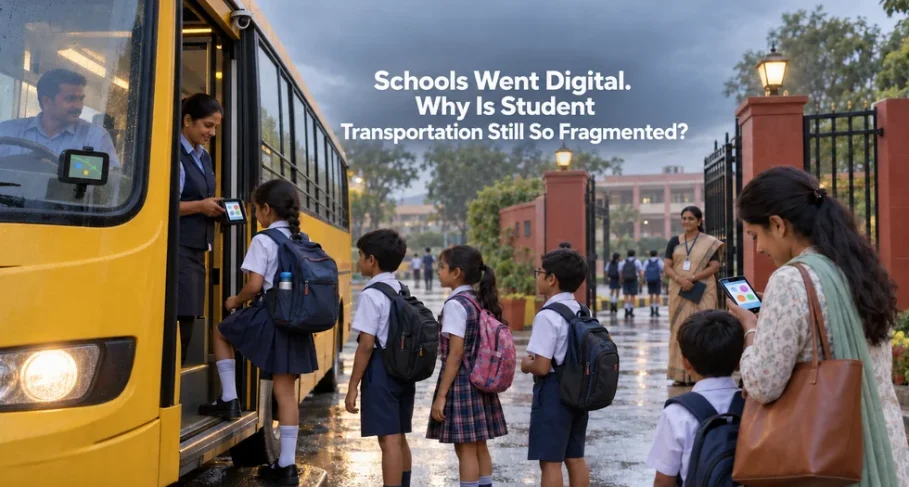
Schools have spent the last decade digitizing almost every part of their operations.
Admissions are online. Attendance is increasingly digital. Parents receive updates through apps and portals. Learning platforms have become common across classrooms. Fees, assessments, student records and communication are increasingly connected.
Yet for many schools, the student’s journey between home and school remains a separate operational world.
That journey involves children, parents, drivers, vehicles, routes, transport operators and school administrators. It also involves some of the most time-sensitive decisions a school has to make every day.
India’s school education system is enormous. According to UDISE+ 2024-25, the country has nearly 14.71 lakh schools and 24.69 crore students, with more than 1 crore teachers. The scale alone makes transportation a significant operational challenge for many institutions.
At the same time, schools are becoming more connected. UDISE+ 2024-25 reports that internet facilities are available in 63.5% of schools nationally. In Maharashtra, the figure is higher, at 72.1%.
The infrastructure for digital operations is expanding.
So why does school transportation still feel so fragmented?
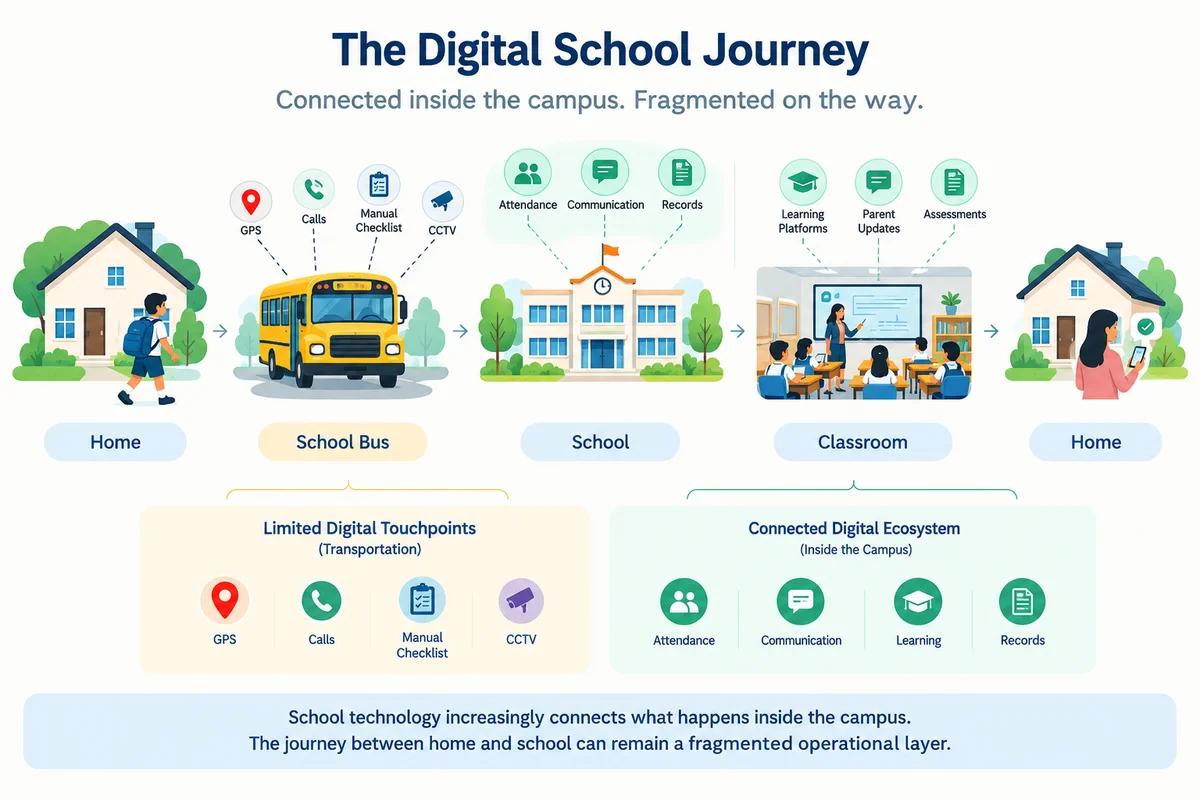
The School Is Digital. The Journey Often Is Not.
Think about the typical digital school experience.
A parent may receive attendance information, academic updates, circulars, fee notifications and messages through a school platform.
But once the child leaves home in the morning, transportation may be managed through a combination of a GPS device, a driver’s phone, spreadsheets, CCTV, WhatsApp messages, phone calls and manual records.
Each tool may work perfectly well on its own.
The problem is that they do not necessarily create one coherent picture.
A school may know where a bus is without knowing exactly who has boarded it.
A parent may know the bus is five minutes away without knowing whether the right student boarded.
A transport operator may know that a vehicle completed its route without having a complete record of what happened during that journey.
This is the difference between having data and having operational visibility.
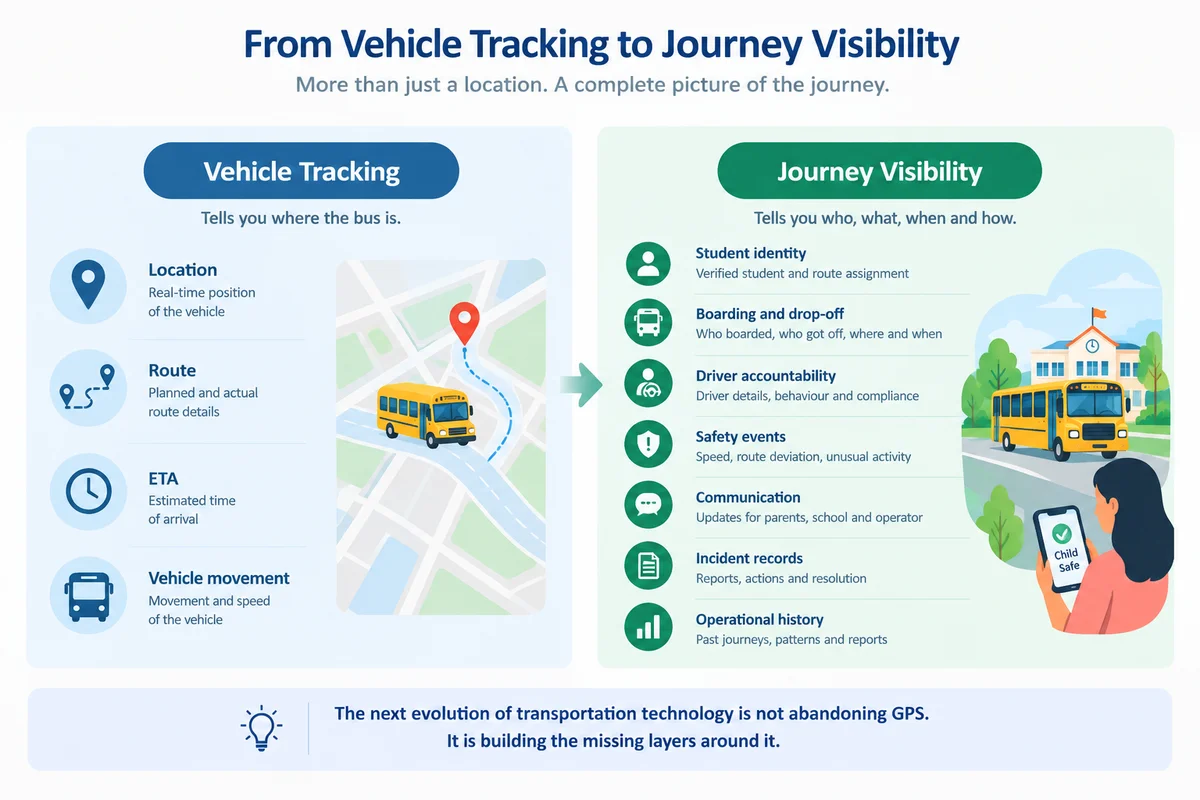
GPS Answered an Important Question. It Did Not Answer Every Question.
GPS transformed school transportation.
Knowing the real-time location of a vehicle helps schools and parents estimate arrival times, monitor routes and respond to delays.
But location is only one dimension of safety.
Ask a school: Where is the bus?
A GPS system can answer that.
Now ask:
- Which students boarded?
- Did they board the correct route?
- Who was responsible for the vehicle?
- Was the journey operated as expected?
- Was an incident reported?
- What happened afterward?
These are different questions.
They involve identity, accountability, communication and response.
That distinction matters because India’s regulatory framework already treats school buses as a special safety category. AIS-063 establishes additional requirements for school buses beyond general bus standards, with the stated objective of maximizing safety and addressing the specific needs of school-going children. The standard includes requirements relating to identification, speed control and other school-bus-specific safety features.
The challenge is therefore not simply whether safety standards exist.
It is whether schools and operators have enough day-to-day visibility to consistently manage what those standards are intended to protect.
Transportation Is Not One Process. It Is a Chain.
School transportation works because several stakeholders perform different roles.
Student needs a safe and predictable journey.
Parent needs timely information and confidence that the child has arrived safely.
Driver needs clear instructions and a defined operating process.
Transport operator needs visibility into vehicles, routes and drivers.
School needs oversight, communication and the ability to respond to incidents.
When these stakeholders work from disconnected systems, the school can end up with multiple versions of the same event.
A driver may know something happened.
The operator may have a vehicle record.
The school may receive a phone call.
The parent may have a WhatsApp message.
The real question is: Can anyone see the complete picture?
That is where transportation technology has an opportunity to evolve.
Student-level Data Changes the Way Schools Can Think About the Journey
One of the most important developments in Indian school technology is the increasing use of student-level digital information.
The Ministry of Education says that UDISE+ began collecting individual student-wise data nationally from 2022-23. The 2024-25 system records 24.69 crore students. The stated purpose includes better tracking of students and improved management of the education system.
The underlying idea is important: education systems increasingly need to understand the individual student, not just the institution or classroom.
The same thinking can be applied to transportation.
A bus is not simply a vehicle moving between two coordinates.
It is carrying specific students through a specific journey.
That creates a more useful set of questions:
- Was the student assigned to this route?
- Was the student recorded as boarding?
- Was the expected stop reached?
- Was an unusual event detected?
- Was the appropriate person informed?
- Was the incident documented?
This moves transportation from vehicle tracking toward student journey management.
More Connectivity Does Not Automatically Mean Better Integration
It is tempting to assume that adding technology will solve the problem.
It often does not.
A school could have a GPS system, CCTV, RFID, spreadsheets, phone calls, messaging groups and multiple software platforms and still struggle to answer a basic question quickly.
What is happening right now?
This is a common problem in digital transformation.
The objective is not to collect more information. It is to make the right information available to the right person when a decision needs to be made.
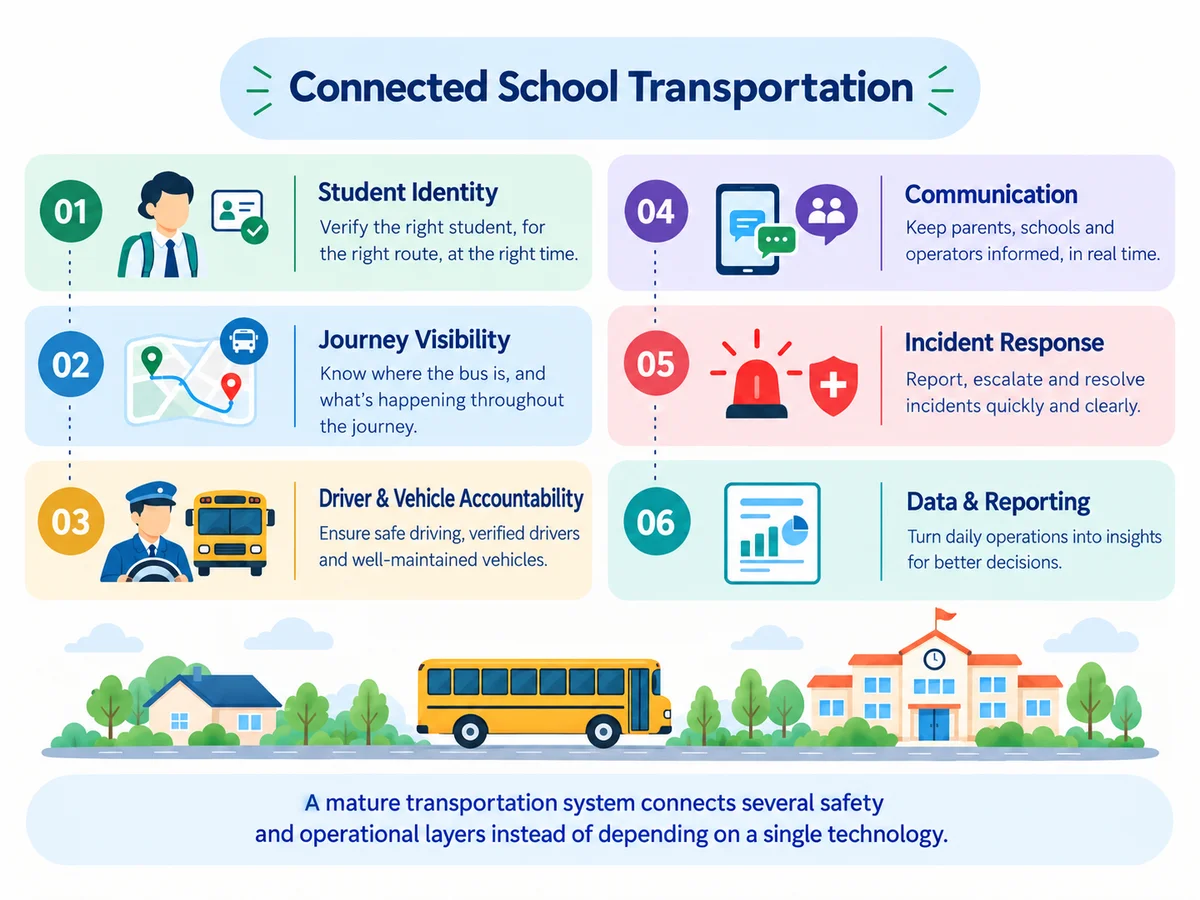
For school transportation, that means moving toward a shared operational picture.
The technology does not necessarily have to replace existing systems. It needs to connect the relevant pieces.
What Should School Leaders Evaluate?
When schools evaluate transportation technology, live location should be only one part of the conversation.
A useful evaluation framework should include seven questions.
- Identity: Can the school verify which student is using a route?
- Visibility: Can authorised stakeholders understand the current journey?
- Accountability: Can the school access relevant driver, vehicle and operational information?
- Response: Can incidents be reported, escalated and documented?
- Communication: Can the right people receive timely information?
- History: Can the school reconstruct what happened after an event?
- Integration: Can transportation connect with the broader digital ecosystem instead of becoming another isolated tool?
This changes the purchasing conversation.
The question is no longer: Do we need GPS?
The better question is: What information does the school need to operate a safe, accountable transportation system every day?
The Next Step Is Not More Technology. It Is Better-connected Technology.
Digital transformation in education should not stop at the school gate.
The home-to-school journey is part of the student’s experience too.
India already has a large and increasingly data-driven school education system. UDISE+ has moved toward student-level information, while school connectivity continues to expand.
The next challenge is turning that digital capability into better-connected operations.
For transportation, that means thinking beyond the bus as a moving object.
It means thinking about the journey as a system.
The future of school transportation should not be defined only by whether a bus has GPS.
It should be defined by whether a school can confidently answer four questions:
- Who is travelling?
- Where are they?
- Is the journey being operated safely?
- What happens when something goes wrong?
When those answers become visible and connected, transportation stops being a separate logistics function and becomes part of the digital student experience.
That may be the next meaningful step in school technology: not simply digitizing what happens inside the classroom, but creating a more connected and accountable journey to and from it.