

This website stores cookies on your computer. These cookies are used to improve your website experience and provide more personalized services to you, both on this website and through other media.
Accept
EdTechReviewEdTechReview
  • News
  • Trends
  • Insight
  • eLearning
  • Research
  • Dictionary
  • EdTech Voices
  • More
    • Data & Statistics
    • Reviews
    • AWS for Education
    • Events

    Resources

    • Infographics
    • Reports & Case Studies
    • Videos
    • Books
    • Webinar

    Needs

    • 1:1 Learning
    • 21st Century Education
    • 21st Century Leadership
    • 21st Century Learning
    • 21st Century Teaching
    • 3D Printing
    • More Tags

    For

    • Students
    • Teachers/Educators
    • Administrators
    • Entrepreneurs/Startups
    • Govt. Officials/Policymakers
    • Parents
Explore
Search
Contribute
  • Submit A Post
  • EdTech Trainers and Consultants
  • Your Campus EdTech
  • Your EdTech Product
  • Your Feedback
  • Your Love for Us
  • EdTech Product Reviews
ETR Resources
  • About
  • Mission/Vision
  • Team
  • Services
  • Testimonials
  • Authors
  • Sponsor
  • Partner
  • Advertise
  • Our Clients
  • Media Kit
  • Press Release
  • FAQ’S
Reading: The Future Belongs to Children Who Can Change Their Minds
Aa
EdTechReviewEdTechReview
Aa
Search
  • News
  • Trends
  • Insight
  • eLearning
  • Reviews
  • Dictionary
  • EdTech Voices
  • Data & Statistics
  • Research
  • AWS for Education
  • Events
  • EdTech Voices
  • Tags
  • About
  • FAQ’S
  • Our Clients
  • Partner
Follow US
Home > Trend & Insight > Insight > The Future Belongs to Children Who Can Change Their Minds
Insight

The Future Belongs to Children Who Can Change Their Minds

Namrata Surana
Namrata Surana Published Aug 26, 2026
Share
6 Min Read
The Future Belongs to Children Who Can Change Their Minds
SHARE

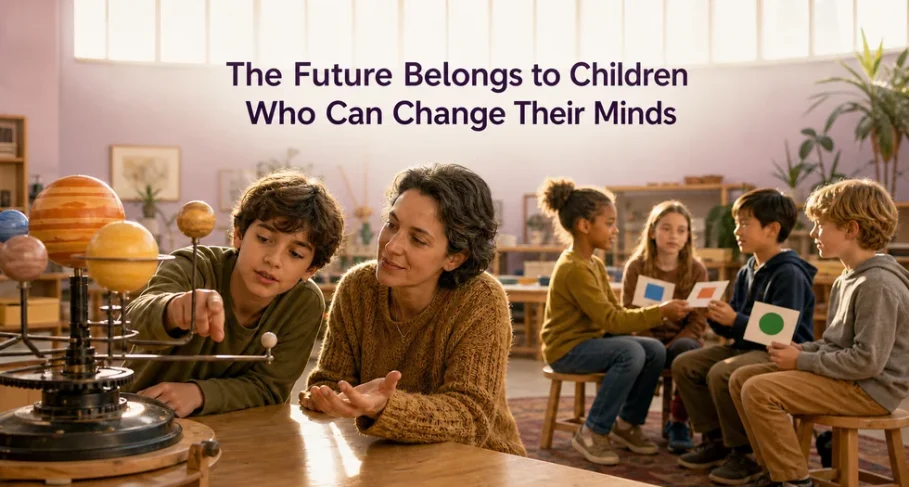
A ten-year-old once spent twenty minutes arguing with her teacher about Pluto being a planet. She had learned that it was a planet from her first-grade teacher, and she was not going to be persuaded otherwise. Her teacher finally pulled up the official report from the International Astronomical Union, explaining why Pluto had ceased to be a planet, and the girl conceded, remarking that it all made sense now.

Contents
What Is Intellectual Humility?What Is Not Intellectual Humility?How Can Kids Learn?What Can It Lead To?
AdvertisementWhy this Ad?

At dinner, she eagerly explained the situation to her parents. She was not embarrassed about her error; she was rather happy about it. That little girl’s parents were lucky, for in that moment, they witnessed a display of intellectual humility, one of the most sought-after traits in a child that is also one of the most difficult to obtain.

What Is Intellectual Humility?

The ability to think critically begins when a person learns to think through evidence, and that quality is what allows them to recognize when one’s mind may be changed.

In a digital era where information is abundant, but good information is scarce, we must teach our children the skills to differentiate the two.

A ten-year old can read something on Google and believe it to be true without a second thought. Misinformation moves faster than rebuttals. Various studies on the sharing of social media posts have shown that fake news is shared, on average, five times more than genuine stories. A child who is unable to think through this will simply accept the louder opinion, and the loudest opinions are not always the right ones. This is especially important when considering the long-term effects of our choices; from the most basic decisions on whether to accept the terms of an end-user license agreement to higher-level decisions like medical diagnoses and the evaluation of job offers.

This is what underlies all of these decisions: the ability to understand one’s evidence-based opinion and to apply the same to others’ evidence-based opinions. It is what prevents us from being taken advantage of, as advertisers and manipulators of all kinds exploit weaker thought processes to get their answers across.

What Is Not Intellectual Humility?

Intellectual Humility is not being indecisive or not having an opinion, but rather holding one’s thoughts and opinions close enough to be acted upon, while being able to keep them loose enough to be improved.

An example of this can be seen in the works of naturalist pioneer Charles Darwin. He kept meticulous records of observations he made as he traveled the world to better understand life on earth. However, when he published Origin of Species, he included a detailed list of evidence that would contradict his own claims in order to prove to his peers and the greater public that his words, however right they might have been from a higher power, were backed by actual science.

How Can Kids Learn?

Having a parent or a teacher make an honest mistake in front of a child and then admit it can be very valuable, allowing the child to understand what it means when someone is mistaken, and how to accept such information in their own lives.

Praising the ability to come around to a new perspective or the ability to recognize good evidence when one sees it is equally important.

An example of this can be seen in children’s debating clubs, where kids are required to argue from the viewpoint of a specific character. Many of these debaters will say that they found being on the opposite side of a debate and having to argue it was the most useful thing they’ve experienced, as it taught them to truly understand and respect an opposing viewpoint rather than simply dismissing it outright.

What Can It Lead To?

Beyond helping people grow into balanced and thoughtful adults, intellectual humility also fosters growth in other areas of life.

Resilience is one such area, as the ability to hold on to one’s principles rather than one’s opinions provides a kind of padding from which one grows stronger. People also tend to become more empathetic, as they are more able to listen to others’ concerns without immediately disagreeing.

By teaching a child how to change their mind, we raise them not to be unshakable and unbending in everything they believe, but be balanced and confident in their principles. It teaches them that being right is not always important, while being just is always necessary.
TAGGED: 21st Century Skills, Critical Thinking, K-12, Life Skills, Media Literacy, Parents
Share This Article
Facebook Twitter Whatsapp Whatsapp LinkedIn Reddit Telegram Email Copy Link
By Namrata Surana
Namrata is the Founder of Project Elevate, an initiative focused on critical thinking, financial literacy, AI literacy, and life skills for school students. She holds an MBA from a leading Indian business school and a Master's degree in Business Law, and has over five years of strategy consulting experience across India, Europe, and Southeast Asia.
Previous Article Best online career counselling in India  CCO counselling session with student and parents Best Online Career Counselling in India 2026: Why Career Counselling Online Is the No.1 Choice for Students and Parents
Next Article How Learning Gaps Can Be Identified Before Assessment AI-Powered Insights How Learning Gaps Can Be Identified Before Assessment (AI-Powered Insights)
AdvertisementWhy this Ad?

Latest EdTech News To Your Inbox

Stay Connected

AdvertisementWhy this Ad?

Latest EdTech News To Your Inbox

Stay Connected

AdvertisementWhy this Ad?

You Might Also Like

How to Build Educational Apps That Drive Real Teacher and Student Adoption in 2026
Insight

How to Build Educational Apps That Drive Real Teacher and Student Adoption in 2026

Sep 1, 2026
Why AI Lesson Planning Tools Are Only Solving Half the Problem
Insight

Why AI Lesson Planning Tools Are Only Solving Half the Problem

Aug 31, 2026
Best online career counselling in India  CCO counselling session with student and parents
News

Best Online Career Counselling in India 2026: Why Career Counselling Online Is the No.1 Choice for Students and Parents

Aug 21, 2026
Were Teaching Children for Jobs That Wont Exist Heres What We Should Teach Instead
Insight

We’re Teaching Children for Jobs That Won’t Exist, Here’s What We Should Teach Instead

Aug 15, 2026
Beyond the Examination Crisis Structural Reforms Must Take Precedence in Indias Education Ecosystem
Insight

Beyond the Examination Crisis: Structural Reforms Must Take Precedence in India’s Education Ecosystem

Aug 9, 2026
Education Crisis 2026 Protests Signal a Looming Economic Disaster for Indias Youth
Insight

Education Crisis 2026: Protests Signal a Looming Economic Disaster for India’s Youth

Aug 8, 2026
The Hidden Cost of Always Giving Learners the Answer
Insight

The Hidden Cost of Always Giving Learners the Answer

Aug 7, 2026
Bringing Interactive Smart Boards to Small-Town and Rural Classrooms in India
Insight

Bringing Interactive Smart Boards to Small-Town and Rural Classrooms in India: A Practical Guide for Better Digital Learning

Aug 6, 2026
Show More
EdTechReviewEdTechReview

H433, 2nd Floor, Vikaspuri, New Delhi, India, 110018
Phone: 011 41321030

Follow US

Copyright © EdTechReview. All Rights Reserved.

  • Home
  • Advertise
  • Event Associations
  • Press Release
  • About
  • Services
  • Contribute
  • News
  • Trend & Insight
  • Data & Statistics
  • eLearning
  • Reviews
  • Research
  • EdTech Voices
  • Dictionary
  • Tags
  • Resources
  • Events
  • Courses
  • EdTech Product for Review
  • Sponsored/Paid Post Service
  • Our Clients
  • FAQ’S
  • Contact Us
  • Important Links
  • Sitemap
  • Terms of Use
  • Privacy Policy
newsletter
Join 100K+ subscribers!

Subscribe to our weekly newsletter that brings the latest EdTech news, trends, insights, reports, interviews, etc. for educators, school leaders, entrepreneurs, investors, & others.

loader
Zero spam, Unsubscribe at any time.
Go to mobile version
Welcome Back!

Sign in to your account

Lost your password?