Sal Khan made the case at TED a few years ago that AI could be every student’s personal tutor: a one-on-one experience, available to anyone, that research suggests could dramatically lift learning outcomes. Spending time at tech events across Silicon Valley and San Diego this year, I found that idea had become close to consensus. Founders, educators, and investors broadly agree: AI will raise the floor of teaching quality in ways we have not seen before.
I find myself increasingly aligned with that view. The evidence behind it is not nothing. Recent AI tutoring trials have shown meaningful effect sizes. The optimism is grounded in something real, and I think the educators and technologists making this case are pointing in the right direction.
Where I want to add some texture is on the question of where exactly the leverage sits.
Having built a live coding instruction platform at scale, I have been on the inside of this deployment: AI tutors, lesson plan generators, disengagement signals, automated progress reports, adaptive content. I have watched what these features do and, more importantly, what they do not do. That experience has shaped a view: AI’s biggest opportunity in education is not in what it does for students directly, but in what it makes possible for the teachers who reach them.
What the AI Actually Does
The AI being deployed across edtech does a few things well. It generates content. It automates reports that used to take teachers hours. It surfaces completion metrics for parents. It routes students toward practice problems based on past performance.
I am not writing from outside this pattern. We have built all of these.
These are real efficiencies. But having watched their effect on actual learning, here is what we found: they improve the infrastructure around teaching. They do not improve the teaching itself. They make existing systems run faster. They do not change what is fundamentally happening between a learner and a teacher in a live session.
What the Operational Reality of Live Instruction Actually Looks Like
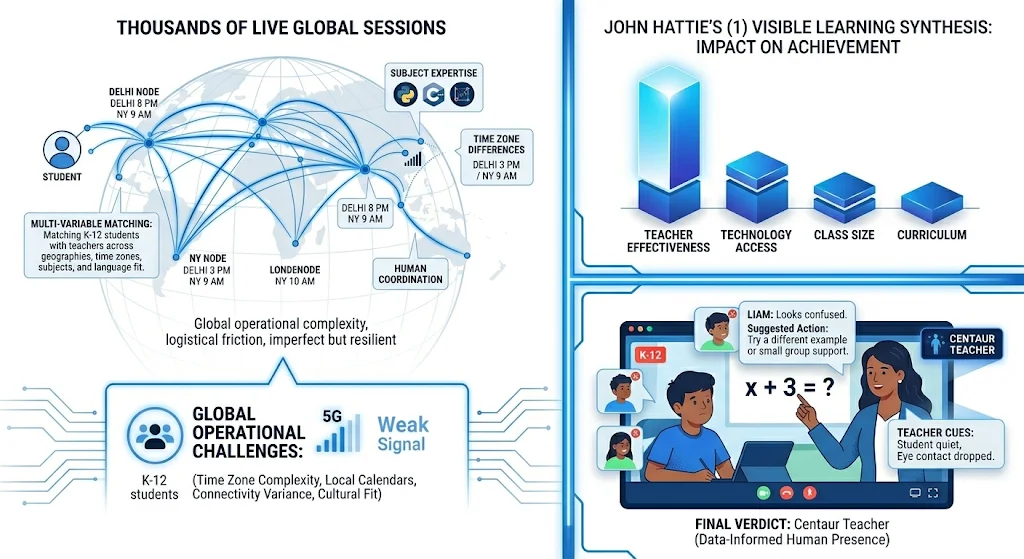
Scaling live instruction is not a software problem. It is a human coordination problem that software helps you manage, imperfectly.
When you are running live instruction at this scale, the coordination challenges are unrelenting. Teachers and students coordinate across time zones, academic calendars, and home environments on both sides of every session. The matching problem alone involves variables that no algorithm captures cleanly: finding the right teacher for a given child requires matching on teaching style, pace, personality fit, and subject depth.
And then there is the texture of live instruction at scale. Connectivity is unreliable in ways that vary by region but never fully go away. Students’ and teachers’ availability shifts with academic calendars, school commitments, and the competing demands that come with professional teaching roles. Home environments introduce their own variability on both sides of the screen.
The Variable That Keeps Winning
Through all of this, the pattern that held most consistently was not about the tools. It was about the teacher.
John Hattie’s synthesis of over 800 meta-analyses places teacher effectiveness at the top of what drives student achievement, well above class size, technology access, or curriculum design.[1] Across the millions of sessions we have run, that finding held: teacher quality was the most consistent predictor of outcome, across geographies, age groups, and subject areas. The quality of the teacher is the quality of the product.
Building Culture at Scale
At a small team you can know each teacher personally. At a large one, that is no longer possible. What scales is the system that carries the culture: how you onboard, how you give feedback, how you recognize good sessions.
The teachers who thrive in this model are the ones who feel genuine ownership over their classroom, who receive feedback that makes them better, and who have a peer community they can learn from. Building that infrastructure of trust took longer than building the product did.
The Better Investment: AI for Teachers, Not Instead of Them
The most effective AI applications in this space are not the ones students interact with directly. They are the ones that make the teacher’s job better.
AI that gives a teacher two hours back from lesson preparation shows up in the classroom as patience and presence. AI that surfaces early signals of student disengagement gives the teacher information they would have taken weeks to notice on their own. AI that generates a progress report in seconds means the teacher spends that time talking to the parent instead of writing the report.
This is the version of AI in education that actually compounds into better learning outcomes, because it routes its benefits through the one variable the data keeps pointing to.
The Final Verdict: The Case for the “Centaur” Teacher
There is a concept in chess called “Centaur Play,” where a human and an AI collaborate to make moves that neither could achieve alone. For too long, the edtech narrative has been a tug-of-war: the vision of AI replacing the human tutor versus the vision of technology as a mere digital textbook.
My experience has convinced me that both sides are missing the mark. The future of education is a race to see who can build the best Centaur Teacher.
The standalone AI tutor lacks the “human nudge”- the ability to recognize a student’s frustration through a micro-expression or to motivate a discouraged child through a shared cultural reference. Conversely, even the best human teacher is limited by their own cognitive load. They cannot track the micro-progression of 30 students simultaneously or recall every specific error a child made months ago.
When we point AI toward the teacher, we solve both sides of the equation:
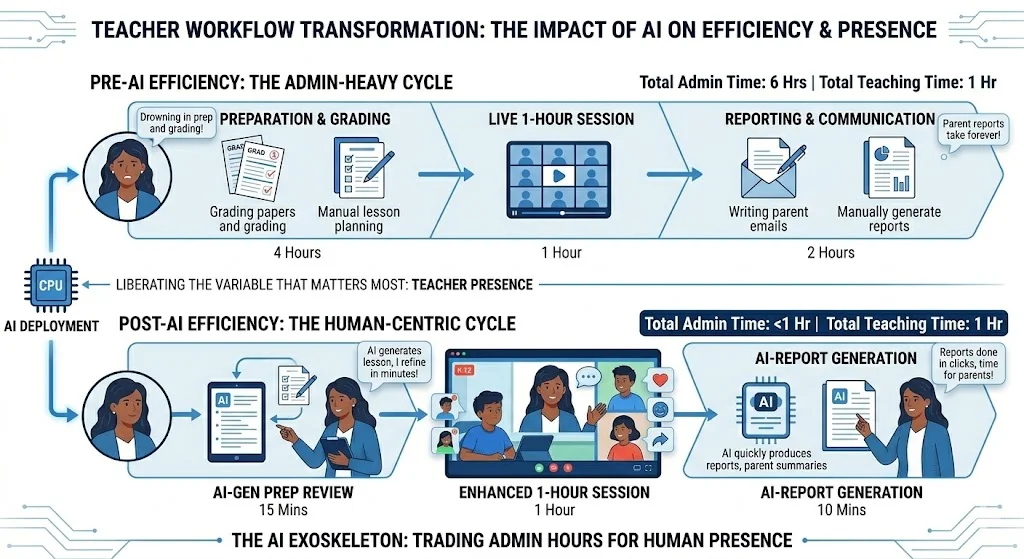
- The Teacher provides the bridge: Empathy, social-emotional guidance, and the mentorship that makes a student want to learn.
- The AI provides the infrastructure: Real-time data, automated prep, and the “second pair of eyes” that ensures no student falls through the cracks.
The right question to ask of any edtech platform is not how much AI it has. It is whether that AI makes the teacher better, and by extension, whether it makes learning better for every student that teacher reaches.
AI is the most powerful tool we have ever had to democratize high-quality education, but its power is as an amplifier, not a replacement. By automating the process, we finally liberate the professional. The best technology in education doesn’t ask the student to look at a screen; it helps the student be truly seen by their teacher.
References
[1] Hattie, J. (2009). Visible Learning: A Synthesis of Over 800 Meta-Analyses Relating to Achievement.

[2] RAND Corporation. (2024). New RAND Research Reveals a Growing AI Training Gap.

[3] UNESCO. (2024). AI and the Futures of Education.

[4] Escueta, M. et al. (2017). Education Technology: An Evidence-Based Review.