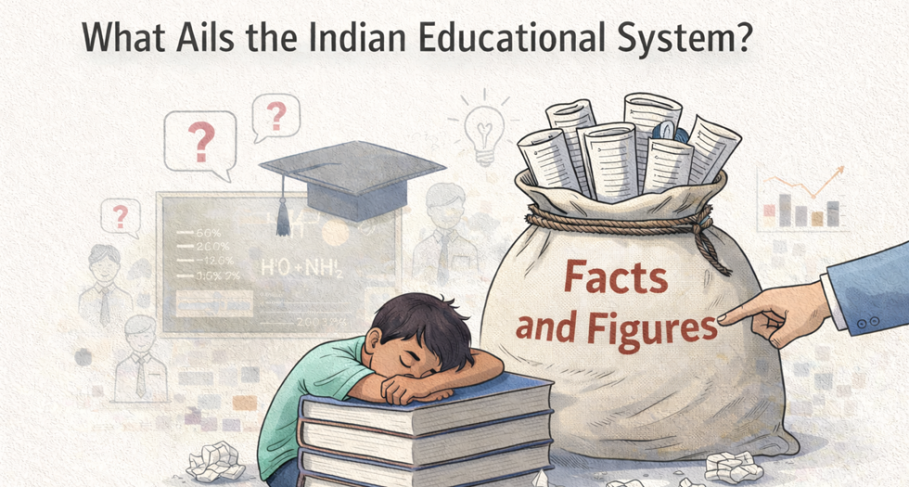
Currently, there is considerable debate about the Indian educational system. Many people view that the present system has several flaws and, as a result, we cannot produce world-class leaders. In this regard, it is pertinent to understand the current challenges.
Currently, the Indian education system focuses too much on facts and figures, thereby killing the creativity, analytical, and reasoning skills among children. It does not encourage questioning by the students. The mindset is so developed that whatever is said by the teachers has to be taken as correct without any cross-questioning. In fact, the mindset is developed by parents themselves as they don’t encourage their children to question elders. All these things lead to regimented and conditioned mindsets among children at the initial stage itself. In fact, it is at this stage that children develop their inquisitiveness, logical, analytical, and thinking skills.
We are all to be blamed for the present mess in the Indian education system, such as parents, teachers, authorities, and the system. Besides, there is less focus on research and development in India.
Psychology of Indian Children
At home, too, parents order their children to obey what the elders say. Although it is good in terms of building character and values, it adversely affects their creativity. They develop a fear of posing questions. In the classroom, asking questions is not encouraged by teachers. Some children don’t ask questions in class as they think that others may think of the questions to be foolish. Some children don’t ask questions because they think that the teacher may get angry. Some children don’t ask as they think that others may treat it as irrelevant.
Children at a tender age don’t have social obligations of failure. They don’t have guilt or shame as their minds are fresh. This is the age where we need to encourage questioning and help them explore themselves without any command and control.
The Role of Teachers
Teach them about the concepts fully. Don’t encourage them to mug up mere texts. Teachers must inspire students. Bring in the live examples and anecdotes that help in content assimilation and absorption among the children. Encouraging conceptual education is the need of the hour.
In a few cases, the students adopt self-preparation. Even if the teachers don’t teach, the students are competent to learn through a standardized mechanism. It is a boon in disguise.
Teachers should refer number of books on each topic to have diversified and extensive knowledge on the subject. It helps them to widen their intellectual faculties and also enhances their confidence in handling questions in the classroom.
Overcoming Challenges
We still follow the old pattern of the educational system, which we adopted from the West. There have been drastic changes in their educational system with the changing times. Unfortunately, we have not overhauled our educational system for a long time. Commercialization of the Indian educational system is another cause for concern. Of course, we need funds to run educational institutions, but there is a limit for everything. Somewhere, some lines have to be drawn to professionalize Indian educational institutions.
There is a shortage of teachers and a dearth of infrastructure. The proportional ratio between the teacher and the students in a classroom is widening, which requires attention.
The Indian educational system should emphasize ethical values and principles more. Focus more on personality development, life skills, leadership development, and motivation, which enable the students to get tuned with the industry immediately after completion of their education. In addition, it builds a strong work culture and professionalism.
It is a matter of regret that even after 79 years of independence, we stand nowhere in the quality of education. Teachers should be made more accountable and responsible for the performance of their students. They need to be educated first so that they can educate students. Provide proper training to teachers who are not up to the standards. Instead of laying them off for non-performance, train and groom them until they come up to the required standards. In addition, continuous training of teachers will also help in getting updated with the changing technology. It also helps them to know the latest tools and techniques in teaching methodologies, thus making them competent and confident teachers.
Recruit competent teachers. The authorities should take adequate care in the selection of teachers. They should check their aptitude and passion for teaching during the selection process. When teachers take to teaching by choice but not by chance, the quality of teaching will go up in India.
Taking feedback should be made mandatory even at the primary school level itself as it encourages more accountability and responsibility among the teachers.
Salaries for teachers are very low. If you pay peanuts, you get monkeys. Even if tigers join, they turn out to be monkeys over time. When you pay the best, you get the best. Therefore, salaries have to be fixed as per the accepted guidelines and standards to make teaching careers lucrative and attractive.
There should be a change in the mindset of teachers. Teachers don’t encourage questioning. Mere dictation of the notes from textbooks in the classroom does not carry any meaning. In some cases, teachers postpone the questions raised by students. In some cases, questioning students are penalized.
Teachers should be taught with psychology as it helps in gauging the potential of the students and tailoring their teaching methodology. Indians are poor team workers. They should be taught about team spirit, and they should also be taught how to manage group dynamics.
The same teacher should not take too many sessions continuously, as it decreases the attention span for students, thereby defeating the very purpose of teaching. Teachers also get stressed out from continuous teaching.
Teachers should motivate and inspire students with live examples, anecdotes, and short stories. It excites the teaching process.
It is unjust for parents to force their dreams on their children. It stifles their creativity. It is necessary to find out what their children are passionate about and encourage them along the same lines.
A Take-Home Message
Indian children work very hard right from the primary educational level itself. The strength of children should not be judged by the weight of their books but by their wealth of knowledge. Their merit should not be judged by their memory but by their analysis, logic, and reasoning. The value of the students should not be judged by their paper degrees but by their application. Only when we look at this perspective can we can have qualitative education which will be superior to the developed countries.
Don’t force children to learn. Encourage and facilitate them to learn. Don’t dump them with a lot of stuff. Instead, encourage their imagination. And finally, don’t force Indian children to work hard, but make them work smart.
Indian professionals are in great demand across the world. It is not basically because they hail from reputed educational institutions, but because they put in a lot of hard work at the workplace in the initial years to prove themselves. That is the case for professionals in the workplace. When we look at the students, it is their hard-working abilities and self-preparation that enable them to succeed at the academic level. Even though the quality faculty is not inducted at professional institutions, the Indian students excel by dint of their hard work and self-preparation.
We tend to highlight problems, not solutions; we tend to talk of barriers, not bridges; we tend to talk of challenges, but not overcoming them. How can we progress with such a mindset?
It is regrettable to note that India, with a billion-plus population don’t have a proportional representation of Noble Laureates. It is time for India to walk the walk and talk the talk.