“We have invented an extremely powerful way of learning which was not previously possible and the implications can be colossal.” – Christopher Williams
Christopher Williams says he initially created Chatta for families of 2 and 3 year-old children to promote “interaction and storytelling.” He’d been commissioned to address the growing issue in the UK of children starting school well behind in their communication and language development. The Chatta approach was developed based on research with thousands of children in hundreds of schools. The method caught on quickly and began having an impact not just in the early years but in many other areas of learning. The approach links experiences or curriculum content together with images, “modeled language from teachers” and “oral rehearsal for pupils.” Teachers and parents create digital ‘talking postcards’ to support children’s communications. The impact is often powerful, enabling children of all ages to achieve rapid and sustained progress in their language development. Chatta is supported with a digital app, which gives users clear and simple steps to implement the Chatta approach.
To tell us more about the impact of Chatta on early learning, The Global Search for Education is pleased to welcome its co-founder, Christopher Williams.

“Students taught with Chatta write freely and confidently and are never short of ideas.” – Christopher Williams
Chris, how does Chatta support progress in writing?
The Chatta approach has very strong links to the thinking processes. The core goal of Chatta, for students of all ages, is ‘Oral Narrative Competence,’ which is a proven indicator of writing competence. Chatta leads to students thinking, speaking and writing in clear structured, sequenced sentences. Everyone using the Chatta approach is able to give a fluent, engaging, and unscripted spoken presentation to others based on any subject or activity. Vygotsky’s conclusion, that ‘Talk is the halfway house between thinking and writing,’ is central to the Chatta method. Spoken modeled language, oral rehearsal, and presentation provide students with the words and structure they need to write. Students taught with Chatta write freely and confidently and are never short of ideas. They have learned how to think and speak with a writer’s voice.
How does the interaction between teacher and technology work?
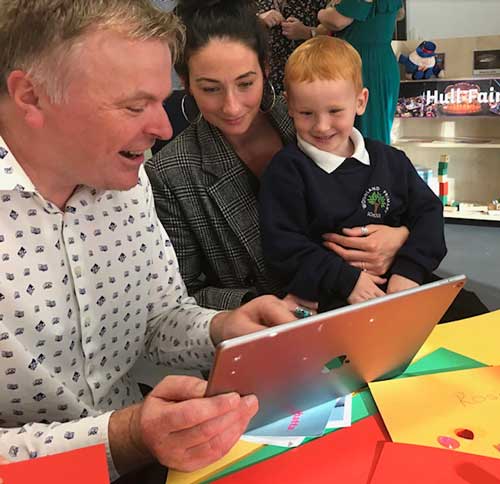
The technology is used by the teacher to present content to students, preferably based on meaningful context or something the pupils have been doing. The teacher uses images linked to the context of the learning activity and builds an audio-visual storyboard, modeling their thinking throughout as if thinking aloud.
Chatta has been designed to mirror the way people think.
Once the images are complete, the teacher makes a voice recording using a button on each image. The teacher chooses words, phrases, and language structures of the style of the spoken and written presentation they are teaching, for example, the language of instruction. The teacher continues to make reference to the audio-resource and encourages students to rehearse and present extended oral presentations to the group and each other. The audio-visual resources – called ‘chats’ – are shared with parents at home, or the students themselves for access away from the classroom. Parents use technology, in the same way, turning everyday experiences and events into stories.
“The audio-visual nature of Chatta is very powerful for students with autism.” – Christopher Williams
How do you promote more parent/child interaction? Please share examples.
This happens in two ways. Firstly, a teacher sends the parents ‘chats,’ which appear as step by step, narrated stories on a parent’s smartphone. Parents are continually encouraged to listen to their child tell the story or explain their learning.
For example, one class had a visit from the fire brigade and the shiny red engine was parked on the playground, lights flashing, ladder up, hose spraying. The images captured allowed the teacher to build an audio-visual story board explaining each feature of the engine and how it helped the firefighters. The children were all able to provide detailed, engaging explanations without notes or even visual prompts as the experience and the language associated with it were effortlessly recalled. Once home, they spoke with such confidence, as if they’d built the engine themselves.
The second way Chatta supports and promotes parent/child interactions is that parents and their children use the Chatta software to make and tell their own stories together. Everything can become a story and everything can be photographed: a walk to the park, a visit to Grandma’s, making breakfast. The powerful part of this is that these stories are based on real experiences and can be linked to a child’s own interests in many ways. Parents make hundreds of stories with their children, using the exact same approach the teacher is using at school.
How do you support pupils with special learning needs, such as autism and dyslexia?
Chatta is very powerful for supporting students with additional needs, of all ages. It helps students with autism in many ways, including developing language and vocabulary, social interactions, transitions and learning in all subjects. The audio-visual nature of Chatta is very powerful for students with autism. One young man with Asperger’s’ Syndrome lives very independently but had severe anxiety related to shops closing with him still inside. His parents prepared a simple Chatta resource giving him the language to help in a number of situations which may have previously caused problems, e.g: “How long until the store shuts?” The resource is rarely used but its existence removes all anxiety.
Teachers using Chatta with dyslexic students find it quick and easy to ‘pre-teach’ vocabulary and key content using the audio-visual Chatta resource. They also allow students to record their own learning in the same way, rather than putting reading and writing first. Reading and writing remain crucial but the learning and understanding occur first, leading to a much more positive learning experience.

“Parents tell us Chatta is ‘life-changing’ for their autistic and dyslexic children.” – Christopher Williams
How would you quantify your achievements to date with pupils aged 18 months to 18 years? What are the biggest challenges you’ve faced?
We are still at the early stage of engagement with the education research community but have had success with a randomized controlled trial. We have schools telling us the impact is phenomenal and sending supporting data. Parents tell us Chatta is ‘life-changing’ for their autistic and dyslexic children. A school in Malaysia has described ‘unprecedented’ results in spoken language examinations.
The biggest challenge I have faced has been introducing something to people that is brand new, and that it doesn’t have anything to compare it with. People aren’t always ready for that and can believe that Chatta sounds too good to be true. Chatta is still working with the thought leaders, innovators, and early adopters, which at times for me can be frustrating, but I am learning a lot about the process of change and innovation and am becoming more patient.
How are you planning to build/develop Chatta in the next 10 years? What are your key goals?
I’m always working on adding to the resources available for Chatta. Currently, we support early years education, teaching children with additional support needs, teaching writing, and closing gaps in attainment for disadvantaged children.
I am continuing to work towards engaging with the education research community, and Chatta is joining a project with University College London later this year. In the coming year, Chatta will be working with a number of schools in the UK and beyond, which will act as ‘Centres of Excellence’ and support other schools in the implementation of Chatta.
Chatta hasn’t been designed to replace reading; in fact, Chatta supports and promotes reading, but I believe the approach is so powerful that in 10 years’ time using Chatta will be as commonplace as reading a book or watching TV. We have invented an extremely powerful way of learning which was not previously possible, and the implications can be colossal.
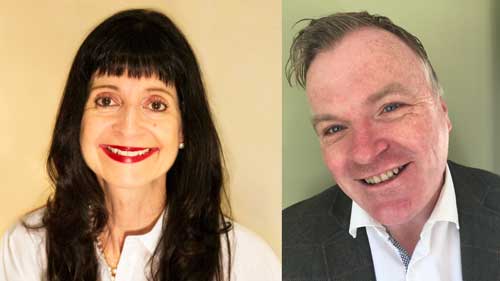
C M Rubin and Christopher Williams