


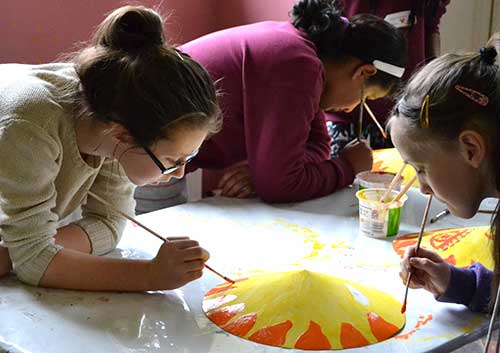

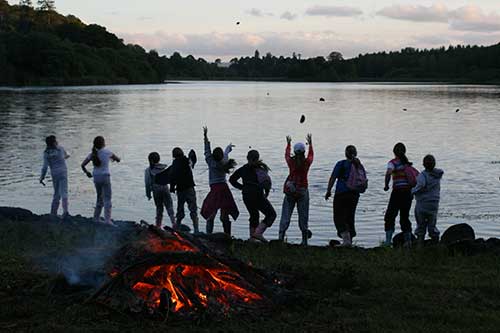
When terror and fear is left in a child, Sacha Abercorn OBE, the Duchess of Abercorn, explains it will “carry further destruction with it through a lifetime.” In 1987, the Duchess founded The Pushkin Trust, which began as The Pushkin Prize in Ireland, a creative writing competition for primary schools in the North and South of Ireland to help children express their thoughts and feelings. Today, creative writing still remains at the central core of Pushkin activities that often use the environment as a source for inspiration. The overarching goal of their work is to develop the “wholeness” of every person, nurturing them through imaginative workshops or summer camps to find their ‘voice,’ i.e. to connect with the “energising, creative core that lies at the center of every individual.” This year, the charity will celebrate its 30th anniversary. Its programs for children have expanded and evolved to include opportunities for teachers and entire school communities. For example, Pushkin’s “Inspired Educators” program seeks to help teachers find their own “inner child” again.
In 2015, the Duchess of Abercorn visited America to share Pushkin ideologies and practice at the Creative Oklahoma conference in Oklahoma City, which is where we met. Sacha is the great‐great‐great granddaughter of the famous Russian poet, Alexander Pushkin. It is my great pleasure to welcome her to The Global Search for Education.
Sacha, in this new information age, how important is it to help students cultivate their own ‘voice’? How might this help them be better writers, communicators, employees, and citizens?
The challenge for our young people at this time is the struggle to retain their sense of individuality, health and well-being in the face of over-whelming technology in this age of limitless information.
It is only by the nurturing of the heart and soul and by allowing children from the earliest age to be valued and listened to, by giving them ways to express their thoughts and feelings by creative means that this balance can be redressed. It is time for us to awaken to our true selves, to listen to what makes our hearts sing – to find our element.
The finding of our own ‘voice’ comes firstly from recognizing that we have a story to tell. Over the past 30 years’ experience with children involved in the Pushkin Trust, we have witnessed how thoughts and feelings have taken shape and form in short stories and poems and given the child a sense of self worth and motivation that has encouraged them to become life long learners.
The great maxim, “Unto thine own self be true,” is perhaps what is needed now above all else. For how can we become good citizens and empathize with those around us if we have not first begun to understand that our hearts have equal value to our thoughts? To be a whole human being is the challenge of our time.
Pushkin himself was committed to social reform and emerged as a spokesman for literary radicals. How has his legacy as an artist but also a person influenced the Pushkin Trust?
Pushkin was a poet, a story-teller and a man of universal spirit. He was not a political figure.
As a human being, he lived life to the fullest. He experienced the heights and depths of what it was to be human in his short life and was able to express himself in every aspect of the written word from lyric poetry, prose poetry to short story and historical drama.
Pushkin’s ability to give voice to the heart and to express it in words has made him the guiding spirit of the Pushkin Trust.

Do you see creativity as something that is properly valued in education today? What is the true value of creativity in our lives?
Because creativity which is to do with the non-rational aspects of our being cannot be given marks, it is unable to be valued on a par with our rational mind. If we learn our History or Geography or Mathematics, we can be assessed for being correct or incorrect. But how can we give marks for how we feel and therefore how we express ourselves?
To be truly creative means to be a human being fully alive. What more can be asked of us!
What kinds of essential skills to live a full and flourishing life are not taught today but should be?
In the work of the Pushkin Trust, we are not talking about skills because we are not talking about training.
We are talking about humanizing values which are encouraged by listening to our feelings and finding ways to express them creatively by allowing children to day-dream and by recording our dreams. The importance of tuning in to our own images instead of being bombarded by images from the television or computer games is paramount. It is vital to be able to turn inwards and discover our inner landscape – the world of the imagination from which life is regenerated.
How do you see the Pushkin Trust pushing young people to create and exemplify good work – work that is excellent in quality, socially responsible and meaningful to its practitioners?
Young people today are pushed around so much that they have lost all orientation. The Pushkin Trust focuses on a stillness that allows a person to turn inwards and to become centered in themselves. From that center within flows their life force. This in turn brings about a re-calibration of their moral compass and the wholeness or holiness of the human emerges.
It is your 30th Anniversary this year, and in the words of Seamus Heaney, you will be “Celebrating the Marvellous”. Tell me what that means to you.
It means we will not only be celebrating the voice of the child being heard in classrooms in Ireland and Russia and the cross-fertilizing of thoughts and ideas by way of the imagination between our two nations, but also we will be celebrating the voice of the teacher – the Inspired Educator. We will be celebrating that marvellous moment when child and adult, pupil and teacher are working together – the teacher no longer as authority figure but as psychopomp or keeper of the threshold. The story of the young Pushkin as a boy being told the fairy stories of his land by his old Nanny, Arina Rodionovna, was a perfect example of this. It was this early experience of story-telling that caught Pushkin’s imagination and led him to be the voice of the soul of Russia. It is this voice that so many nations are seeking at this time.
Thank you Sacha.
This first appeared here.

