When does a teacher’s workday actually end? Is it when the final bell rings, or hours later, after adjusting slides, finding visuals, and building worksheets at the kitchen table?
A survey of 1,036 current full-time and part-time teachers examines the hidden workload behind presentation prep and the role of AI models in streamlining it [1]. The survey revealed that 71% of educators prepare lesson presentations outside scheduled working hours at least sometimes. It indicates that presentation prep is an increasingly common daily burden that spills into personal time.
Key Insights on Lesson Planning
- 71% prepare presentations for their lessons at least sometimes outside of regular working hours.
- 69% spend another 30 minutes or more on supporting materials after the presentation is ready.
- 41% would not trust Artificial Intelligence with factual accuracy without their own final review.
- 43% said that if AI tools gave back two hours a week, they would spend them on better individual attention to students.
Why Teacher Lesson Preparation Is a Weekly Challenge
70% percent of the responding teachers make at least three presentations per week, and 14% percent produce or modify eleven or more.
In one whole school year, teachers prepare hundreds of lessons, and it is not about making just quick adjustments: half of the teachers spend more than one hour creating a ready-for-classroom presentation.
It means that preparation of presentations is not only a design task, but also a production cycle. And even in the case of available templates, teachers should still choose content, structure it, and consider the effectiveness for their students.
For 71% of Teachers, Preparation Crosses Into Personal Time
Less than one in four participants stated that they only conduct presentation lessons during their allotted working hours.
However, much more significantly, 71% stated that preparation of presentations takes place outside the allotted time frame occasionally. It does not mean that 71% of teachers mostly prepare presentations at home. For 42% of them, the task is mostly conducted during their working hours, but occasionally spills outside.
What matters in the first case is the spillover. Presentation lesson preparation is that kind of activity which tends to extend endlessly, until the lesson is ready. It might require an extra example, a better explanation, or an activity for students who need more practice.
Structuring Lessons Takes More Time Than Designing Slides
If presentation work were mostly a formatting problem, faster design tools would solve most of it.
The survey suggests otherwise. Structuring the lesson and breaking down key points was among the most frequently selected time-consuming activities, cited by 58% of respondents. Content development followed closely at 56%.
The difference is significant when dealing with the issue of teacher preparation of lessons within the educational context. Well-presented material does not always equate to a good lesson since there is still much work that must be done by the teacher.
The Work Does Not Stop When the Slides Are Done
The completion of the presentation doesn't always mean the end of the lesson.
In terms of respondents, 59% generate worksheets after generating presentations, 46% handouts, 44% quizzes or tests, 33% assignments, and 32% speaker notes.
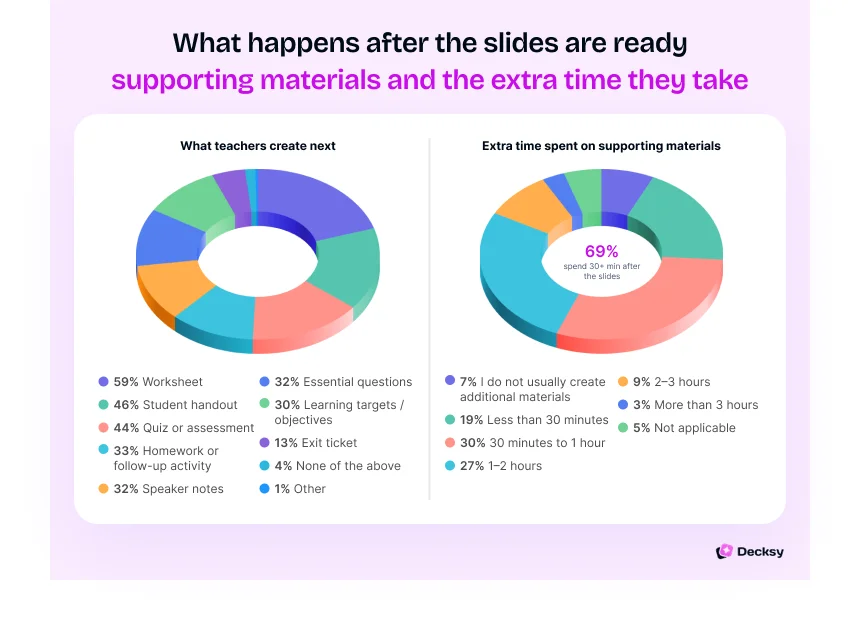
Those materials add another layer of preparation. 69% percent spend at least another 30 minutes on supporting materials after the presentation is ready.
This may be the clearest definition of the hidden work behind lesson presentations. The deck is visible. The ecosystem around it is not. A lesson that appears simple to students may involve several documents, activities, and checks behind the scenes.
How AI Fits Into Teacher Lesson Preparation
AI is already integrated into the process of work for most of the respondents. More than 70% use AI in lesson planning regularly or sometimes.
Out of those teachers who use AI, 82% stated that they save at least one hour per week, while 37% save at least three hours per week with the help of the technology.
At the same time, time saved does not mean that teachers will delegate the responsibility for lesson accuracy. Out of teachers who use AI in work, 54% use the technology for checking facts within lesson materials, while 41% of all teachers surveyed would not delegate responsibility for factual correctness without personal revision.
AI can aid in organizing notes, drafting activities to support learning, or suggesting methods of presenting a hard-to-explain topic. The teachers must still check the facts, their relevance, and suitability for the learners.
What Teachers Would Do With Two Extra Hours
The survey also asked teachers what they would do if AI tools saved them two hours of lesson planning every week.
The most common answer was not simply to reduce their workload. Forty-three percent said they would devote that time to more individual attention for students.
That puts the value of faster preparation into perspective. Time removed from repetitive work can return somewhere else: to student support, unfinished responsibilities, or simply the teacher’s own evening.
The Bottom Line
Presentation in the classroom on the screen is the most visible part of lesson planning.
It covers all this that happens behind the scenes: organizing, informing, illustrating, verifying, adjusting, practicing, testing, and extra time spent preparing outside of classroom hours.
Some of that work is now performed by artificial intelligence. However, it seems like the job of a teacher is not to have technology run the classroom. Rather, teachers are using technology to make the process faster, yet retaining control over accuracy and the classroom experience.
Methodology
The study was conducted by Decksy among 1,036 full-time and part-time U.S. teachers aged 23–65. Data were collected via online panels using Random Device Engagement (RDE) to ensure a representative sample. Percentages are rounded to the nearest whole number and reflect multiple-selection responses.
References
[1] The hidden work behind lesson presentations. What do teachers really spend their time on?: https://decksyai.com/blog/teachers-presentation-statistics/