Over 40% EdTech Entrepreneurs in India cite User Engagement as a Key Challenge with their Mobile Apps
App Relevance and Ease of Use pip other important considerations such as Subscription-based Usage among End Consumers of Education Apps
The Report ‘Efficacy of Mobile EdTech in India’ released by Education and Employability Sector focused Impact Investor Gray Matters Capital also lists out learnings from a Behavioral standpoint for Mobile EdTech Solutions in 4 sector segments – Test Prep, Early Childhood Education, Teacher Capacity Building and Vocational Training.
BENGALURU, 14th December, 2018: Gray Matters Capital, an impact investor focused on investing in enterprises working to improve access to affordable quality education and employability in India, has today released a report titled ‘Efficacy of Mobile EdTech in India:Mapping User Engagement to Learning Outcomes’ outlining the key learnings.
The report is based on the hands-on work done by Gray Matters Capital and the mentors of its Mobile EdTech Accelerator Program – GMC Calibrator, with the 8 cohort companies.
The behavioural blueprint and user labs conducted in conjunction with Behavioural Architecture expert firm,Final Mile Consulting; the user testing with over 2000 users enabled by Career Launcher (CL Educate); insights from 42 Education entrepreneurs as well as inputs by market data analysis and expert views have contributed to this report.
EdTech Entrepreneurs and their tryst with APP-ification
- Reasons for EdTech entrepreneurs to build a mobile interface as against other choices stem from a need to provide better access for their customers, improve their product visibility and also, to drive better monetization.
- Of the 4,500 EdTech firms tracked by research firm Tracxn, the report reveals 25% have mobile apps. Of these just about 50 have downloads greater than 1 million, highlighting the challenge posed in User Acquisition.
- Improving User Engagement (40%), creating Personalized Learning Paths (31%) and Monetization (26%) are the top challenges faced by EdTech entrepreneurs with Mobile Apps besides Customer Acquisition. Interestingly, customer acquisition is not seen as a big challenge for EdTech players without a mobile app based solution.
- Among the entrepreneurs surveyed, 48% adopted a Freemium business model while 24% had a subscription-based model. The rest were free-to-use apps depending on advertisement driven revenue.
- Entrepreneurs catering to consumers from Tier II and Tier III cities state that such users still prefer classroom based learning and that making them shift to mobile based learning will be difficult.
Mobile EdTech: Is there proclivity from the End – Consumer?
- Relevance (42.3%) and ease of use (26%) were important considerations for the users. Only 11.3% indicated their preference for free rather than a paid education app.
- Users are loath to downloads apps greater than 25MB. Vernacular voice and chat enabled apps, provision of offline content and and summary content help reduce the potential issue of network drops.
- Test prep app Byju’s and English learning app Duolingo were the education apps that had the most brand recall. This is indicative of the user focus on getting jobs or doing better in jobs with help of English, not just learning for the sake of it. On the other hand, for younger children, the report found that parents actively look for resources that will improve academic learning and specially reading ability.
- Students in the age group of 18-25 preparing for competitive exams largely seen adopting a hybrid model of test prep apps and classroom coaching. 85% of the test prep users are open to paying Rs. 100-250 per month for such coaching apps.
- Out of the parents surveyed, 50% were ready to spend more than Rs. 250 per month for enhancing their child’s learning through mobile based application, while the other 50% could pay Rs.100-250 per month.
- 70% of the users surveyed preferred content in vernacular languages.
Learnings and Recommendations
- TEST PREP (Govt. Jobs Entrance Exams): Products need to showcase the differentiated value vs. the ecosystem. E.g. Personalized learning, Answering questions in native languages. Tasks on the apps can be broken down into smaller milestones to reduce the anxiety leading up to the demanding exams.
- Early Childhood Education: Parents have a high aspiration for their children, independent of income and learning English remains a critical aspiration. It is important for apps in the ECE space to build more emotional payoffs in short periods of interactions to build continuous engagement with age-appropriate content.
- Teacher Capacity Building: From a behavioural standpoint, teachers feel they do not need to use anything apart from textbooks to prepare for a class. Micro-teaching modules, optimized for space on mobile and local language are key requirements for apps in this space to succeed.
- Skilling and Vocational Training: From an engagement viewpoint, the apps need to align with the job goal and change focus from exam orientation.When it comes to skilling adults, many hold a strong mental model of age as a barrier for them to learn something new. UI/UX that is easy, coupled with motivational behavioral nudges and adopting learning techniques familiar to the users are requisites for apps in this space.
Speaking at the report launch, Ragini Chaudhary, India CEO, Gray Matters Capital said, “At GMC Calibrator, we work for 6 months with companies across the Education-Employability spectrum who are trying to bring improved learning outcomes and employment opportunities using both offline solutions along with digital mediums and mobile devices. Our hypothesis was that if we could help them focus on just three things – improve the user engagement, help enhance monetization and ensure optimization of the performance, we could pave the way for more scale.” She added, “This report helps us get perspectives of entrepreneurs and users, so as to help us with insights to calibrate the EdTech solutions.”
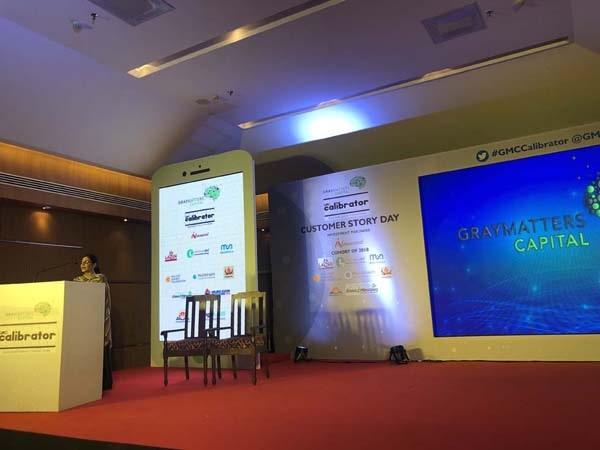
Releasing the report on the culmination of the first cohort of the GMC Calibrator, Debleena Majumdar, Director -Research and Growth, Gray Matters Capital, said, “The GMC Calibrator was launched with an objective to promote ‘Self Learning to Self Earning’. Traditional viewpoint says that only the ones categorized as the self-motivated learners can benefit from mobile self learning. We believe, the ones categorized as ‘those who need a nudge’ above can also engage with mobile self learning to earning opportunities, given the right inputs and motivation. And that starts with behavioural understanding of users. This report encapsulates these learnings of the last six months.”