A company that was once worth twenty-two billion dollars is now, by its own founder’s admission, worth zero.
I am not writing this to dance on BYJU’S grave. I am writing it because I think we — the people who build education technology in this country — have quietly agreed not to ask the obvious question. We raised the capital, ran the ads, booked the cricketers, filled the funnels. And at the end of it, the honest measure of any education company is brutally simple: did children understand more, and did that understanding reach the child who had the least? On that measure, most of what we built does not pass. BYJU’S is not the exception. It is the clearest mirror the industry has.
I build inside this industry. I run a learning-technology company in Chennai. So take everything that follows as a man implicating himself, not lecturing from the stands.
I am also the father of three daughters — my eldest in Class 11, my younger twins in Class 6. The intent, every single day, is that they understand what they are taught rather than mug it up. They mug it up anyway, because neither they, nor their teachers, nor their schools have a tool that turns a concept into something you can experience. I can watch the attention span shrinking even in the gap between my eldest and my youngest. And here is the detail that strips me of any excuse: as a filmmaker and a content creator for television and OTT, my entire craft for twenty years was holding attention and increasing view-time. I assumed I could carry that craft into education — with new-media technology like AR, VR and 360° — and make the difference. Hundreds of conversations later, with students, teachers and schools across every board, the field humbled me. The tool, on its own, is not the answer. That is what sent me looking for what the answer actually is.
The Problem We Chose, and the Problem We Avoided
There are two problems in Indian education.
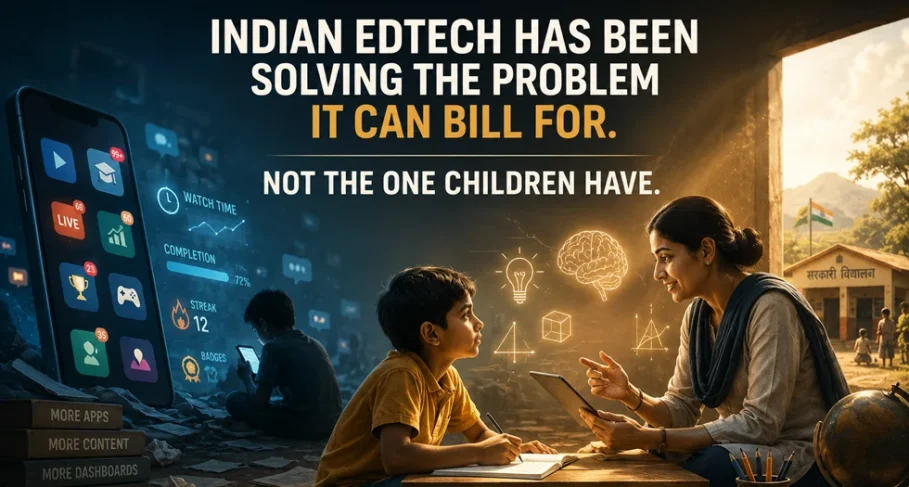
The first is a distribution problem. Not enough content, not enough reach, not enough access to good explanations. This problem is fundable. You can solve it with an app, a video library, a subscription, a sales team. You can put a number on it — downloads, daily active users, watch-time, completion badges, “lessons delivered.” Venture capital understands these numbers. So this is the problem the industry chose.
The second is a learning problem. Children sit through years of school and do not understand what they were taught. This problem is not easily fundable. You cannot ship understanding as a file. It does not move with a marketing budget. It is slow, human, stubborn, and it resists the dashboard. So this is the problem the industry quietly walked around.
For a decade, Indian edtech optimised for the first problem and called it progress on the second. We confused distribution with pedagogy. We confused engagement with learning. We measured the things that were easy to measure and hoped they were the things that mattered.
They were not.
What “Engagement” Was Actually Measuring
Here is the uncomfortable centre of it. An app can hold a child’s attention for forty minutes and teach her almost nothing. Watch-time is not understanding. A streak is not a skill. A completion certificate is not competence. We know this, and we built business models that depended on not saying it out loud.
BYJU’S is the monument to this confusion. India’s advertising watchdog, ASCI, repeatedly flagged its campaigns for misleading claims about learning outcomes. Reports described sales teams telling parents their children would fail without the product. That is not pedagogy. That is fear, packaged and sold by the lakh. The mood among parents has since flipped from FOMO, the fear of missing out, to what people now call FOGS, the fear of getting scammed. We earned that suspicion. The whole category earned it.
And now, before we have even sat with that lesson, a new wave is making the same move with a new noun. Swap “video lessons” for “AI tutor” and the pitch is identical: personalised, scalable, available to every child, learning reimagined. Some of it will be genuinely useful. But most of it is once again solving the distribution problem — delivering content faster and cheaper — and once again calling it learning. We are about to automate the wrong thing at scale.
What the Science Says the Real Lever Is — And It Is Not a Screen
Step away from the pitch decks and into the research, and a clear hierarchy appears. It has been sitting there for forty years.
In 1984, the educational psychologist Benjamin Bloom published what is still the most important finding in the field. A child tutored one-to-one, with constant feedback and correction, performs about two standard deviations better than the same child in a conventional classroom. Two sigma. It means the average tutored child outperforms 98% of children taught the ordinary way. Bloom did not present this as a triumph. He presented it as a problem — his challenge to the world was to find a way to give every child something close to one-to-one mastery, at the scale of a whole system. Forty years later, that is still the real brief. Everything else is a footnote to it.
When John Hattie synthesised more than 1,200 meta-analyses covering over 300 million students, the pattern held. The largest, most reliable levers on learning are human and pedagogical — feedback, the quality of teaching, a teacher who can see where a child actually is. Hardware, by itself, barely moves the needle. The device is not the variable. What the device asks the child to do, and whether a skilled adult is in the loop, is the variable.
And underneath all of it is the biology. Hermann Ebbinghaus mapped the forgetting curve in 1885: without active effort, we lose roughly 70% of what we passively take in within a day. Memory is built by doing — by generating, retrieving, manipulating, by the body being involved, by genuine curiosity firing the chemistry of attention. A child who acts on a concept remembers it. A child who watches a polished video of someone else acting on it mostly does not. This is not ideology. It is the most replicated result in cognitive science, and almost every “engaging” edtech product is built as though it were not true.
So the science says: the lever is participation, feedback, and a human who teaches. The industry sold passive content, delivered to a screen, at scale. We did not misunderstand the research. We ignored it, because the research did not fit the business model.
The Teacher We Keep Trying to Delete
Every few years our industry rediscovers an old fantasy: that technology can route around the teacher. It is a seductive idea in a country short of good teachers, and it is almost always sold as empowerment for the child.
It is worth being honest about where this comes from, because the most famous Indian experiment in the genre is real and remarkable. In 1999, Sugata Mitra cut a hole in a wall in a Delhi slum, embedded an internet-connected computer, and walked away. Children who had never seen a PC taught themselves and each other to use it. His “Hole in the Wall” work proved something genuine — that curiosity and peer learning are powerful engines, especially where there is no school worth the name.
But the lesson the industry took from it was the wrong one. We heard “children don’t need teachers.” That is not what the work shows. It shows that children are extraordinary learners when curiosity is switched on — and that in the absence of any functioning system, self-organised learning beats nothing at all. “Better than nothing” is a moral emergency measure, not a national education strategy. Hattie’s 300 million students say the opposite of the fantasy: the teacher is the most powerful lever we have. The right role for technology is not to replace her. It is to hand her a sharper instrument and get out of the way of the relationship.
I saw this with my own eyes. We had built our pilot session expecting that perhaps four students would actively engage while the rest of the class watched them — passivity by another name. What happened instead has stayed with me: the teacher running the session pulled the entire class in. Not the technology — the teacher, with the technology in her hands. I walked out of that room certain of one thing. The teacher does not need replacing. She needs the right instrument.
A school is not a content-delivery node. It is the one place a child is known — by a teacher who notices the kid in the back row going quiet, by classmates who argue a wrong answer into a right one. Strip that out and call it personalised learning, and you have not modernised education. You have hollowed it out and put a logo on the hole.
The Test That Actually Matters: The Last Child, in the Last Village
Here is the line I want every founder and every investor in this sector to sit with.
A solution that only works for the child who already has the most is not a solution. It is a privilege with a subscription button.
Look at where our industry actually reaches. Only about 24% of rural households in India have internet access, against 66% in cities. Fewer than one in five rural schools — 18% — has a working internet connection. Less than half of rural households own a smartphone, and the one in the home usually belongs to a working adult, not the child who needs it at study time. Yes, mobile use among 11-to-17-year-olds has shot up. But access to a glowing rectangle is not access to learning — the same surveys that celebrate the smartphone numbers also find that more than half of rural 14-to-18-year-olds cannot do a division problem expected of a Class 3 child.
An app-first, device-per-child, data-hungry model does not reach that child. It was never built to. It was built for the metro household with wi-fi, a spare tablet, and a parent who can pay.
When I visited government schools for field research, I came away with a conviction I had not gone looking for: some of our richest talent sits in government and rural schools, where children and teachers wring the maximum result from the minimum infrastructure. I know that world from the inside. In 1997, an English-literature student about to drop out of college, I took a night job running an internet browsing centre simply to survive. I knew nothing about computers. I learned the entire machine by doing — and that learning is the reason I can still absorb every new technology that arrives at my door. Experiential learning teaches adaptability. It is the most durable thing I own.
If the goal is real, it has to survive contact with the hardest case: a girl in a government school in a village at the end of a bad road, with one shared phone in the house, intermittent power, no broadband, and a teacher carrying a hundred children. Whatever we build has to reach her — affordably, on the infrastructure that is actually there, with her teacher empowered rather than bypassed, alongside the classmates she already learns with. Design for her, and the product is forced to become cheaper, more social, less dependent on each child owning a device, and more respectful of the teacher. Design for the metro child, and you build one more beautiful thing the last village will never see.
That is the test. Most of Indian edtech, including some of what I have built, has not yet passed it. I would rather say that plainly than add to the pile of decks that pretend otherwise.
What Honest Looks Like From Here
I am not anti-technology — I have bet my working life on it. I have lived through nearly every transition my craft has been put through: splicing celluloid by hand on a Steenbeck, then editing non-destructively on a screen; film cameras, then digital sensors; optical effects, then VFX, and now AI. I adopted each of them without flinching. So when I say the problem is not the technology, understand that I am not romanticising the past. I am against technology that dresses up the easy problem as the hard one. Three commitments, then, that I believe this industry owes Indian children — and that I am trying to hold myself to.
Measure understanding, not attention. Before-and-after learning, ideally checked by someone with no stake in the result, published whether it flatters us or not. When we ran an early classroom session in Chennai, the honest summary was “a thirteen-student signal, not a study.” Engagement metrics that merely prove a thing is fun should embarrass us, not satisfy us.
After that pilot we sat through a feedback session — the most brutal I have been put through. The teachers tore the product apart. And yet the data said the thing their criticism could not: even for the harshest critic in that room, engagement with the subject and understanding of it had measurably risen. Both were true in the same breath. That is what honest measurement buys you — it lets a product be flawed and effective at once, and it tells you precisely what to fix next.
Keep the teacher at the centre. If a product only works by removing the human, it is not solving Indian education; it is abandoning the one thing the research says works.
Build for the last child first. Not the headset, not the premium tier, not the metro pilot that photographs well. The version that reaches the village. If it cannot reach her, it is not done.
A company can be worth twenty-two billion dollars and then worth zero, and in between teach a generation of children almost nothing durable. That is the cautionary tale we were handed for free. The question is whether we treat it as a one-off failure of one company, or as what it actually is — a verdict on an entire industry that spent ten years answering the question it could bill for, instead of the one the child in the last classroom was actually asking.
We know which problem matters. We have always known. The only thing left to decide is whether we are finally willing to build for it.
There is a line from Avvaiyar, the Sangam-era Tamil poet our grandmothers raised us on: Karkai nandre, karkai nandre, pichai pukinum karkai nandre — it is good to learn, it is good to learn; even if you must beg, it is good to learn. Knowledge is worth pursuing no matter the poverty around it. Let us listen to her golden words, and make learning reach every last child in this country.
References & Further Reading
- BYJU’S valuation collapse and the founder’s “worth zero” remark (October 2024); NCLT insolvency proceedings, 2024 — Inc42, TechFundingNews.
- ASCI rulings on misleading BYJU’S learning-outcome claims; reporting on high-pressure sales tactics.
- Benjamin Bloom, “The 2 Sigma Problem,” Educational Researcher, 1984.
- John Hattie, Visible Learning — synthesis of 1,200+ meta-analyses; effect size 0.40 ≈ one year’s growth; teaching and feedback among the largest levers.
- Hermann Ebbinghaus, the forgetting curve (1885); the generation effect and embodied-cognition literature.
- Sugata Mitra, “Hole in the Wall” / self-organised learning environments, New Delhi, 1999 onward.
- Rural–urban digital divide: ~24% rural vs 66% urban household internet; 18.47% rural vs 47.29% urban school internet; rural smartphone ~45%; 11–17 mobile use 29%→81% — Education Ministry data / ASER 2024 / CEDA, Ashoka University.
- ASER 2024 on foundational numeracy among rural 14–18-year-olds.