
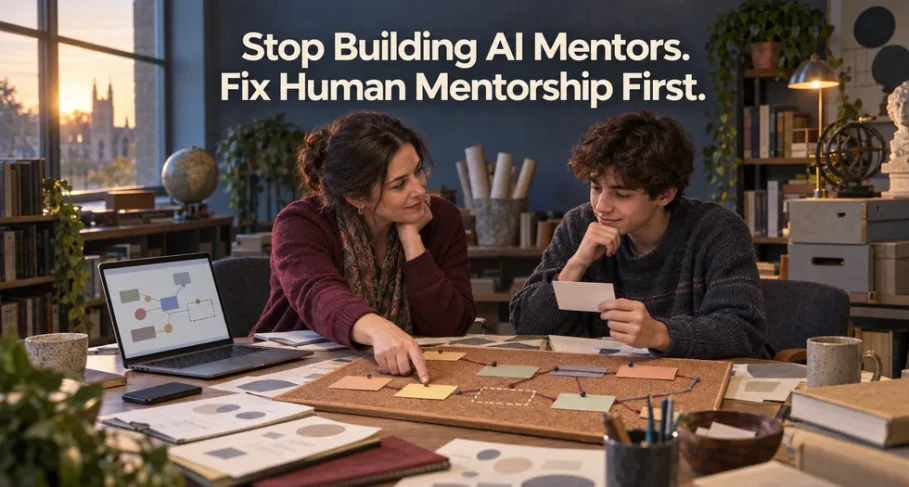
By the time I realized one student’s research project was in trouble, more than half of the mentorship program was already over.
The student was working one-on-one with a mentor to complete an independent research project, and on paper, things were going well. The mentor was engaged, the student was showing up, and each weekly conversation was productive. But when I stepped back and looked at the project, the mismatch was obvious: the research question was still too broad, substantial work remained, and the timeline no longer matched the goal.
Nothing had gone dramatically wrong in any single session. That was exactly the problem. Everyone had been focused on the next meeting, while no system was clearly showing where the project was headed.
The mentor was not failing. The infrastructure around the mentorship was.
That experience made me wonder whether the race to build AI mentors is solving the wrong problem. In many mentorship programs, the problem is not the quality of the mentor. It is the infrastructure around them.
Even a great mentor needs the right support. Good mentorship is not just about having meaningful conversations. It is about remembering what came before, keeping the student moving forward, and recognizing when something is no longer working and needs to change.
Good Sessions Can Still Produce a Bad Outcome
Mentorship is surprisingly easy to evaluate one meeting at a time. Was the student engaged? Did the mentor give useful feedback? Did they leave with something to work on? Those are reasonable questions, but they can create a false sense that everything is going well.
Research projects rarely fall behind all at once. A student can leave each meeting having made progress, but a few weeks later, the project is still much bigger than the time left to finish it. The question has not narrowed enough, new ideas keep getting added, and suddenly there are only a handful of sessions left.
That drift can be hard to see. A mentor may see one version of the project during a Zoom call, another in a shared document, and a few more updates through messages or notes. Each piece can look fine on its own. It is only when you put them together that you realize the project is no longer going where you thought it was.
The Appeal of an AI Mentor
It is easy to see why AI mentors are appealing. Tools such as Khan Academy’s Khanmigo can give students individualized support on demand, helping them work through problems rather than simply handing them an answer. A human mentor has limited time, while an AI tutor can be available whenever a student gets stuck.
AI is also becoming good at some of the most visible parts of mentorship. It can brainstorm research questions, suggest revisions, explain unfamiliar concepts, create a project plan, and recommend next steps.
But these may also be the easiest parts of mentorship to replicate.
A mentor’s value does not always come from answering a student’s question. Sometimes it comes from recognizing that the student is asking the wrong question. An AI mentor might help a student narrow a research topic. A human mentor may realize that the student should abandon that topic entirely.
Research on developmental relationships points to something similar. Young people do not just need adults to give them answers. They need adults who challenge them, encourage them, and notice when they are stuck or capable of more than they think.
A mentor might realize that a project is technically doable but not actually interesting to the student. Or they may notice that the student keeps putting off the hardest part of the work. Sometimes slow progress means the student needs to work harder. Other times, it means the project itself needs to change.
Knowing the difference takes judgment.
If judgment is where the human mentor adds the most value, then technology should give that mentor better information to act on.
This Is Where AI Could Be More Useful
Instead of trying to recreate the mentor, AI could improve the infrastructure surrounding the mentorship.
Imagine a system that looks across session notes, milestones, project plans, and student progress. It could surface patterns that are easy to miss when those pieces are scattered across different places.
In a case like the research project I described, that might mean flagging that a student is several sessions into the program, the research question is still too broad, and major stages of the project have not yet begun.
The point would not be for AI to decide that the project should be narrowed. It would be to make sure the mentor or program team sees the pattern early enough to make that judgment themselves.
I believe the better question is not, “How can AI give students better advice?” but “How can AI help mentors notice when something is going wrong?”
Helping a mentor catch a problem earlier may matter more than giving the student another source of advice.
Make the Human Better
The student whose project fell behind did not need another voice giving him advice. He needed the right person to see the problem sooner.
There is enormous value in making high-quality support more accessible, and AI will likely play an increasingly important role in helping students learn independently. But we should be careful not to confuse the most visible parts of mentorship with the most valuable ones.
The future of AI mentorship may not be a better artificial mentor.
It may be a better-equipped human one.
References
Search Institute — Developmental Relationships Framework: https://searchinstitute.org/resources-hub/developmental-relationships-framework