Generation Z has had their brains melted by social media, their laid-back attitude is telling of their intellect, and the infamous Gen Z stare? It’s proof of their low IQ. According to some, anyway.
Yet, the “stupid” Gen Z stereotype seems silly when you consider they’re the most highly educated generation yet, tech comes naturally to them, and they recognize the importance of ethics and the environment – pushing for societal improvement in ways their predecessors struggled with.
According to a new survey conducted among 2,000 Americans aged 18-27, 91% equate intelligence with being educated and well-read [1]. At the same time, 83% identify technological proficiency as intelligence. Moreover, almost half of those surveyed, 48%, say that being able to write prompts for AI is a sign of intelligence.
Key Takeaways
- 37% of American Gen Z insist they’re smarter than past generations, citing adapting to trends (85%), AI prompting (48%), and understanding memes (46%) as clear signs of intelligence.
- Just 54% see college as useful, with a desire for higher education to teach modern subjects such as mental health first aid (70%), climate survival (50%), and AI prompt engineering (30%).
- Finance is an area of struggle for many Gen Zers, with 46% unable to understand cryptocurrency, 33% unsure about inflation and interest rates, and 8% unable to identify the number of cents in a dollar.
Academic Digital Literacy Requires Depth
While technology skills and academic content are sometimes presented as conflicting objectives, this survey indicates that both are important to young adults.
One who formulates a prompt well might know how to give instructions and develop a request. However, using the explanation that comes out of it properly takes more than that: it needs being able to find the assumptions made, spot errors, compare sources, and articulate one’s own interpretation.
Imagine a history class where students ask the AI chatbot to interpret a political event. What it outputs might be a compelling chronology without necessary context. Instead of taking it at face value, students can look up primary sources, identify questionable statements in the explanation, and articulate why the chatbot failed to include something.
Make EdTech Support Thinking, Not Just Completion
The survey also shows a lack of certainty concerning the practical use of higher education. Indeed, 54% of those questioned consider that college gives useful knowledge and skills, while 32% think that attending college means only building up their resume.
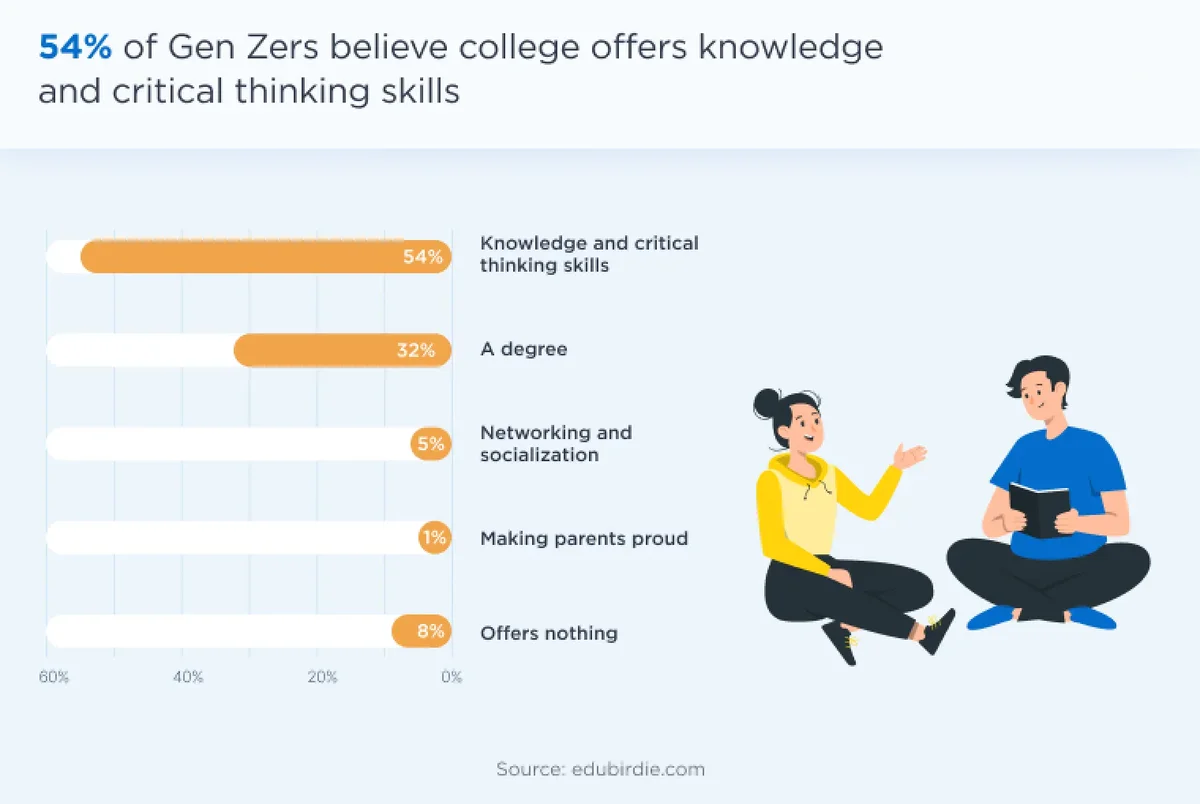
That is a personal opinion of young people in the USA, not the estimation of the university's quality. However, it gives educators an opportunity to think about how students perceive the necessity of what they study.
Educational technology may be helpful in such cases if it allows connecting theoretical information and practical actions. Simulations allow testing some decisions and seeing their consequences. Collaboration software may assist in conducting peer review. Adaptive practice technologies provide specific explanations of concepts if a learner fails to understand something.
Convenience is not an educational goal in itself. Software that provides correct answers immediately does not make any efforts to enhance understanding but just makes everything easier. Therefore, teachers and administration should consider whether the technology motivates a learner to explain, question, modify, and apply new knowledge.
Teach AI Literacy Across Subjects
AI literacy cannot be left solely to a brief training on prompting. It should be integrated into the curriculum at places where students deal with evidence, ambiguity, and alternative interpretations.
Geography could explore problems of AI-generated maps and their descriptions. Language classes could consider how machine translation alters meaning and style. Research methods could introduce verification of citations and disclosure of AI assistance.
The survey reveals that 30% of participants would like to take a course on AI prompting in their college. Such interest could serve as an entry point, but a comprehensive course should include many other things: data privacy, biases, attribution, limitations, and ultimately a human responsibility for making decisions based on AI.
Professional development of teachers and corresponding policies are also needed, since without common standards, students might get inconsistent instructions regarding AI usage across courses.
The Bottom Line
Is Gen Z a smart generation? Clearly. Gen Zers navigate technology effortlessly, can grow a social media following like no other, and (for the most part) have no struggles when it comes to conventional education. Intelligence comes in many shapes and forms, and like every generation before and after them, Gen Z has it in abundance.
References
[1] Memes, Money, and Elon Musk: How Does Gen Z Define Intelligence?: https://edubirdie.com/blog/how-does-gen-z-define-intelligence