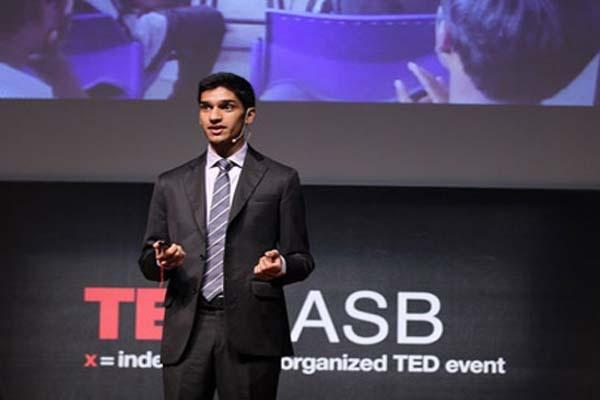
TED is a nonprofit initiative devoted to ideas worth spreading. It started out in 1984 as a conference bringing together people from three areas: Technology, Entertainment and Design.
Since then its scope has become ever broader. Along with two annual conferences, the TED Conference and TEDGlobal, TED includes the award-winning TED Talks video site, the Open Translation Project and TED Conversations, the inspiring TED Fellows and TEDx programs, and the annual TED Prize.
TED Talks:
TEDTalks began as a simple attempt to share what happens at the TED Conference with the world. Under the name “ideas worth spreading,” talks were released online and rapidly attracted global audience in the millions. On achieving the great response from audience, the entire TED website has been reengineered around TED Talks, with the goal of giving everyone on-demand access to the world’s most inspiring voices. As of November 2012, TED Talks have been viewed more than one billion times.
Twitter Handle: @TEDTalks
Here, I’d like to share with you 5 of those greatest TED Talks that I find very useful for educators. Scroll down to watch this collection:
Tyler DeWitt: Hey science teachers — make it fun:
Tyler DeWitt, a high school science teacher, once after teaching his favorite concept in all of Biology “Viruses and How they attack?” to his students, very excitingly started a discussion about it and was shocked to hear no response from all of his students. He realized that they might have taken notes and memorized the definitions but none of them understood the main idea. He then explained the same concept to his students in the form of a horror story by using animations, cartoons as well as toys of Bacteria and Viruses. His students then understood the whole idea behind it and started learning it instead of hating it like they did before. Tyler DeWitt seriously believes that the information students have been learning in high school is being presented in a way that it doesn’t exactly stick into their mind. He identified a couple of reasons about why students hate Science:
Seriousness in the Textbooks:
Science Textbooks stick to a word called “Seriousness” (No stories, engaging words, fun and use of simple language is prohibited). For example, “Science practical works are very interesting and engaging with explosions, color changes, etc., but if a text book seems too much fun, it’s somehow unscientific”, said Tyler DeWitt.
The Incomprehensible language:
The language in the textbooks is truly incomprehensible.
Example:
Simple explanation: “These Viruses can start to make copies of themselves by stepping their DNA into a bacterium”
Textbook language: “Bacteriophage replication is initiated through the introduction of viral nucleic acid into a bacterium”.
Science communication has become a horrible storyteller that discourages all the interest and enthusiasm a student has. Good storytelling is all about emotional connection which our current textbooks don’t have. We have to convince our audience about what we are talking about.
As a Ph.D student at MIT, Tyler absolutely understands the detailed and specific scientific communication between experts but he strongly refuses this incomprehensive language between 13 year olds. For a young learner, knowing something which is partially inaccurate but simple in language doesn’t actually ruin the chances of success. But if he starts hating something (100% accurate with specified scientific words) because of its complexity in language, this will surely ruin his chances of success.
Tyler told that he spent most of his free time making Science videos that convey the actual concept in a simple language. He also welcomes any Science lover to his open community Socratic.org to help him make Science simple.
Here is his TEDTalk. Watch it and get inspired.
Sugata Mitra: The child-driven education:
Educational researcher Dr. Sugata Mitra’s “Hole in the Wall” experiments have shown that, in the absence of supervision or formal teaching, children can teach themselves and each other, if they’re motivated by curiosity and peer interest. In 1999, Mitra and his colleagues embedded a computer into a wall of a slum in New Delhi. The children in that slum rarely went to school, didn’t know any English, hadn’t seen a computer and weren’t aware of what the Internet was. Mitra and his team connected the PC to a high speed Internet and left it there (with a hidden camera filming the area). What they noticed was kids from the slum playing around with the computer and in the process learning how to use it and how to go online, and then teaching each other.
The “Hole in the Wall” project demonstrates that, even in the absence of any direct input from a teacher, an environment that stimulates curiosity can cause learning through self-instruction and peer-shared knowledge. Mitra, who’s now a professor of educational technology at Newcastle University (UK), calls it “minimally invasive education.”
At TED2013, Sugata Mitra made a bold TED Prize wish: Help me build a place where children can explore and learn on their own — and teach one another — using resources from the worldwide cloud.
Here is his TEDTalk:
Dan Meyer: Math class needs a makeover
According to Dan Meyer, teaching high school Math is like selling a product to a person who doesn’t want it but is forced by a law to buy it.
Drawbacks of present curriculum:
Lack of initiative
Lack of perseverance
Lack of retention
Aversion to word problems
Eagerness for formula
Dan Meyer suggests educators to design 21st Century math curriculum as follows:
Use multimedia: Because It brings real world into classroom.
Encourage student intuition
Ask the shortest question you can.
Let students
Be less helpful.
Today’s Math curriculum is teaching students to expect and excel at paint-by-numbers classwork, robbing kids of a skill more important than solving problems: formulating them. In his talk, Dan Meyer shows classroom-tested Math exercises that prompt students to stop and think.
Here is his TED Talk, watch and learn what really matters in Math.
Ken Robinson: Changing education paradigms
In this talk from RSA Animate, Sir Ken Robinson lays out the link between 3 troubling trends: rising drop-out rates, schools’ dwindling stake in the arts, and ADHD (Attention Deficit/Hyperactivity Disorder). Creativity expert Sir Ken Robinson challenges the way we’re educating our children. He champions a radical rethink of our school systems, to cultivate creativity and acknowledge multiple types of intelligence. His TED Talk video has clearly explained how today’s factory-like education model is outmoded and how it needs to evolve into a more personalized model if we are going to take it to a new level.
Let’s use video to reinvent education: Salman Khan on TED.com
Salman Khan talks about how and why he created the remarkable Khan Academy , a carefully structured series of educational videos offering complete curricula in numerous subjects like Math, Science, Languages, etc. He shows the power of interactive exercises, and calls for teachers to consider flipping the traditional classroom script where students watch video lectures at home and do “homework” in the classroom with the teacher available to help.
The above mentioned are a few TED Talk videos that I consider very useful for teachers, educators as well as administrators. I hope this collection of TED Talks helped you to get a little motivation as well as some valuable information about the type of teaching that really matters. You’re free to share your views in the comment box.