
This website stores cookies on your computer. These cookies are used to improve your website experience and provide more personalized services to you, both on this website and through other media.
Accept
EdTechReviewEdTechReview
  • News
  • Trends
  • Insight
  • eLearning
  • Research
  • Dictionary
  • EdTech Voices
  • More
    • Data & Statistics
    • Reviews
    • AWS for Education
    • Events

    Resources

    • Infographics
    • Reports & Case Studies
    • Videos
    • Books
    • Webinar

    Needs

    • 1:1 Learning
    • 21st Century Education
    • 21st Century Leadership
    • 21st Century Learning
    • 21st Century Teaching
    • 3D Printing
    • More Tags

    For

    • Students
    • Teachers/Educators
    • Administrators
    • Entrepreneurs/Startups
    • Govt. Officials/Policymakers
    • Parents
Explore
Search
Contribute
  • Submit A Post
  • EdTech Trainers and Consultants
  • Your Campus EdTech
  • Your EdTech Product
  • Your Feedback
  • Your Love for Us
  • EdTech Product Reviews
ETR Resources
  • About
  • Mission/Vision
  • Team
  • Services
  • Testimonials
  • Authors
  • Sponsor
  • Partner
  • Advertise
  • Our Clients
  • Media Kit
  • Press Release
  • FAQ’S
Reading: KinderLab Robotics Launches Thinking With KIBO, an AI Curriculum for Young Learners
Aa
EdTechReviewEdTechReview
Aa
Search
  • News
  • Trends
  • Insight
  • eLearning
  • Reviews
  • Dictionary
  • EdTech Voices
  • Data & Statistics
  • Research
  • AWS for Education
  • Events
  • EdTech Voices
  • Tags
  • About
  • FAQ’S
  • Our Clients
  • Partner
Follow US
Home > News > KinderLab Robotics Launches Thinking With KIBO, an AI Curriculum for Young Learners
News

KinderLab Robotics Launches Thinking With KIBO, an AI Curriculum for Young Learners

Shalini Pathak Published Sep 4, 2023
Share
5 Min Read
KinderLab Robotics Launches Thinking With KIBO an AI Curriculum for Young Learners
KinderLab Robotics Launches Thinking With KIBO, an AI Curriculum for Young Learners
SHARE

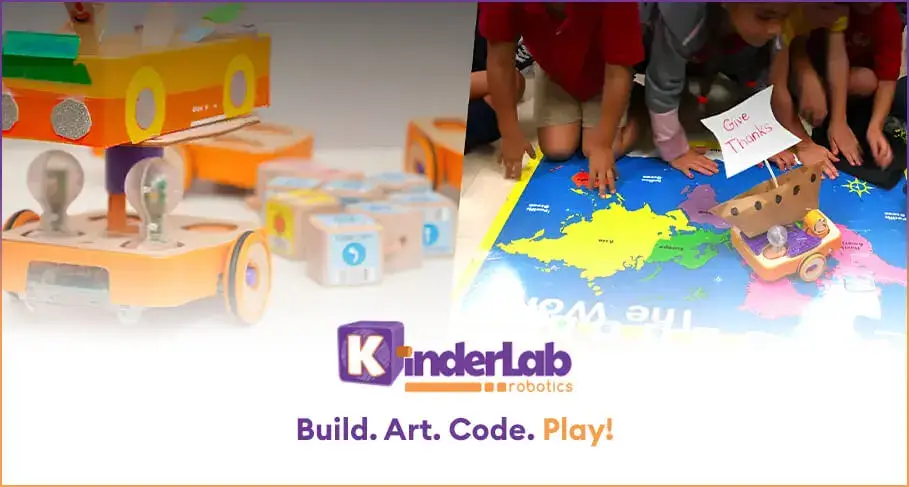
KinderLab Robotics, a leader in educational STEAM robotics for grades pre-K–5, has introduced Thinking with KIBO: Introducing Artificial Intelligence (AI) in Early Grades, a free curriculum designed to help students understand how AI tools work and think critically about how these tools can improve lives in their communities.

AdvertisementWhy this Ad?

Each lesson, designed for children in grades 1-3, allows students to explore core notions about AI through activities with the hands-on and screen-free KIBO robot. Thinking with KIBO involves students in grades K-5 on computer science principles and growing artificial intelligence subject standards. The curriculum is appropriate for a 5- to 6-week unit in computer science or technology/media schools, as well as afterschool programmes, enrichment centres, libraries, maker spaces, and other settings.

Speaking about the initiative, the Director of curriculum, training, and product management of KinderLab Robotics, said:

We can make advanced and abstract ideas like AI accessible to young kids when we stick with what works in early childhood: hands-on experience with physical manipulatives and playful opportunities for self-directed knowledge construction. KIBO provides a research-proven method to explore computer science, engineering, and now AI concepts in early childhood STEM education.

Thinking with KIBO is aligned with the draft AI4K12 curriculum guidelines, which explore the “Five Big Ideas in AI”: Sensing, Representation and Reasoning, Learning, Natural Interaction, and Social Impact. These guidelines, a collaboration between AAAI and CSTA, frame AI education as an essential component of K–12 computer science education.

David S. Touretzky, Professor of Carnegie Mellon University and chair of the AI4K12 Steering Committee, added:

Children today are growing up in a world saturated with artificial intelligence technology. It’s never too early to teach them the basics of AI and computing, which is why the AI4K12 Guidelines begin with kindergarten.

Although there are important questions about how AI tools will and should be used in the classroom, KinderLab’s new curriculum instead centres on teaching children how AI works. Featuring four 60-minute lessons and a fifth lesson that can be extended from one to two hours, the core learning objectives of the new curriculum include:

  • AI is a tool made by people. Artificial intelligence can sometimes seem like magic, but it is just a tool created by human engineers. This understanding can help demystify AI and, for some students, make it seem less scary.
  • AI systems (and robots!) make decisions based on input and rules. Both robots and AI rely on what engineers call the “sense – think – act” cycle. The systems take information, decide what to do based on rules, and then take action. Humans design the sensors, the rules, and the actions. An AI system’s rules can be very complicated, and the rules can even change over time through machine learning, but they are still rules.
  • AI doesn’t think like people do, and it’s not alive. Although we use the words “artificial intelligence,” the intelligence of these systems is different from human intelligence. AI systems don’t really “think” like we do. They can’t choose what to do outside of their rules or develop new ideas and aren’t aware of themselves like people.
  • AI can help people solve complex problems. Even though AI doesn’t think, AI is still an amazing tool for helping us think by processing far more information than people can. Exploring the uses of these systems will help students understand how AI can be used responsibly, and it might even inspire them to work on developing AI themselves.

KinderLab Robotics is dedicated to promoting universal STEAM literacy. The company aims to accomplish this by providing young children with research-based robot kits. Robotics in early learning dynamically introduces STEAM principles, piquing the interest of even the youngest learners in Science, Technology, Engineering, Arts, and Math. Dr. Marina Umaschi Bers of Boston College developed KIBO, particularly for teachers. It is now used in over 70 countries and has demonstrated efficacy in helping youngsters in pre-k-5th grade study STEAM—and get excited about it. KinderLab provides a comprehensive set of teaching tools for incorporating STEAM aspects into various curricula, including art, cultural studies, and reading literacy.


TAGGED: AI Teaching Tools, Artificial Intelligence, Computer Science, EdTech Startups/Companies, Machine Learning, Online Courses, Online Education, Robotics, STEAM
Share This Article
Facebook Twitter Whatsapp Whatsapp LinkedIn Reddit Telegram Email Copy Link
By Shalini Pathak
Follow:
Shalini Pathak is a Staff Writer at EdTechReview (ETR) - India's leading edtech media & community. She has over four years of experience in media, covering different beats. Like all writers she's an enthusiastic reader first with a passion to create out of the box content, and an ability to write about any topic. As a part of the ETR team, she will cover the latest in the edtech industry with a focus on edtech startup stories and their funding.
Previous Article Education & Research Platform Wiley Introduces Online Practice Tests for UPSC Aspirants Education & Research Platform Wiley Introduces Online Practice Tests for UPSC Aspirants
Next Article Copenhagen-Based Hiring Platform Woba Raises $319M to Accelerate Its Global Reach Copenhagen-Based Hiring Platform Woba Raises $3.19M to Accelerate Its Global Reach
AdvertisementWhy this Ad?

Latest EdTech News To Your Inbox

Stay Connected

AdvertisementWhy this Ad?

Latest EdTech News To Your Inbox

Stay Connected

AdvertisementWhy this Ad?

You Might Also Like

How AI and Smart Sensors Are Creating Safer Learning Environments
Trends

How AI and Smart Sensors Are Creating Safer Learning Environments

Jul 16, 2026
upEducators Top Choice for Becoming a Nursery Teacher in India
News

Why is upEducators the Top Choice for Nursery Teacher Training (NTT) Course in India?

Jul 7, 2026
What Schools Really Pay Without Language Access Systems in Place
Insight

What Schools Really Pay Without Language Access Systems in Place

Jul 4, 2026
Indian EdTech Has Been Solving the Problem It Can Bill For Not the One Children Have
Insight

Indian EdTech Has Been Solving the Problem It Can Bill For, Not The One Children Have

Jul 2, 2026
The Most Important Variable in Education Isnt AI
Insight

The Most Important Variable in Education Isn’t AI – What Building Live Instruction at Scale Actually Taught Me

Jun 26, 2026
Why AI-Powered Personalized Learning Is Becoming the New Standard in EdTech
Insight

Why AI-Powered Personalized Learning Is Becoming the New Standard in EdTech

Jun 25, 2026
Top 7 AI Leadership & Business Administration Programs for Executives in 2026
eLearning

Top 7 AI Leadership & Business Administration Programs for Executives in 2026

Jun 25, 2026
EdTech in 2026 - Are We Actually Learning or Just Watching
Insight

EdTech in 2026 – Are We Actually Learning or Just Watching?

Jun 24, 2026
Show More
EdTechReviewEdTechReview

H433, 2nd Floor, Vikaspuri, New Delhi, India, 110018
Phone: 011 41321030

Follow US

Copyright © EdTechReview. All Rights Reserved.

  • Home
  • Advertise
  • Event Associations
  • Press Release
  • About
  • Services
  • Contribute
  • News
  • Trend & Insight
  • Data & Statistics
  • eLearning
  • Reviews
  • Research
  • EdTech Voices
  • Dictionary
  • Tags
  • Resources
  • Events
  • Courses
  • EdTech Product for Review
  • Sponsored/Paid Post Service
  • Our Clients
  • FAQ’S
  • Contact Us
  • Important Links
  • Sitemap
  • Terms of Use
  • Privacy Policy
newsletter
Join 100K+ subscribers!

Subscribe to our weekly newsletter that brings the latest EdTech news, trends, insights, reports, interviews, etc. for educators, school leaders, entrepreneurs, investors, & others.

loader
Zero spam, Unsubscribe at any time.
Go to mobile version
Welcome Back!

Sign in to your account

Lost your password?