
This website stores cookies on your computer. These cookies are used to improve your website experience and provide more personalized services to you, both on this website and through other media.
Accept
EdTechReviewEdTechReview
  • News
  • Trends
  • Insight
  • eLearning
  • Research
  • Dictionary
  • EdTech Voices
  • More
    • Data & Statistics
    • Reviews
    • AWS for Education
    • Events

    Resources

    • Infographics
    • Reports & Case Studies
    • Videos
    • Books
    • Webinar

    Needs

    • 1:1 Learning
    • 21st Century Education
    • 21st Century Leadership
    • 21st Century Learning
    • 21st Century Teaching
    • 3D Printing
    • More Tags

    For

    • Students
    • Teachers/Educators
    • Administrators
    • Entrepreneurs/Startups
    • Govt. Officials/Policymakers
    • Parents
Explore
Search
Contribute
  • Submit A Post
  • EdTech Trainers and Consultants
  • Your Campus EdTech
  • Your EdTech Product
  • Your Feedback
  • Your Love for Us
  • EdTech Product Reviews
ETR Resources
  • About
  • Mission/Vision
  • Team
  • Services
  • Testimonials
  • Authors
  • Sponsor
  • Partner
  • Advertise
  • Our Clients
  • Media Kit
  • Press Release
  • FAQ’S
Reading: Why AI Grading Tools Are Changing the Game for K-12 Teachers
Aa
EdTechReviewEdTechReview
Aa
Search
  • News
  • Trends
  • Insight
  • eLearning
  • Reviews
  • Dictionary
  • EdTech Voices
  • Data & Statistics
  • Research
  • AWS for Education
  • Events
  • EdTech Voices
  • Tags
  • About
  • FAQ’S
  • Our Clients
  • Partner
Follow US
Home > Reviews > Why AI Grading Tools Are Changing the Game for K-12 Teachers
Reviews

Why AI Grading Tools Are Changing the Game for K-12 Teachers

Editorial Team Published Mar 11, 2026
Share
5 Min Read
Why AI Grading Tools Are Changing the Game for K-12 Teachers
SHARE

For years, teachers have viewed automated grading with a healthy skepticism, promising time savings, but often delivering rigid, unreliable results. Early tools struggled with anything beyond multiple-choice questions, and most educators stuck with traditional methods as a result. That’s changed. Powered by more sophisticated language models and real-world classroom testing, today’s AI grading tools have matured into something genuinely useful: systems that save hours without sacrificing the quality of feedback students actually need.

Contents
The Weight of the WorkloadHonest About the LimitationsA Model That Works: Human + AIA Closer Look: FeedbackWhere This Is Headed
AdvertisementWhy this Ad?

The Weight of the Workload

The numbers are telling. A 2025 Gallup-Walton Family Foundation survey of over 2,200 U.S. public school teachers found that six in ten now use AI tools daily, saving an average of nearly six hours per week, roughly six full working weeks a year. Grading alone accounts for nearly ten of those weekly hours, frequently spilling into evenings and weekends.

It’s no surprise, then, that the AI education market has grown sharply, from $3.6 billion in 2023 and projected to exceed $73 billion by 2033. But growth doesn’t equal trust. Teachers are right to ask: can these tools handle the real range of classroom assignments, from math worksheets to open-ended essays, accurately and fairly?

Honest About the Limitations

Any responsible conversation about AI grading has to acknowledge where it falls short. Research from MIT Sloan’s instructional technology team found that some tools grade leniently on weaker writing and harshly on stronger work, the opposite of what you’d want. Tools trained on narrow datasets can also carry biases, and feedback on complex, open-ended work can feel generic.

These are legitimate concerns, particularly in K-12 settings where grading decisions carry real weight. Before adopting any platform, educators should ask: What data was this trained on? How does it compare to human graders? Can teachers override scores easily? Is it FERPA-compliant? The best tools answer these questions openly and position AI as support for teacher judgment, not a substitute for it.

A Model That Works: Human + AI

The most effective implementations follow a hybrid approach. AI handles the initial scoring, teachers review and adjust. This keeps grading consistent while preserving the contextual judgment that no algorithm fully replicates. The features that distinguish trustworthy platforms tend to be practical ones:

  • Customizable rubrics that align with Common Core or NGSS standards, including partial credit and evidence-based feedback
  • Full transparency into how scores are generated, with easy overrides for edge cases
  • Academic integrity tools that flag both copied and AI-generated content
  • Strong data privacy — FERPA/COPPA compliant, with student work never used for model training
  • Rigorous validation across diverse, real-world assignment types, including handwritten work

Done well, this approach can reduce scoring subjectivity by up to 40%, while freeing teachers to focus on reteaching, small-group support, and the kind of relationship-building that actually moves students forward.

A Closer Look: Feedback

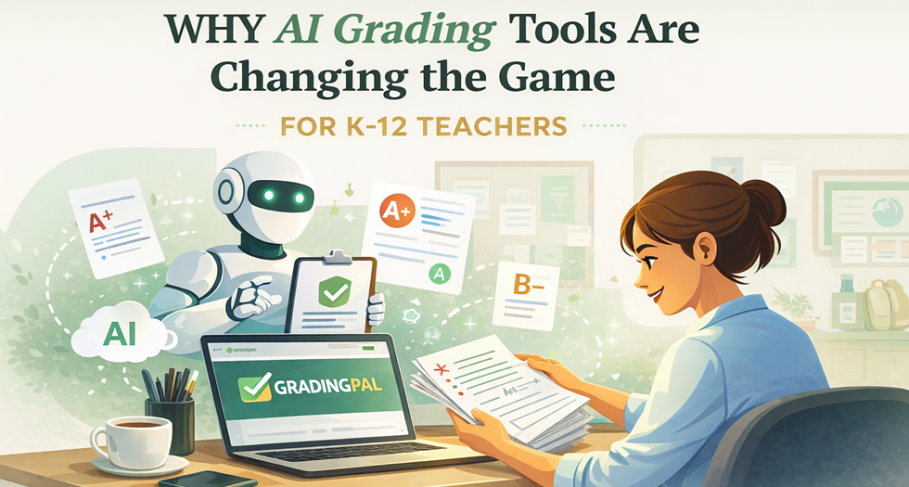
GradingPal is one platform built with this philosophy in mind. Designed for K-12 classrooms across grades and subjects, it handles essays, quizzes, math, science labs, and more, with automatic alignment to standards-based grading frameworks.

The development process reflects genuine care for accuracy: the team tested six language models against over 1,500 essays and ran beta trials with more than 500 educators before launch, achieving strong alignment with human grader scores. OCR support for handwritten assignments makes it practical for everyday classroom use, and a built-in integrity checker adds a useful layer of oversight. Teachers using it report saving around eight hours a week, time they’re redirecting toward individualized instruction and lesson planning.

One 8th-grade ELA teacher put it simply: “Feedback is spot-on, and I can override anything. My weekends are mine again.” You can explore more about GradingPal on their website.

Where This Is Headed

AI won’t replace teachers, but for many, the current workload is unsustainable, and that’s a problem worth solving. Tools that are transparent about their limitations, respectful of teacher expertise, and genuinely validated against real classroom conditions can make a meaningful difference. If you’re curious, the lowest-risk starting point is a single assignment type. Measure the time saved, check the feedback quality, and go from there.
TAGGED: AI Teaching Tools, AI Tools, Feedback Software Tool, Grading Software, Teachers/Educators, Tools for Teachers/Educators
Share This Article
Facebook Twitter Whatsapp Whatsapp LinkedIn Reddit Telegram Email Copy Link
By Editorial Team
Follow:
EdTechReview (ETR) is a premier media platform and community for educational stakeholders to connect and find useful news, information and resources on educational technology having a niche subscriber base of 120K+ and an annual readership of 3M+ from over 220 countries and territories across the globe.
Previous Article Why Hands-On Training Is An Essential Part Of Your Technology Skills Strategy Why Hands-On Training is an Essential Part of Your Technology Skills Strategy
Next Article How One Canadian Startup Is Reinventing Language Learning with AI How One Canadian Startup Is Reinventing Language Learning with AI
AdvertisementWhy this Ad?

Latest EdTech News To Your Inbox

Stay Connected

AdvertisementWhy this Ad?

Latest EdTech News To Your Inbox

Stay Connected

AdvertisementWhy this Ad?

You Might Also Like

How AI Tools Are Changing the Way We Work Learn and Create
Trends

How AI Tools Are Changing the Way We Work, Learn, and Create

Jun 9, 2026
Education Has Nowhere to Hide in the Agentic Era
Insight

Education Has Nowhere to Hide in the Agentic Era

Apr 15, 2026
Prep Edu - British Councils top 3 partners in East Asia
News

Prep Edu – British Council’s Top 3 Partners in East Asia

Apr 14, 2026
AI Voice Agents for EdTech Making Learning More Interactive and Accessible
Trends

AI Voice Agents for EdTech: Making Learning More Interactive and Accessible

Mar 31, 2026
SchoolStatus Launches Literacy Solution to Help Districts Engage Families in Improving Reading Outcomes
News

SchoolStatus Launches Literacy Solution to Help Districts Engage Families in Improving Reading Outcomes

Mar 12, 2026
How One Canadian Startup Is Reinventing Language Learning with AI
News

How One Canadian Startup Is Reinventing Language Learning with AI

Mar 12, 2026
How AI Transcript Evaluation Automates GPA Re-Calculations and Curriculum Matching
News

How AI Transcript Evaluation Automates GPA Re-calculations and Curriculum Matching

Feb 27, 2026
How AI Is Transforming Short-Form Video for EdTech Marketing & Learning Creators
Trends

How AI Is Transforming Short-Form Video for EdTech Marketing & Learning Creators

Jan 30, 2026
Show More
EdTechReviewEdTechReview

H433, 2nd Floor, Vikaspuri, New Delhi, India, 110018
Phone: 011 41321030

Follow US

Copyright © EdTechReview. All Rights Reserved.

  • Home
  • Advertise
  • Event Associations
  • Press Release
  • About
  • Services
  • Contribute
  • News
  • Trend & Insight
  • Data & Statistics
  • eLearning
  • Reviews
  • Research
  • EdTech Voices
  • Dictionary
  • Tags
  • Resources
  • Events
  • Courses
  • EdTech Product for Review
  • Sponsored/Paid Post Service
  • Our Clients
  • FAQ’S
  • Contact Us
  • Important Links
  • Sitemap
  • Terms of Use
  • Privacy Policy
newsletter
Join 100K+ subscribers!

Subscribe to our weekly newsletter that brings the latest EdTech news, trends, insights, reports, interviews, etc. for educators, school leaders, entrepreneurs, investors, & others.

loader
Zero spam, Unsubscribe at any time.
Go to mobile version
Welcome Back!

Sign in to your account

Lost your password?