For HR and learning leaders, one truth has become unavoidable, organisations are rolling out more technology – faster – than employees can comfortably absorb. ERP, HCM, CRM, cybersecurity tools, AI copilots, workflow automation platforms, the list keeps expanding. It’s little wonder that leaders and employees cannot keep up.
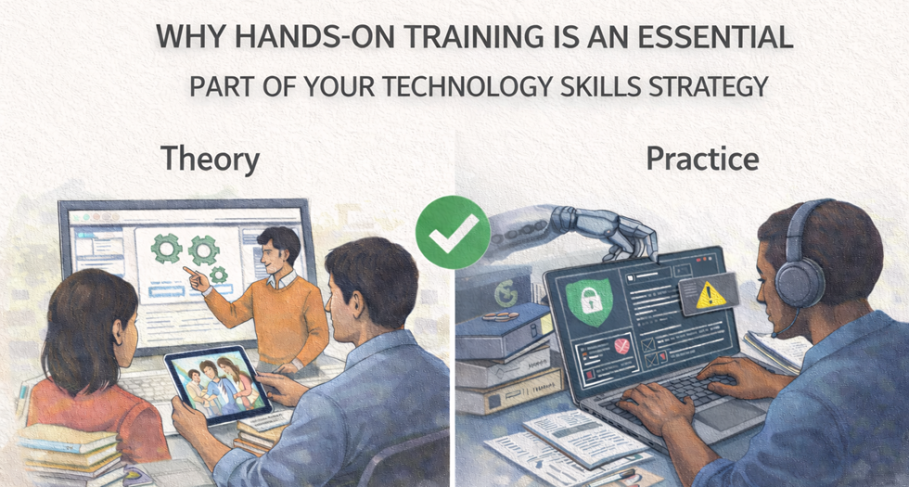
It’s not because employees are unwilling. It’s because traditional training methods like videos, simulations, slide decks, classroom walkthroughs, teach the theory of what to do, but rarely build the confidence to actually do it. Many employees can pass a knowledge check but freeze at a login screen.
That’s the gap HR leaders must close to build a truly tech-enabled workforce.
Today’s most successful organizations are moving beyond passive instruction and replacing it with hands-on, immersive training environments such as virtual IT labs where employees learn by doing. And the impact is reshaping everything from system rollouts to onboarding to continuous skill development.
What are modern virtual IT labs?
Modern hands-on labs are secure, live environments that mirror real enterprise systems but in a non-production, safe, environment. Unlike simulations or screenshot walkthroughs, labs let employees click real buttons, configure real settings, and see authentic system responses.
This realism matters. Enterprise workflows are interconnected: a field update in an HCM system can impact payroll, analytics, access controls, or downstream integrations. Labs allow employees to safely explore those connections and understand consequences in a low-risk space.
And today’s platforms go far beyond simple access. Guided challenges, contextual hints, automation, adaptive difficulty, and real-time feedback make the experience dynamic, personalised, and measurable.
70% of learning happens through experiences
The 70–20–10 model has long guided leadership and talent development:
- 70% of learning comes from experiential practice
- 20% through coaching and collaboration
- 10% through formal learning
In many organizations, the 10% portion remains disproportionately emphasised. Employees absorb information but rarely get enough real-world practice before they’re expected to perform.
Virtual labs directly strengthen the 70% in a controlled, scalable way. They give learners access to the actual workflows, data structures, and decision points they’ll face on the job. Instead of memorising steps, learners are immersed in the scenarios and challenges they will encounter in their roles. They can practice, make mistakes and get feedback, in a way that doesn’t threaten customer data or business continuity. Errors become learning opportunities, not production risks.
Labs also reinforce the other parts of the 70–20–10 model. They can be paired with coaching, peer learning, and shadowing, and they make formal instruction more meaningful by giving employees a place to immediately apply what they just learned.
Because labs can adapt to different skill levels, they challenge beginners and experienced employees appropriately, creating a scalable way to build confidence and capability before anyone touches production systems.
Getting started
Launching a virtual lab program doesn’t have to be complex. Organisations that succeed typically begin with a quick win, such as a process that is mission-critical, error-prone or often used. Processing payroll adjustments, onboarding in new software, cleaning and analysing data or working on customer support requests are all examples of processes that can benefit from hands-on training.
Once you’ve chosen your process, L&D can work with functional experts to define what “good” looks like: the steps involved, the decisions the user needs to make, and the outcomes that indicate competence. The scenario is then built into a lab where learners can practice the task as many times as needed.
The final step is pairing labs with in-app reinforcement during and after go-live. When learners encounter the live system, contextual reminders help them recall what they practiced. Adoption increases because the knowledge is fresh and rooted in real experience.
Integrating with wider learning systems
Because modern labs plug into most LMS and LXP environments, learners can move seamlessly from theory to practice within the same interface, completing short conceptual modules and immediately applying what they’ve learned in a realistic environment. This tight sequencing significantly improves retention and reduces the common drop-off that occurs when learners wait days or weeks to try a new skill.
Labs also boost instructor-led and coaching-based learning. Instructors can use them to shift sessions from passive explanation to active practice, reinforcing concepts with hands-on application. The performance data that labs generate (scoring, telemetry, and error patterns) gives instructors, managers and trainers clear insight into where learners excel and where they need support. That makes follow-up coaching, shadowing, and stretch assignments far more targeted and meaningful, because decisions are based on demonstrated skill rather than guesswork.
Finally, integrating labs into onboarding, role transitions, and internal mobility pathways gives HR leaders reliable, performance-based skill signals. These signals reflect how well someone can apply a skill in realistic conditions, offering a much more accurate picture of readiness than course completions or video views.
Empowering the tech-savvy workforce
For employees to feel truly empowered to use workplace technology, they need training that gives them the space to experiment, make mistakes safely, and build real confidence long before they touch production systems. Virtual IT labs are helping to bring the 70–20–10 model to life by giving people what they need most: a place to practice before the stakes are real.