
The Last Sectors to Know
Every sector that has ever been dismantled by a new compute layer had one thing in common. The people inside it were the last to know. Not because they were stupid. Because they were invested. Kodak’s engineers invented the digital camera and buried it. The music industry had Napster’s source code and called the lawyers. Education has something neither of them had: a moral argument for its own indispensability. That argument is about to be tested in ways the sector is not prepared for.
What Is Actually Happening
Let me be precise, because vagueness is how the sector escapes accountability.
Jensen Huang, chief executive of Nvidia, the company that builds the physical substrate on which artificial intelligence runs, recently described OpenClaw, an open-source agentic framework, as “the new computer.” Not a useful application. Not a productivity enhancement. The new computer. At Nvidia’s GTC 2026 conference, Huang declared it “the most popular open-source project in the history of humanity”, one that reached that status faster than Linux, Kubernetes, or HTML did across decades.
Huang has spent his career building the infrastructure beneath technological revolutions. When he reaches for that particular register of language, it is worth pausing to consider what he means.
What he means is this: the unit of computation has changed. The PC era gave individuals access to processing power. The internet era gave them access to each other and to information. In what I am calling the agentic era, individuals gain access to autonomous action at a scale we have not truly grasped. A solo founder running OpenClaw can now execute, continuously and without sleep, what previously required a staffed operation. The leverage is not incremental. It is categorical.
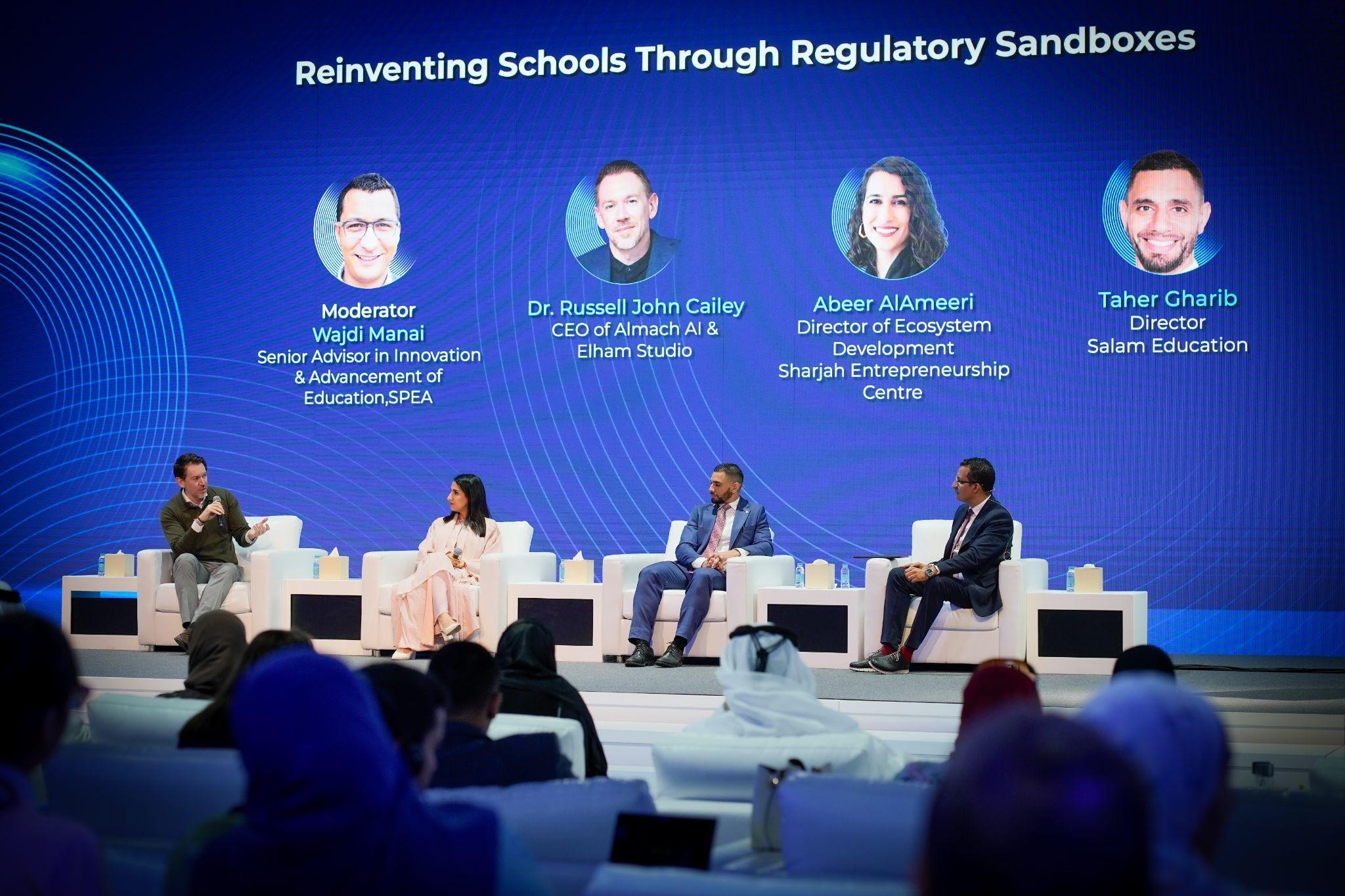
This is the context in which education continues to hold its conferences.
What This Means for Schools
Consider what this technology actually does at the organisational level. An agentic system can conduct and synthesise candidate research before a hiring manager has opened their inbox. It can model school financing scenarios against live market data, identify gaps in a curriculum against emerging labour market intelligence, manage asset pipelines, stress-test strategic plans, and surface board-level decisions before a leadership team has even framed the question.
This is not automation in the narrow sense of replacing repetitive tasks. It is the wholesale augmentation of institutional intelligence. Every function that currently requires a specialist, a consultant, or a committee sitting through three rounds of revision is now within reach of a single operator who understands how to deploy these systems. The organisations that grasp this first will not merely be more efficient. They will be structurally different from those that do not.
The Honest Qualification
And yet honesty demands a qualification. For all the structural possibility this infrastructure represents, we are woefully short of real examples. We do not yet have a documented case of an agentic system running a school’s marketing strategy end-to-end. We do not have the case study of a faculty team replaced by an operator and a well-deployed agent.
The proof of concept exists at the component level. The integrated institutional demonstration does not. This is not a reason to wait. It is a reason to be the one who builds it first. The educators and operators who generate those case studies in the next two years will not just have a competitive advantage. They will have written the playbook everyone else follows.
The Broken Glow
Education assumed for decades that knowledge was scarce, that the future was largely predictable, and that five-year plans were a sign of strategic maturity rather than a defence mechanism against uncertainty. Those assumptions produced the sector we have now. One that measures progress in academic years, rewards compliance over curiosity, and treats the contrarian as a problem to be managed rather than a signal to be read.
The research on AI tutoring confirms the pattern. The variable is not the technology. The variable is the intelligence applied to its use.
The Collapse of Time
What compounds this is what I would call the Collapse of Time, the accelerating gap between the pace at which the world changes and the pace at which institutions respond. The careful timelines education built around itself were never really about quality or rigour. They were about comfort. When survival was at stake during the pandemic, vaccine development compressed from five years to six months. The timelines moved because they had to.
What the agentic shift is now demonstrating is that the same compression is available to every knowledge institution on earth. The institutions choosing not to use it are not being cautious. They are betting that the risk of moving stays lower than the risk of standing still. That tipping point has almost certainly already passed, and most of the sector hasn’t noticed.
Performing Concern Is Not the Same as Taking Action
I have spent fifteen years working inside international education, designing curriculum, advising school founders, working with institutions across Asia and the Gulf. I have sat in enough strategy meetings to recognise the characteristic sound of an industry performing concern without incurring the cost of action. The language is always the same: implications, frameworks, guardrails, consultation. The effect is always the same. Time passes, the world moves, and the institution issues a statement.
OpenAI, Anthropic and Nvidia are not pausing their roadmaps while curriculum committees deliberate. The agentic infrastructure is being built at a pace that makes institutional response times not merely slow but structurally irrelevant. By the time most schools have agreed on a policy, the policy will be addressing a technology that no longer describes the frontier.
The Moral Argument Won’t Hold
There is a temptation in pieces like this to soften the conclusion. To acknowledge complexity, to grant good faith to the institutions under scrutiny, to end on a note of cautious optimism. I understand the temptation and I am not going to indulge it.
Education does not get a grace period because it feels important. The sector’s social weight — its connection to children, to development, to the long arc of human potential — is precisely why its failure to engage seriously with this transition is not merely a strategic error but a moral one. The students sitting in classrooms designed for a world that no longer exists are not abstractions. They are the cost of the sector’s comfort with its own inertia

The agentic era is not coming. It is here. Imperfect and without enough case studies, but here nevertheless. Increasingly running on consumer hardware rather than the cloud, accessible through messaging applications, trained on the sum of recorded human knowledge, and available to anyone willing to spend a couple of days learning how it works.
What it is not doing is waiting for education to decide whether it has concerns.