
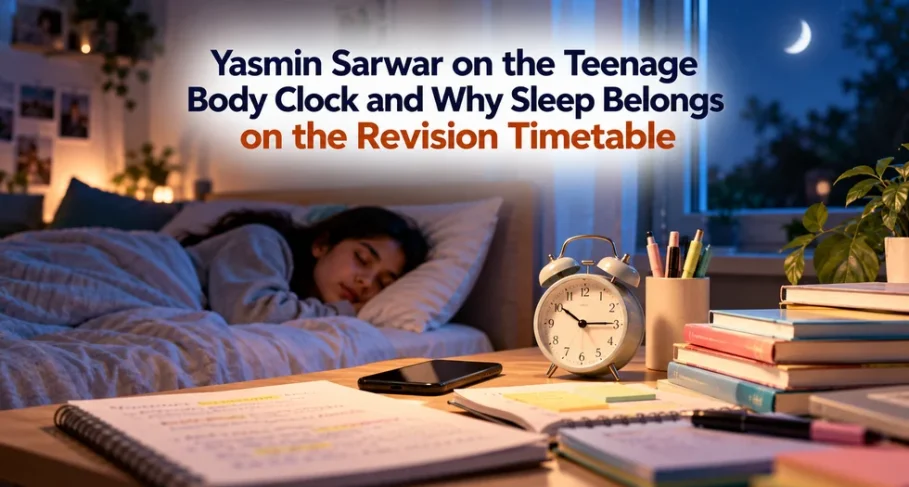
Somewhere around the start of puberty, the human body clock moves. The shift is far from subtle. According to the American Academy of Pediatrics, most adolescents develop a delay of up to two hours in the times they fall asleep and wake compared with middle childhood, driven partly by the brain releasing the sleep hormone melatonin later in the evening. Their need for sleep does not shrink to match. The academy’s 2014 policy statement put the optimal amount for most teenagers at between eight and a half and nine and a half hours a night, and concluded that the average teenager finds it difficult to fall asleep before 11pm.
That single finding changes the meaning of a scene repeated in thousands of homes every school night. The fifteen-year-old who is wide awake at half past eleven, and who has to be prised out of bed at seven, is usually cast as undisciplined. Biology offers a kinder reading. For Yasmin Sarwar, sleep is the most neglected part of almost every conversation about studying, and one of the few areas where small, unglamorous changes tend to make a large difference to how a student learns.
The Work the Brain Does Overnight
Sleep is generally treated as whatever time is left once homework, revision and everything else are finished. The research on memory suggests it belongs inside the work instead. In a 2016 study published in Psychological Science, researchers at the University of Lyon asked 40 volunteers to learn 16 pairs of words in an unfamiliar language and then relearn them twelve hours later. Half learned in the morning and relearned that evening. The other half learned in the evening, slept, and relearned the following morning.
The sleepers had a clear advantage. They remembered more at the start of the second session and needed roughly half as many attempts to relearn the full list. A week later they could recall about 15 of the 16 pairs, compared with about 11 for the group who had stayed awake, and the gap was still visible six months on. Sleep, in effect, had done part of the studying for them.
The Lyon experiment was small, and learning word pairs is a long way from mastering the Tudor succession or a page of organic chemistry. Its findings sit comfortably, though, within decades of laboratory work showing that the sleeping brain replays and strengthens what it encountered during the day. The material a student meets in the evening is, in a real sense, still being worked on after the lights go out.
For teenagers, the lesson is that an hour of revision taken from sleep is often a poor exchange. A student who stays up until one in the morning going over a chemistry topic may feel virtuous, but is cutting into the very process that would have fixed the material in place. The extra hour at the desk can end up undoing more than it adds.
The Competitor on the Pillow
The body clock explains why teenagers are awake late. It does not explain everything they are doing while awake. Phones arrive in the bedroom at almost exactly the age the body clock begins to drift, and they make the drift worse. Bright light late in the evening can hold back melatonin further, although sleep researchers increasingly point out that what is on the screen matters as much as the light it gives off. A group chat still buzzing at midnight, a video that rolls straight into the next one or a message that lands just as the lights go out are all built to hold attention, and a teenage brain that is already wide awake is an easy audience.
Sarwar’s view is that banning phones outright usually starts an argument nobody wins. A more workable approach is to agree where the phone sleeps. A charger on the landing or in the kitchen, rather than beside the pillow, removes the temptation without turning every evening into a negotiation. It works best when the adults in the house follow the same rule, and when the phone goes out of the room a little before bed rather than at the moment of switching off the light.
Working With the Clock
The more useful shift is to plan study around the body clock rather than against it. Late evening, when many teenagers feel most alert, can suit lighter tasks such as reading or looking over notes they will come back to the next day. Effortful new work is often better placed earlier, before tiredness sets in. The Lyon findings also point to a simple habit: a short burst of self-testing the morning after an evening’s study, which builds on whatever sleep has already consolidated.
Consistency matters as well. A teenager who sleeps until noon on Saturday and Sunday is effectively changing time zones every weekend, and Monday morning can feel like jet lag because, in body clock terms, it is something close to it. Keeping weekend wake-up times within an hour or two of weekday ones is dull advice, but it makes the school week noticeably easier to face. Morning daylight helps too. A walk to the bus stop or breakfast by a bright window nudges the body clock earlier, which is the one direction a teenager’s clock rarely moves on its own.
The Exam Season Trap
Sleep is most likely to be sacrificed at the very moment it matters most. In the weeks before mocks and summer exams, plenty of students cut back on sleep to make room for extra revision, and plenty of parents quietly admire the effort. The memory research points the other way. A student who walks into the exam hall after a full night’s sleep has given their brain the chance to organise what they learned, while one who revised until two is relying on material that was never properly stored.
In Sarwar’s experience, the students who cope best with a heavy workload are rarely the ones who work latest. They tend to be the ones who have settled into a rhythm, with a fixed finishing time, a short wind-down away from screens and a wake-up time that does not lurch about at weekends. None of it looks like hard work from the outside, which is part of the reason it is so easily overlooked. The night before an exam is the clearest test. A student who closes the books at a sensible hour, with the knowledge that sleep will finish the job, usually arrives calmer and clearer than one still cramming at midnight.
Lights Out
Parents are right to notice the teenager who is still awake at midnight. The question is what they conclude from it. Seen as laziness, it becomes a nightly battle over bedtimes. Seen as biology, with a phone making things worse, it becomes a problem with practical answers.
Yasmin Sarwar’s argument is that sleep deserves a place on the revision timetable alongside every subject on it. On the landing, a phone lights up once on its charger and then goes dark. Behind the bedroom door, the most productive part of the evening’s study is only just getting started.