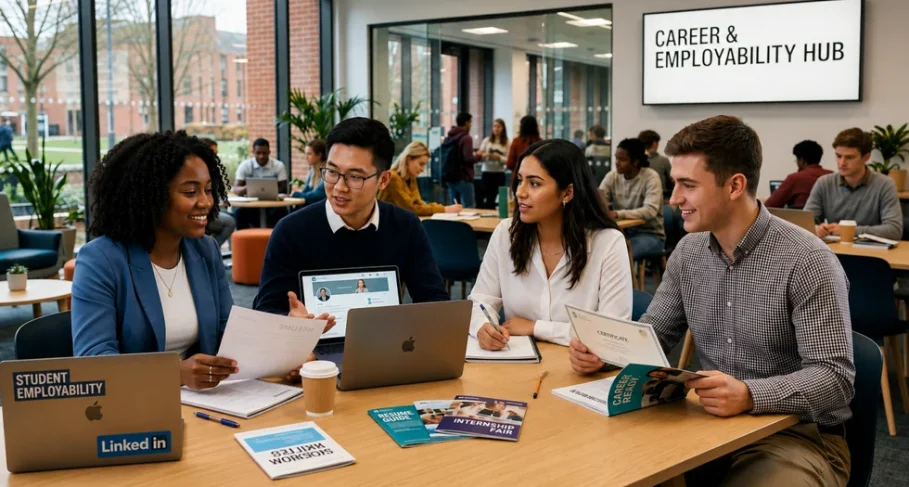
The same issue arises every year during placement season when strong academic performance does not necessarily lead to employment opportunities. Candidates who appear impressive on the resume but fail in face-to-face interviews, group discussions, and job-day scenarios are increasingly being turned down by recruiters. This gap is what student employability addresses, and understanding it is crucial to running a successful placement cell.
What Is Student Employability?
Student employability is the ability of students to secure a job, perform effectively in the workplace, and grow in their careers. It goes beyond academic scores and includes technical knowledge, communication, problem-solving, adaptability, and professional behaviour. For placement officers, employability means preparing students to meet real industry expectations before campus recruitment begins. Students who are job-ready improve placement success rates and enhance recruiter confidence in the institution. By focusing on employability throughout the academic journey, colleges can build stronger employer relationships and achieve better long-term placement outcomes.
Student Employability Key Skills You Need
The gaps are consistently highlighted by recruiters on campus, regardless of branch or degree. Placement officers are responsible for monitoring and reporting on:
Communication: The clarity of communication is crucial in situations such as interviews, group discussions and written evaluations, not just fluency in English.' The skill is typically the first to be sought after by recruiters during mock interviews, and should be scored as a distinct and coachable ability.
Problem-solving: How can a student effectively deal with an unfamiliar case study or technical question when faced with time constraints? Case-study rounds should be introduced early, as recruiters are closely monitoring the reasoning process and not just the final answer.
Teamwork: Teamwork is characterized by collaborative behavior, with a preference for listening and building on other people's ideas rather than dominating others. The occurrence of this characteristic is still prevalent in the shortlisting process, particularly in group discussions.
Time management: Managing time abiding by the deadlines for applications, assessments, and pre-placement documentation. Recruiters consider this to be a measure of workplace dependability, not just administrative expertise.
Adaptability: Comfort with new tools, interview formats, or schedule changes from recruiters is a key factor in adaptability. The same level of inflexibility that students experience during these shifts is being reported by them later on.
Benefits of Developing Student Employability Skills
| Benefits | What It Means | Why It Matters to Placement Officers |
|---|---|---|
| Higher offer-to-interview ratio | Students convert more interview opportunities into actual offers | Directly improves the placement percentage reported to management and prospective students |
| Stronger recruiter relationships | Companies return year after year when past hires perform well | Reduces the effort spent each season chasing new recruiters to replace ones who didn't return |
| Reduced offer drop-outs | Students understand workplace expectations, so fewer struggle and exit early | Protects the relationship with that recruiter for future hiring cycles |
| Better rankings and accreditation data | Structured skill programs generate concrete evidence for institutional audits | Strengthens NAAC, NBA, or NIRF submissions with documented proof, not just claims |
| Reduced dependency on placement officers post-hire | Employable students need less hand-holding once they join | Builds informal institutional reputation through alumni feedback and recruiter word-of-mouth |
Importance of Student Employability.
The results of last season's placement percentage are a leading indicator and not an occasional hindrance, while the predictability of job offers this season is determined by employability.
A batch with high employability skills can improve conversion rates by converting more interview calls into actual offers, which is beneficial for both the management and prospective students.
Companies encourage recruiters to maintain their relationships with colleges that have a history of successful recruitment, not just those who conducted well-prepared interviews.
This can protect against future placement seasons, as poor employment prospects may result in a successful season followed by fewer companies coming back next year.
Employability programs provide placement offices with tangible evidence to include in institutional audits and submissions, rather than just claims.
How to Build It.
Structured placement arrangements such as negotiating internship pipelines with hiring firms, rather than allowing students to handle the search for internships; tracking completion and feedback is central to the process.
Mock interviews and resume reviews are conducted on a schedule with scoring by career services, which is truly accountable. These reviews should not be isolated workshops before placement week.
Following each drive, recruiters collect structured feedback from company panels about candidate shortcomings and integrate it into the training plan for the next group.
Track student involvement in technical clubs, case competitions, and projects to ensure their participation is accurate, as these are frequently used as talking points during interviews and sought by recruiters. Additionally, they should be documented.
Conclusion
Student employability is no longer a minor component of placement work, but rather the determining factor for your institution's placement numbers. This is why it remains an essential factor. Employability is measured, tracked, and actively built by placement officers, which keeps recruiters from returning and offer numbers increasing. By integrating this information into your placement cell's schedule, rather than just recalling your pre-placement notes, you can differentiate between a successful and unsuccessful placement.
FAQ’s
What is student employability?
Student employability is a student's ability to secure a job, perform effectively in the workplace, and grow in their career. It includes technical skills, communication, problem-solving, adaptability, and professional behaviour beyond academic performance.
Why is student employability important for placement officers?
Student employability helps placement officers improve placement rates, strengthen recruiter relationships, reduce offer drop-outs, and build the institution's reputation with employers.
What Are the Biggest Employability Challenges Faced by Students?
Common challenges include poor communication skills, lack of practical experience, weak problem-solving ability, limited industry exposure, and inadequate interview preparation.
How Does Student Employability Impact Campus Placements?
Students with strong employability skills perform better in recruitment processes, resulting in higher interview-to-offer conversion rates, improved placement percentages, and increased recruiter satisfaction.
Is Student Employability More Important Than Academic Performance?
Academic performance remains important, but recruiters increasingly value students who can apply their knowledge, communicate effectively, and adapt to workplace challenges. Developing both leads to better placement outcomes.