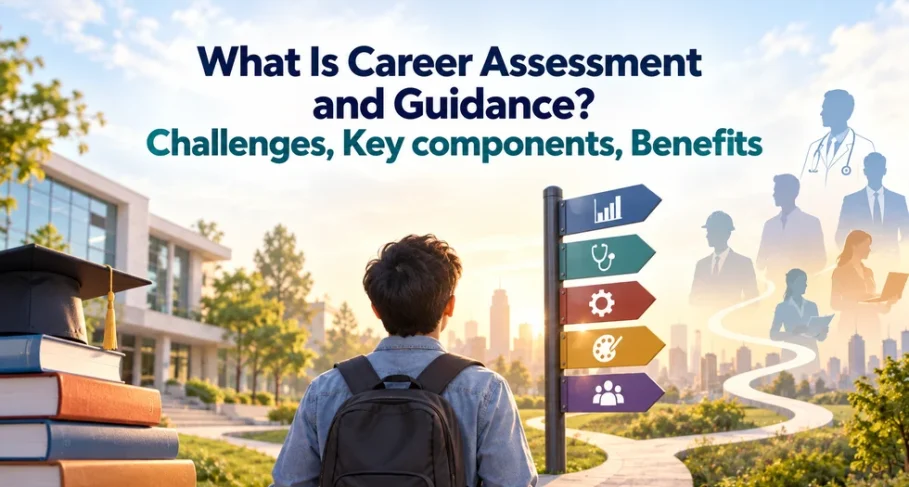
During each placement season, there is always a challenge faced by hundreds or thousands of students, each with their own strengths and interests and career aspirations, who are assigned to securing the best positions. If there is no structured way to explain what each student is genuinely suited for, guidance becomes generic, placements become a numbers game, and mismatches between role and student become the norm. The role of this is to provide career assessment and guidance. It is not just a support mechanism for placement officers, but also the foundation for the successful completion of placements.
What Is Career Assessment and Guidance?
Career assessment and guidance means figuring out a student's strengths, interests, and gaps, then pointing them toward roles that fit through tests, checks, and real conversations. For students, it replaces guesswork with confidence; for placement officers, it replaces one-size-fits-all training with structure. AI platforms now pull all this into one dashboard, cutting the manual work of reading every report.
Common Challenges in Career Assessment and Guidance
Even with the right platform, a few problems tend to show up again and again.
Low student engagement: Many students treat assessments as just another form to fill out, rushing through questions without really thinking about their answers — which means the recommendations that come out the other end aren't worth much either.
Data that doesn't reflect reality: If the skill mapping or job-market data behind a platform is outdated, it starts pointing students toward roles that don't actually exist anymore, or missing ones that do.
Staff who don't trust the tool: Some counselors and placement officers, used to doing this the old way for years, are skeptical of letting an algorithm weigh in on something as personal as a student's career and without buy-in from the people using it, even a great platform ends up ignored.
Reports nobody follows up on: It's easy to run an assessment, generate a report, and move to the next student. But if nobody sits down with them afterward to talk through what it actually means, the exercise doesn't change much.
Effectiveness of Career Assessment and Guidance
Career assessment and guidance deliver measurable outcomes that help placement officers improve student employability, placement readiness, and recruiter satisfaction.
| Key Outcome | Description | Impact on Placement Officers |
|---|---|---|
| Improved Student-Role Matching | Students are guided toward career opportunities that align with their skills, interests, and strengths. | Improves interview success rates and reduces role mismatches during placements. |
| Reduced Post-Placement Attrition | Students make informed career decisions based on career fit rather than external influences. | Increases offer-to-joining ratios and improves long-term placement success. |
| Stronger Recruiter Relationships | Recruiters receive candidates who are better aligned with job requirements and organisational expectations. | Builds recruiter trust and encourages repeat campus hiring. |
| Early Identification of Skill Gaps | Assessment insights identify competency gaps early, allowing students to upskill before placement season. | Helps placement officers plan targeted training and improve placement readiness. |
| Data-Driven Career Guidance | Career recommendations are supported by assessment data instead of assumptions or intuition. | Enables placement officers to make informed decisions and provide personalised career guidance. |
Key Components of an Assessment and Guidance Platform
Psychometric and aptitude testing : the baseline layer, measuring reasoning ability, personality, and work-style preferences that everything else builds on.
Skill mapping : a real inventory of what a student can actually do, checked against what target roles genuinely require.
A recommendation engine : usually AI-driven now that turns all that data into specific, ranked role suggestions instead of generic advice.
Gap analysis with a plan attached : not just flagging what's missing, but pairing it with a course, certification, or project to actually close it.
Benefits Career Assessment and Guidance for Placement Officers
| Key Benefit | Description | Benefit to Placement Officers |
|---|---|---|
| Better Student-Role Matching | Students are guided toward roles that align with their assessed strengths and interests, rather than applying everywhere and hoping. | Leads to stronger interview performance and fewer offers rejected mid-process. |
| Reduced Post-Placement Attrition | Guidance addresses the root cause of early exits students taking roles for the wrong reasons, like peer pressure or lack of alternatives. | Improves offer-to-joining ratios and long-term placement outcomes. |
| Stronger Recruiter Relationships | Well-matched candidates mean fewer complaints and mismatched hires from the companies that visit campus. | Builds recruiter trust, encouraging companies to return year after year. |
| Evidence-Based Guidance | Assessment data gives officers objective backing when advising students or discussing candidate fit with recruiters. | Replaces gut-feeling recommendations with data officers can actually stand behind. |
Conclusion
Career assessment and guidance isn't some extra add-on anymore it's become part of how placement cells actually get things done. Less guessing, better matches, recruiters who keep coming back. AI just makes it possible to do this for every single student instead of a lucky few, giving officers real data to back up their calls instead of gut feel. And at the end of the day, the institutions that really win aren't the ones with the longest list of recruiters they're the ones whose students already know they belong in that interview room before they even sit down.
FAQ’s
What Is Career Assessment and Guidance?
Career Assessment and Guidance is the process of evaluating a student's skills, interests, personality, aptitude, and career aspirations to recommend suitable career paths. It helps students make informed career decisions while enabling placement officers to improve placement outcomes through data-driven guidance.
Why Is Career Assessment and Guidance Important for Placement Officers?
Career assessment helps placement officers identify students' strengths, skill gaps, and career readiness. This enables them to provide personalised guidance, improve student-role matching, and increase campus placement success.
How Does Career Assessment and Guidance Work?
It evaluates a student's skills, aptitude, personality, and interests through assessments to identify strengths, skill gaps, and suitable career paths. AI-powered platforms provide personalised recommendations based on these insights.
What Is the Impact of Career Assessment and Guidance?
Career Assessment and Guidance improves placement readiness, enhances student-role matching, reduces skill gaps, and helps placement officers achieve better placement outcomes and recruiter satisfaction.
What Is the Future of Career Assessment and Guidance?
The future of Career Assessment and Guidance lies in AI-driven insights, predictive analytics, and personalised career recommendations, helping placement officers prepare students for evolving industry demands and future job roles.