
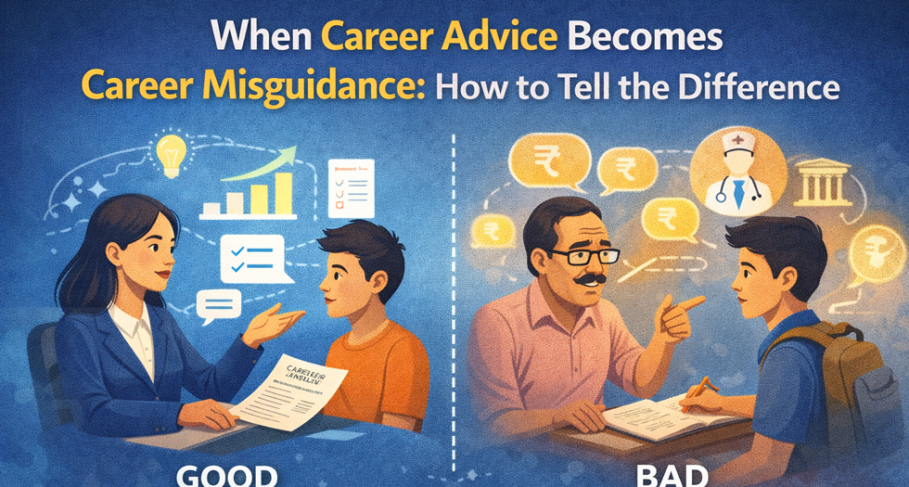
India’s education system trains students to clear exams, not to navigate careers. But does the nation really suffer from a guidance deficit or a guidance coherence crisis?
The Crisis Nobody’s Talking About
In India’s bustling classrooms and coaching centers, a quiet catastrophe unfolds every day. A student sits across from a well-meaning parent or teacher and makes a decision that will define the next two decades of their life, based on information so incomplete it borders on reckless.
The statistics are brutal. 90% of Indian students choose careers blindly. Only 10% receive professional career counseling. Yet 86% of graduates report regret or lack clarity about their work. Most shocking of all: graduate unemployment stands at 35%, higher than illiterate unemployment at 3.4%. This isn’t a career guidance deficit. It’s a career coherence crisis, a systemic breakdown where education and employment operate in parallel universes, rarely intersecting, never aligning. Misguidance typically manifests in five ways:
Advice based on Familiarity and Not Aptitude
The first source of misguided advice is from people you trust: parents, older siblings, and the “successful relative.” The advice may be well-intended, but it is profoundly flawed.
Societal Pressure Disguised as Wisdom
“Beta, just do engineering or medicine or IAS. These are secure paths.” This advice was relevant in 1990. It’s career suicide in 2026. The “Holy Trinity” exists by virtue of being understood as prestigious and a story of stability. Conversely, new frontiers such as AI, climate tech, renewables, digital content, UX, and data analytics remain unexplored not because they are less valid, but simply because they are unknown.
Information Without Interpretation
The internet has democratised access to career information. A student scrolls through career websites, finds 50 job descriptions, and is no closer to clarity, often more confused.
Real misguidance happens when information arrives without expert interpretation. Nobody helps the student understand the hidden skill requirements, the actual day-to-day reality, the personality fit, or the market trajectory of a given role.
One-Time Advice vs. Ongoing Support
“Choose your stream after 10th, then figure out college, then get a job.” Instead of viewing a career as a continuous process, this linear perspective views it as a single choice.
Real career planning is iterative. A student’s interests evolve. Market demands shift. The world transforms (as we saw during COVID). Yet the guidance ecosystem treats career selection as a box to check, not a process to nurture. Most career “counseling” in Indian schools amounts to a single session with an overburdened teacher playing counselor, if it happens at all. The good guidance is continuous, adaptive, and supported by the trained professionals, while misguidance is transactional, one-off, and too often delivered by the unqualified.
Ignoring the Complete Picture
A good counselor understands that career choice isn’t purely about aptitude. It intersects with financial reality (can your family support this education?) and geographic constraints, does your family support this choice? Will this role align with your well-being? And does this career serve what matters to you? Misguidance comes from advice that isolates one factor, usually academic performance, and treats it as the deciding variable.
The Infrastructure Catastrophe
India needs 1.4 million career counselors to serve 315 million students at international standards. It has approximately 500. This means one counselor for every 630,000 students, against a recommended ratio of 1:250. The math is stark: India is 2,500 times under-resourced.
The National Education Policy 2020 mandates that every school provide career guidance starting from Grade 6. Yet 9 out of 10 school leaders have no idea how to implement it. The policy exists on paper; the infrastructure doesn’t exist in classrooms.
The Credential Gap
Unlike mathematics or science teachers, career counselors have no standardised national certification in India. This means anyone can call themselves a “career advisor,” from genuinely trained professionals to someone who read a book once. The consequence: you can’t distinguish expert from charlatan. Parents in need of assistance lack a framework for assessing reliability.
Red Flags: How to Identify Bad Advice Before It’s Too Late
As a parent or student, keep an eye out for these red flags that indicate you’re getting false advice instead of real career support: advice that works for everyone, No psychometric evaluation, prioritising prestige over fit, out-of-date data, pressure to make a decision right away, and absence of backup plans.
The Bottom Line
Career misguidance isn’t a personal failing; it’s a systemic failure. When 90% of students choose blindly, the problem isn’t the students; it’s the absence of coherent guidance infrastructure. But the tide is turning. NEP 2020 is mandating change. Thought leaders are proving that structured career guidance transforms outcomes. Technology is democratizing access through AI-powered assessments and online counseling. The real question isn’t whether India can create better career guidance. It’s whether India will.
Every student, whether from a metro city or rural district, whether privileged or underprivileged, whether academically conventional or creatively unique, deserves the clarity to choose their path, not stumble into it. That’s not a luxury. In a nation racing toward 2047, it’s a necessity.