
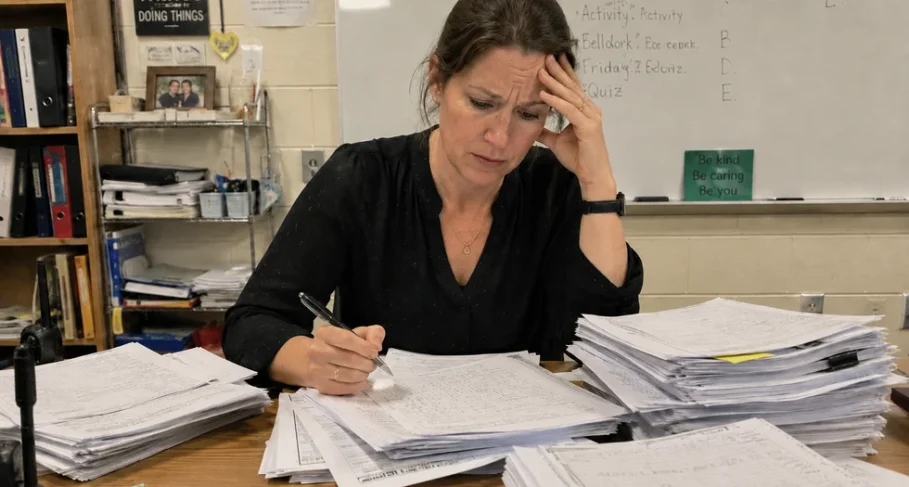
Marking is the part of a teacher's job that takes the most time and teaches them the least. The 2026 CBSE on-screen marking rollout showed what happens when technology is aimed at the wrong part of that problem.
Consider what a school teacher is actually accountable for.
Every school needs results, records and reports, and it needs them on time. Parents want to know why their child scored what they scored, and they want that answer by evening. Students want attention, one at a time. All three are reasonable asks, and all three land on the same person.
The teacher absorbs all of it, then carries home a bag of answer sheets. Nobody in this arrangement is responsible for protecting the teacher's time. It is treated as an unlimited input, so it gets spent on whatever happens to be loudest that week.
Why Evaluation Eats More of the Week Than Teaching Does
A study by the National Institute of Educational Planning and Administration found that Indian teachers spend roughly 19 percent of their working time on teaching and teaching-related activity. Over 42 percent goes to non-teaching core work, and the balance to school management and department tasks. That is the ratio we have quietly accepted.
Accountability Initiative's time-use study with 200 Delhi government school teachers found 93 percent saying paperwork ate a large share of the day, much of it because the same records were kept twice, on paper and on a computer. The National Achievement Survey of 2021 found 65 percent of teachers overloaded.
Evaluation sits in the middle of this. A 2025 Learnosity survey put marking at 9.9 hours a week, with 95 percent of teachers taking it home. But what matters is not only how many hours evaluation takes. It is what kind of hours they are.
A teacher reading the first twenty scripts of a paper is learning something. By the two hundredth, they are doing data entry. Totalling marks. Transcribing them onto award lists. Cross-checking roll numbers. Filling report formats someone in the office designed. None of it makes a person better at teaching.
Dylan Wiliam wrote that "assessment is the bridge between teaching and learning." The bridge is worth building. But most of what teachers do under the heading of assessment is clerical work wearing the costume of academic rigour, and we have never separated the two.
Why CBSE's On-Screen Marking Failed the Teachers It Was Built For
On 9 February 2026, CBSE mandated on-screen marking for Class 12 answer books. Around 98.66 lakh sheets were scanned and sent to roughly 70,000 evaluators. Trouble started with the examiners, before a single result was out. Teachers said one week of training was nowhere near enough. The software demanded strict colour codes for each category of error, and one wrong action could undo an entire answer. An examiner in Pune told Careers360 that adapting to it was "beyond irritating". The Delhi Government School Teachers' Association asked the board to defer the rollout by a session but the board still went ahead.
Results came on 13 May and the pass percentage fell from 88.39 to 85.2. Then the complaints. Blurred scans. Missing pages. Answers left unmarked. Students receiving another student's script. Over four lakh students applied for scanned copies of their answer books, far above the previous year, which measures trust more accurately than it measures error. The chairman and secretary were moved out within weeks.
Despite the multistep OSM procedure, CBSE failed to meet expectations. They claimed evaluation was clear, but many answer sheets were blurred, affecting proper checking. Many students even wrote correct answers yet received low marks.@cbseindia29 #CBSE #OSM pic.twitter.com/eJxcPrtYk1
— Lakshyaa (@Lakshya59025641) May 21, 2026
CBSE did not fail because it used technology. It failed because it changed the medium and left the work untouched. The teacher got a harder interface, the same deadline, and new ways to lose an hour to a misclick. Digitisation was applied to the layer that hurt least.
What a Working Marking System Actually Does
Boards elsewhere have run on-screen marking for two decades without a controversy like this. England's exam regulator, Ofqual, publishes exactly how the machinery works.
No single teacher gets a whole answer sheet. The paper is broken up question by question and sent to different examiners, so no student's result rests on one person's standard. Names and roll numbers are hidden before marking begins.
Senior examiners then mark a small set of answers themselves and agree on the correct score for each. These are called seeds. Copies of them are quietly mixed into every examiner's pile, roughly one in twenty, and nobody knows which one is a seed. Score a seed too far from the agreed mark and the system stops you until you are marking correctly again. An examiner who is steadily a little too generous or too harsh gets all their scores adjusted by that gap. All of it happens while the marking is going on, not in a review afterwards.
That is what you build when marking is treated as a measurement process rather than a chore pushed down onto teachers. CBSE bought the screen and skipped the measurement.
Put AI on the Clerical Work, Not on the Judgement
There is a version of this argument that ends with "let the machine mark the papers." That version repeats CBSE's mistake facing the other direction. It automates the part of evaluation that needs a person and leaves the clerical part where it was.
The useful application is narrower and more boring. Several platforms now read a scanned answer sheet, segment it question by question, match each response against the marking scheme and hand the teacher a draft score with the reasoning attached. What that takes off the teacher's plate, in rough order of how much time it currently eats:
- Producing the first mark. The teacher opens a screen holding the proposed score and the rubric side by side, and confirms or changes it, instead of starting from a blank page on every answer.
- Totalling and transcription. Marks add themselves and carry through to the award list, which is where most clerical errors enter the system.
- Catching what was missed. Skipped and unmarked answers get flagged before submission rather than surfacing after results.
- Checking consistency. Whether two teachers of the same subject are marking to the same standard becomes measurable instead of assumed.
The practical test is whether a teacher spends their evaluation hours deciding or transcribing. A tool that leaves that ratio unchanged is the CBSE mistake in a nicer interface.
Two things separate a tool that helps from one that just moves the work around. The first is whether it reads handwriting at all, since most automated marking was built for typed text or multiple choice, and a CBSE answer book is neither. The second is whether it admits what it does not know. A system that flags its low-confidence answers and sends the teacher to those specifically is useful. One that returns a confident number for every answer has moved the guesswork somewhere the teacher cannot see it.
The evidence supports this. A randomised trial across four undergraduate courses, covering 271 students and 3,080 short answers, found AI-assisted grading closely reproduced what an instructor would do with the time of a small-class teacher. The interesting result is not the model's accuracy. It is that the teacher stays in the loop while doing far less of the work that never needed a teacher.
The line is clear enough. When a student understood the concept but lost marks to clumsy phrasing, a teacher should catch it. When half a class makes the identical error, that is a teaching problem, not a marking problem. Today that judgement is the first thing squeezed out, because deadlines reward speed and nothing rewards insight.
Fixing Evaluation Pays Off for Teachers, Principals and Parents
The case for fixing evaluation is usually made on the teacher's behalf. But the teacher is not the only one who gains from it:
- Teachers get back the hours that taught them nothing. Four hours reviewing draft marks instead of eleven hours writing them from scratch returns seven hours to the chapter that did not land, or to the students who have quietly stopped asking questions.
- Principals get a view of quality before the term ends. Marking captured question by question shows which chapters went badly across sections, and whether two teachers of the same subject are marking to the same standard.
- Parents get a reason instead of a number. Hand a parent a breakdown of which questions their child lost marks on and the argument about the total tends to end.
- Students get feedback while the paper is still fresh. A correction two days later teaches more than the same one two weeks later.
Conclusion
Indian education treats teacher time as free. It is the input we assume is infinite, so we keep adding to it. Election duty. Census work. Data entry in triplicate. A marking season that runs on evenings and weekends. Then we survey teachers, find 65 percent overloaded, and add something else the next year.
The 2026 failure was not caused by digitisation. It was caused by digitising the wrong layer, at national scale, with no pilot and no check capable of catching its own mistakes. The lesson is not that boards should retreat to paper. It is that anything touching evaluation should be judged on two questions. Does it give the teacher time back? Does it give the student a mark they can trust? CBSE's version failed both, and whatever gets built next should be measured against both before nine million scripts are riding on it.