This website stores cookies on your computer. These cookies are used to improve your website experience and provide more personalized services to you, both on this website and through other media.
Accept
EdTechReviewEdTechReview
  • News
  • Trends
  • Insight
  • eLearning
  • Research
  • Dictionary
  • EdTech Voices
  • More
    • Data & Statistics
    • Reviews
    • AWS for Education
    • Events

    Resources

    • Infographics
    • Reports & Case Studies
    • Videos
    • Books
    • Webinar

    Needs

    • 1:1 Learning
    • 21st Century Education
    • 21st Century Leadership
    • 21st Century Learning
    • 21st Century Teaching
    • 3D Printing
    • More Tags

    For

    • Students
    • Teachers/Educators
    • Administrators
    • Entrepreneurs/Startups
    • Govt. Officials/Policymakers
    • Parents
Explore
Search
Contribute
  • Submit A Post
  • EdTech Trainers and Consultants
  • Your Campus EdTech
  • Your EdTech Product
  • Your Feedback
  • Your Love for Us
  • EdTech Product Reviews
ETR Resources
  • About
  • Mission/Vision
  • Team
  • Services
  • Testimonials
  • Authors
  • Sponsor
  • Partner
  • Advertise
  • Our Clients
  • Media Kit
  • Press Release
  • FAQ’S
Reading: Rapid E-Learning Lesson Development
Aa
EdTechReviewEdTechReview
Aa
Search
  • News
  • Trends
  • Insight
  • eLearning
  • Reviews
  • Dictionary
  • EdTech Voices
  • Data & Statistics
  • Research
  • AWS for Education
  • Events
  • EdTech Voices
  • Tags
  • About
  • FAQ’S
  • Our Clients
  • Partner
Follow US
Home > Trend & Insight > Insight > Rapid E-Learning Lesson Development
Insight

Rapid E-Learning Lesson Development

Sudha
Sudha Published Oct 24, 2017
Share
4 Min Read
Rapid E-Learning Lesson Development
SHARE

What is Rapid eLearning?

AdvertisementWhy this Ad?

Design for Rapid eLearning

Learning is complete and focused when it gives 360 degree analysis.  Traditional classrooms and teaching fail to achieve this type of learning. Technology based lessons solves this problem to some extent.  The major flaw in such designs is when the content is limited to more technical aspects rather than the actual consideration of a classroom.  A typical classroom consists of different types of learners and learning experiences. Learners are dynamic and require challenging environment, which change often. Moreover, similarity in the flow of lessons, technically leads to boredom and neglect in the learning process.  Delivery also becomes a routine for the teacher.  Learning takes a back seat with the learner becoming passive. 

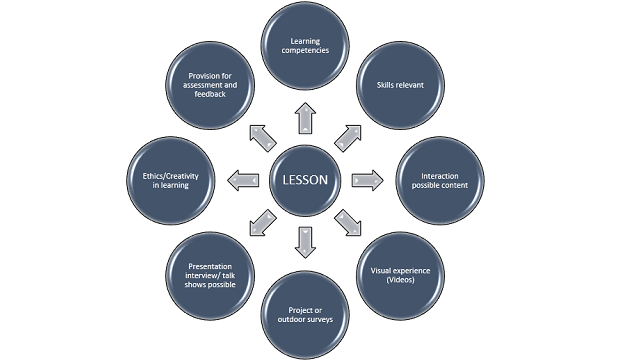
To convert a passive lesson to active one, one needs to check into the design aspect of the lesson.  Lesson design, generally considers – recall, teaching and assessment.  However, when lessons are designed embedding features of media, global problems, puzzles, creativity, original tracks and videos etc., can drive out passiveness to bring activeness in the learning.  In order to do so, the lesson planning should check the following aspects:

  1.       Age group for lesson implementation
  2.       Curriculum boundaries
  3.       Societal concerns
  4.       Budget possibilities
  5.       Training difficulties

With a proper curriculum and set objectives design of such lesson can be done with simple technologies. Designing a lesson with technology may require involvement of multiple persons and it is time consuming as it moves from one department to another.  This scenario can be rectified with the incorporation of Instructional designers, who can identify the essence of the lesson in the flavours required for its design. Teachers who are tech savvy and focus on wider aspects of learning are most suited for becoming instructional designers.  This type of lesson development require less time and the focus is not specifically on delivery of the content but on the competencies to be developed.  Based on the competency design for the lesson, assessment plan can be incorporated along with time management. 

Assessment strategy in classroom scenario should mainly focus on learning rather than learned.  ‘Clickers’ or online forums are best suited for such work.  Teacher can put forth a probing question which involves student participation as ideas online.  The pros and cons of such idea collected can be discussed in a larger forum i.e., in the classroom.  This gives the student to look at the question from multiple perspectives also a chance to understand others view point. 

Story development with lesson flow can also add interest to the lesson. Stories based on mythological, famous cartoons or movies can be opted for the same.  Connectivity to the taught brings more interest and contact to the lesson.

Ethical development among students has long remained a major issue with the use of technology.  Case studies analysis, from anywhere in the world can be brought into the classroom through concepts involved in the lesson to collect feedback and allow students to ponder into issues safely.  Examples of traffic congestion, natural calamities, deforestation etc., can be provided as live feed to classrooms to provide a touch of reality to the situations, which further develops sustainability among the future world citizens.  

TAGGED: E-Learning, Lesson Planning, Online Education, Teachers/Educators
Share This Article
Facebook Twitter Whatsapp Whatsapp LinkedIn Reddit Telegram Email Copy Link
Previous Article The Power of Self Directed Learning in the Workplace The Power of Self Directed Learning in the Workplace
Next Article Engage In Global Education With Empatico Engage In Global Education With Empatico
AdvertisementWhy this Ad?

Latest EdTech News To Your Inbox

Stay Connected

AdvertisementWhy this Ad?

Latest EdTech News To Your Inbox

Stay Connected

AdvertisementWhy this Ad?

You Might Also Like

Top 10 Montessori Teacher Training MTT Courses in India 2026-27 Edition
News

Top 10 Montessori Teacher Training (MTT) Courses in India: 2026-27 Edition

Sep 9, 2026
Schools Went Digital Why Is Student Transportation Still So Fragmented
Insight

Schools Went Digital. Why Is Student Transportation Still So Fragmented?

Sep 8, 2026
Top 10 Early Childhood Care and Education ECCE Courses for Teachers in India 2026-27
News

Top 10 Early Childhood Care and Education (ECCE) Courses for Teachers in India 2026-27

Sep 5, 2026
How to Build Educational Apps That Drive Real Teacher and Student Adoption in 2026
Insight

How to Build Educational Apps That Drive Real Teacher and Student Adoption in 2026

Sep 1, 2026
Why AI Lesson Planning Tools Are Only Solving Half the Problem
Insight

Why AI Lesson Planning Tools Are Only Solving Half the Problem

Aug 31, 2026
How Learning Gaps Can Be Identified Before Assessment AI-Powered Insights
Research

How Learning Gaps Can Be Identified Before Assessment (AI-Powered Insights)

Aug 28, 2026
The Future Belongs to Children Who Can Change Their Minds
Insight

The Future Belongs to Children Who Can Change Their Minds

Aug 26, 2026
Were Teaching Children for Jobs That Wont Exist Heres What We Should Teach Instead
Insight

We’re Teaching Children for Jobs That Won’t Exist, Here’s What We Should Teach Instead

Aug 15, 2026
Show More
EdTechReviewEdTechReview

H433, 2nd Floor, Vikaspuri, New Delhi, India, 110018
Phone: 011 41321030

Follow US

Copyright © EdTechReview. All Rights Reserved.

  • Home
  • Advertise
  • Event Associations
  • Press Release
  • About
  • Services
  • Contribute
  • News
  • Trend & Insight
  • Data & Statistics
  • eLearning
  • Reviews
  • Research
  • EdTech Voices
  • Dictionary
  • Tags
  • Resources
  • Events
  • Courses
  • EdTech Product for Review
  • Sponsored/Paid Post Service
  • Our Clients
  • FAQ’S
  • Contact Us
  • Important Links
  • Sitemap
  • Terms of Use
  • Privacy Policy
newsletter
Join 100K+ subscribers!

Subscribe to our weekly newsletter that brings the latest EdTech news, trends, insights, reports, interviews, etc. for educators, school leaders, entrepreneurs, investors, & others.

loader
Zero spam, Unsubscribe at any time.
Go to mobile version
Welcome Back!

Sign in to your account

Lost your password?