Artificial intelligence is reshaping nearly every corner of education. While a lot of attention has gone to AI tutors for math and science, another quiet revolution is happening in language learning. Around the world, new AI tools are changing how people practice, test, and improve their language skills.
For decades, preparing for language exams meant working through textbooks, memorizing vocabulary lists, and waiting for teachers to grade essays or speaking exercises. Progress was often slow, and feedback could take days or even weeks.
Today, that process is starting to look very different. AI-powered language platforms can evaluate a learner’s writing, pronunciation, grammar, and fluency in seconds. Instead of waiting for a teacher, students receive immediate feedback and can quickly see where they need to improve. The result is a much faster learning loop, and for many learners, a far more engaging experience.
From One-Size-Fits-All to Adaptive Learning
One of the biggest advantages of modern education technology is personalization. Traditional language courses, like Duolingo, usually follow the same curriculum for everyone. But learners rarely struggle with the same things. Some students may need help with grammar, others with pronunciation or writing structure.
AI platforms can analyze a learner’s performance in real time and adjust the practice accordingly. If someone repeatedly struggles with verb conjugation or pronunciation, the system can automatically generate exercises targeting those weaknesses.
This kind of adaptive learning is particularly valuable for people preparing for high-stakes language exams, tests that can determine whether someone gets admitted to a university or qualifies for immigration. Instead of simply taking occasional practice exams, learners can continuously test themselves and track their improvement over time.
Making Practice Feel Like the Real Exam
Another challenge in language learning has always been recreating the pressure and format of real exams. Most practice materials don’t fully capture the experience of the actual test. And evaluating open-ended responses, like speaking or essay writing,has traditionally required human examiners.
Advances in natural language processing and speech recognition are beginning to close that gap. AI systems can now analyze spoken responses, evaluate pronunciation, measure fluency, and score written answers based on grammar, vocabulary, and coherence.
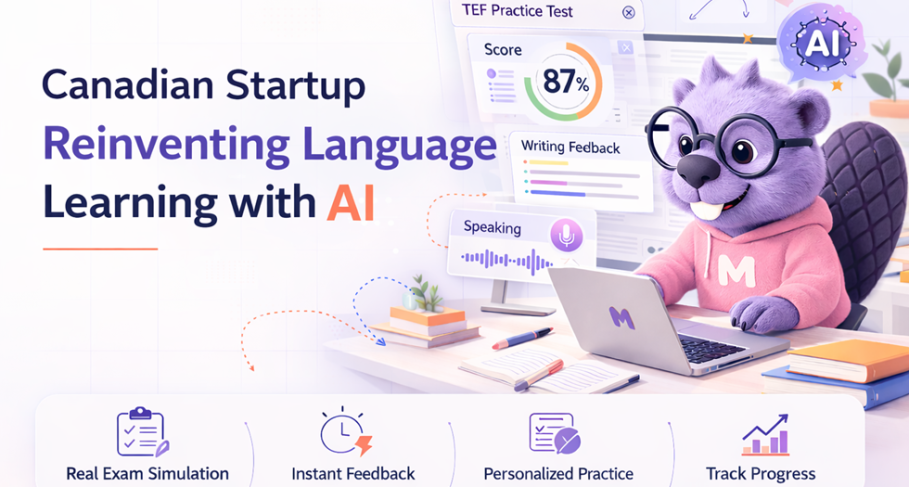
That means learners can simulate real exam conditions while receiving detailed feedback instantly. One example of this new generation of tools is Mocko.ai, a Canada-based startup building an AI platform for language exam preparation. The platform allows users to take full-length mock exams that closely replicate the format and timing of official language tests.
After completing a section, users receive immediate analysis of their performance, including feedback on writing quality, pronunciation, and overall fluency. Instead of waiting days for results, learners can immediately see where they stand and start improving.
A Focus on Real-World Exams
AI tools are becoming especially valuable when they are built around specific exams. Many language tests have unique structures, scoring criteria, and types of questions. Preparing effectively requires familiarity with the exact format of the exam.
For example, immigrants to Canada often need to demonstrate French proficiency through tests such as TEF Canada or TCF Canada. Each exam has its own sections, timing rules, and scoring system.
Platforms like Mocko.ai focus specifically on these tests, allowing learners to practice in environments that mirror the real exam. By replicating the structure and scoring criteria, the platform helps candidates better understand their readiness before they sit for the official test.
The Next Phase of AI Language Learning
As AI models continue to improve, language learning platforms are likely to become even more interactive. Future systems may include conversational AI that can hold unscripted discussions with learners, evaluating their ability to communicate naturally rather than simply answering predefined questions. That could make practice sessions feel much closer to real conversations.
At the same time, the data generated by millions of practice sessions could offer new insights into how people learn languages, helping educators design better teaching methods and learning tools.
What’s clear is that language education is entering a new phase. AI isn’t replacing teachers, but it is changing how learners practice and prepare.
And for anyone facing a high-stakes language exam, the ability to receive instant, personalized feedback might be one of the biggest advantages technology has brought to education in years.
How is Mocko.ai reinventing language learning with AI?
Mocko.ai uses advanced natural language processing to provide an “instant feedback loop.” Unlike traditional methods, it evaluates a learner’s pronunciation, grammar, and fluency in seconds, specifically for high-stakes exams like TEF Canada.
Can AI platforms help with TEF Canada and TCF Canada preparation?
Yes, specialized platforms like Mocko.ai are built to mirror the exact structure and scoring criteria of TEF and TCF Canada, allowing immigrants to practice in a simulated exam environment before the official test.
What is the benefit of adaptive learning in AI language tools?
Adaptive learning allows the AI to analyze a student’s specific weaknesses—such as verb conjugation or sentence structure—and automatically generate targeted exercises to fix those gaps, making study time more efficient.
Why is instant feedback important for language learners?
Immediate feedback allows learners to correct mistakes in real-time, preventing the reinforcement of bad habits and significantly speeding up the time it takes to reach proficiency.