
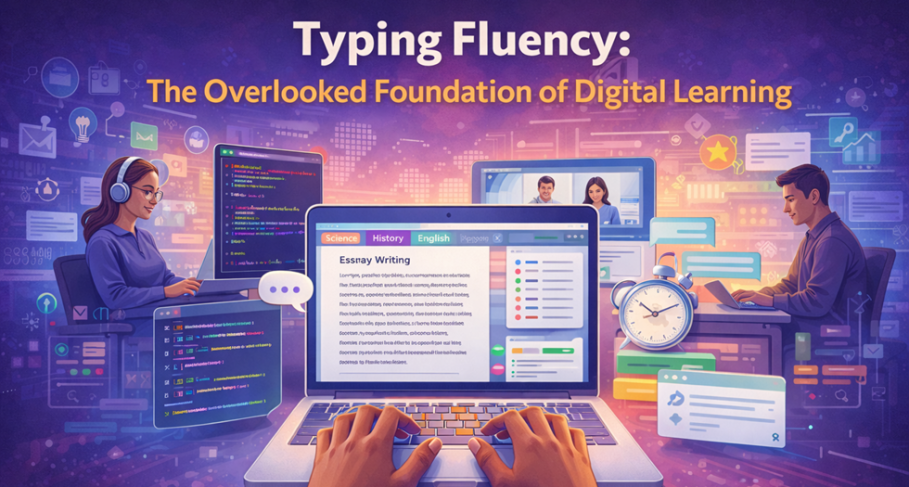
Across the global education sector, discussions about educational technology often focus on artificial intelligence, immersive learning environments, and adaptive learning systems. These innovations are reshaping how students learn and how teachers deliver instruction. Yet beneath many of these developments lies a fundamental skill that rarely receives significant attention: typing fluency.
While voice interfaces and automation tools continue to evolve, keyboard-based input remains one of the most common ways people interact with digital systems. Students write assignments, conduct research, collaborate in shared documents, communicate with teachers, and engage with learning platforms primarily through typed input. For this reason, typing proficiency plays a larger role in digital learning outcomes than is often recognized.
Typing as a Core Digital Literacy Skill
Digital literacy is generally defined as the ability to access, evaluate, create, and communicate information using digital technologies. However, a practical component of digital literacy is how efficiently students can interact with those technologies.
Typing speed and accuracy influence how quickly learners can translate ideas into written form. When students type slowly, the effort of locating keys and correcting errors can interrupt the thinking process involved in writing, reasoning, and problem-solving. This interruption can create friction in learning activities that depend heavily on written communication.
In contrast, when typing becomes more automatic, students are able to focus on their ideas rather than the mechanics of the keyboard. Once muscle memory develops, writing and thinking can occur more fluidly, allowing learners to maintain concentration on the content they want to produce.
Understanding Typing Performance
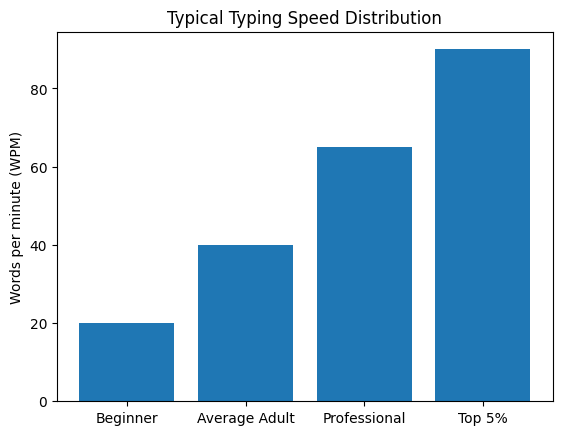
Typing performance varies widely depending on experience and exposure to computers. In general, beginners tend to type at slower speeds, often between 15 and 25 words per minute. Average adult typing speeds are typically estimated around 35 to 45 words per minute, while individuals who regularly work with computers may reach speeds of 60 words per minute or higher.
Accuracy is just as important as speed. Frequent typing errors require time for correction, which can slow overall productivity and interrupt the writing process. Maintaining a high level of accuracy reduces the need for revisions and helps sustain writing flow during longer tasks.
These patterns reveal an interesting gap in many educational systems. Although students increasingly rely on digital devices for learning activities, structured instruction in typing is not always included in modern curricula.
Typing and Cognitive Load
Learning science provides another perspective on the importance of typing proficiency. Cognitive load refers to the amount of mental effort required to perform a task.
When students are still searching for keys on the keyboard, their attention must be divided between generating ideas and managing the mechanics of typing. This split attention can make writing tasks more demanding and may reduce the quality or clarity of written work.
Touch typing—the ability to type without looking at the keyboard—reduces this burden significantly. As typing movements become automated through practice, fewer mental resources are required for the mechanical aspects of typing. This allows the brain to focus more fully on higher-level processes such as organizing ideas, analyzing information, and expressing complex thoughts.
The Continued Importance of Typing in Modern Education
Despite the rapid development of new educational technologies, many core learning activities remain text-based. Students regularly:
- Write essays, reports, and assignments
- Participate in online discussions or collaborative documents
- Complete digital assessments
- Conduct research and summarize information
- Work with coding or structured responses in technical subjects
Even many emerging digital tools rely on written interaction, requiring users to enter prompts, questions, or instructions through a keyboard. As a result, typing continues to function as a primary interface between learners and digital systems.
When students lack typing fluency, their interaction with digital tools can become slower and more effortful, which may reduce efficiency during learning activities.
Approaches to Developing Typing Skills
Typing is a practical skill that can improve with regular practice. Educational approaches that focus on consistent and structured training tend to be most effective.
Several practices are commonly associated with successful skill development:
Structured instruction: Students learn correct finger placement and keyboard orientation using established typing techniques.
Short, regular practice sessions: Daily practice periods of 10 to 15 minutes can gradually build both speed and accuracy.
Feedback and progress tracking: Monitoring typing speed and accuracy allows learners to see improvements over time.
Interactive learning activities: Practice exercises that involve challenges or interactive tasks can help maintain engagement, particularly among younger students.
Because these activities require relatively little time, typing practice can be integrated into broader digital literacy initiatives without significantly affecting curriculum schedules.
Looking Ahead
As digital technologies continue to shape education, foundational interaction skills will remain important. Artificial intelligence, collaborative platforms, and cloud-based learning environments are transforming how knowledge is created and shared. However, the effectiveness with which learners engage with these systems still depends on practical input skills.
Typing fluency is one of those foundational abilities. When students can type efficiently and accurately, they encounter fewer barriers when expressing ideas, completing assignments, and interacting with digital tools.
By recognizing typing proficiency as part of digital literacy, educators can help students navigate modern learning environments with greater confidence and efficiency. In an increasingly digital world, the ability to type effectively remains a valuable skill for both education and future professional life.