
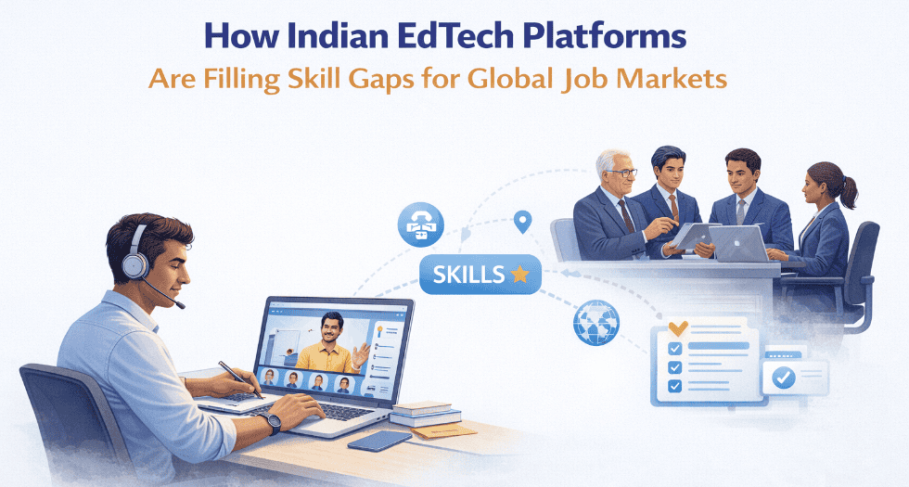
The world’s labor markets are currently experiencing a structural shift in their skill development, validation, and application processes. By 2026, employers in the technology, healthcare, finance, logistics, and professional sectors are facing skill gaps despite an increase in the number of degree-holding individuals. This has led to a gap between the output of the education system and the needs of the labor market. The Indian EdTech industry is being positioned at the forefront of this shift, not as a substitute for higher education but as a system that converts labor market demand into scalable learning paths.
Skill Shortages, Not Talent Shortages, Are Driving Change
According to empirical data on the workforce, more than 40 percent of employers across the globe face difficulties in filling jobs because of a lack of skills in candidates rather than a lack of candidates. The most rapidly increasing skill gaps are in digital skills, analytical thinking, cross-functional problem-solving, and job-execution skills. The conventional education paradigm, which was based on a long-term curriculum and non-changing structures of qualifications, has had trouble keeping up with the required pace of the global job market. Indian EdTech companies have stepped into this arena with a focus on modularity, speed, and alignment with employer-defined skills.
Scale and Employability Are Being Addressed Simultaneously
One of the most defining features of the evolution of the Indian EdTech industry has been its approach to scale. India churns out millions of graduates every year, but the employability rates are still unbalanced on a global scale. The EdTech industry has capitalized on this scale advantage by developing learning infrastructure that is standardized and flexible, with a focus on skill development rather than degree acquisition. Learning programs are being increasingly aligned with job roles and industry standards, so that learners can develop specific skills in a shorter period of time. The data on learning outcomes shows that learners who complete EdTech programs aligned with a job role have better job readiness scores than those who don’t.
Verifiable Skill Signals Are Improving Global Hiring Confidence
The global job market also requires consistency and verifiability. Employers recruiting globally are faced with challenges in assessing the readiness of candidates because of differences in education structures and grading scales. Indian EdTech companies have addressed this issue by adopting learning models that are assessment-driven, where the development of skills is constantly assessed through application exercises, simulations, and performance assessments. The result is a skill signal that is verifiable and eliminates ambiguity for global employers. The adoption of this model has been linked to enhanced hiring efficiency and reduced early turnover in remote teams.
Accessibility Is Expanding for the Working Professional
Another domain where Indian EdTech companies are bridging the divide is in terms of accessibility. The global upskilling requirement is increasingly driven by professionals who cannot leave the workforce to pursue higher education. The flexible and online-first approach enables professionals to access high-demand skills without having to leave the workforce. The data on participation rates reflects robust adoption among early- and mid-career professionals looking to move into global roles.
Applied Learning Is Driving Employer Acceptance
The global applicability of Indian EdTech has also been influenced by its emphasis on applied learning. Unlike conventional education, which focuses on theoretical knowledge, EdTech courses are increasingly incorporating real-world projects, case studies, and tool-based learning. These aspects reflect real-world work environments, allowing students to not only gain knowledge but also the confidence to execute it. Employer feedback data has consistently shown applied learning exposure as an important differentiator while assessing candidates from non-traditional learning backgrounds.
Policy and Economic Shifts Are Accelerating Skills-Based Hiring
Changes in policies and the economy have also fueled this convergence. Employers across the globe are rethinking the need for degrees in favor of skills demonstration, especially in sectors impacted by automation and the pace of technological change. With degree inflation becoming a hindrance rather than a benefit, EdTech platforms offering role-specific skills are gaining acceptance as alternative talent sources. This is particularly evident in the global job market, where skills portability and the ability to be immediately productive take precedence over degree hierarchies.
Quality and Governance Will Determine Long-Term Impact
However, the success of EdTech in addressing the skill gaps in the global workforce is contingent on quality and governance. Not all platforms are working within proven frameworks or employer-centric standards. The most effective platforms are those that are regularly updating their curricula to reflect labor market trends, incorporating rigor in assessment, and keeping their offerings aligned with shifting job roles. Feedback loops between learners, platforms, and employers, fueled by data insights, are essential to keeping offerings relevant at scale.
I have repeatedly argued that the future of education is in its capacity to link learning outcomes directly to employability results. The true power of EdTech, in this sense, is not in the technology itself but in its ability to dynamically adapt to the shifting nature of work itself. When learning platforms are built around skill demand rather than academic tradition, they become tools of economic mobility rather than degree factories.
Conclusion: Indian EdTech as a Global Skills Infrastructure
As the world’s job markets become increasingly fractured and specialized, the importance of Indian EdTech companies is becoming more and more strategic. They are doing more than simply filling a void left by the traditional education system – they are reshaping the very way in which skills are assessed, acquired, and certified on a global level. The ultimate effect of this paradigm shift will not be measured by the number of students, but by the efficacy with which learning networks convert skill into opportunity on a global level.