A few years ago, I believed what many people in online education still believe today.
If students weren’t succeeding, the course probably needed more content.
More lessons. More resources. More assignments. More depth.
It sounds logical.
After all, if learners need help, giving them more information should improve outcomes.
But after spending time in edtech and watching how students actually behave, I’ve become convinced that many online courses don’t have a content problem at all.
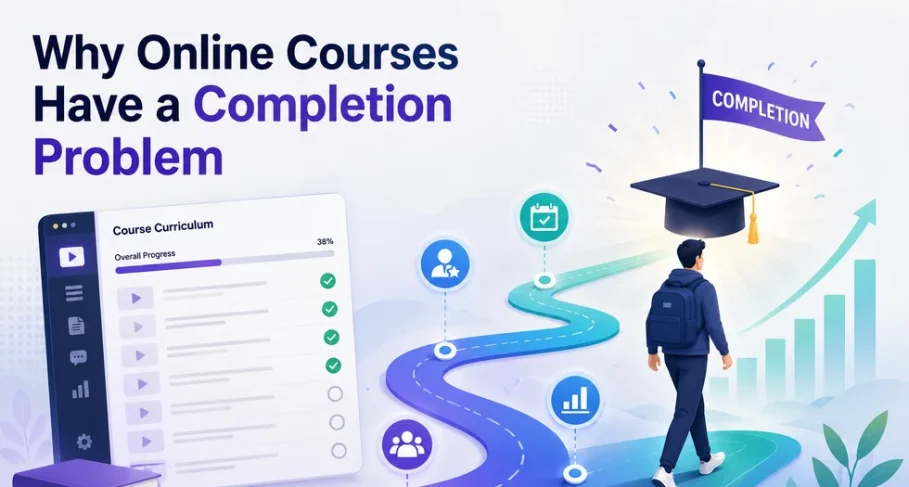
They have a completion problem.
The gap between enrollment and completion is one of the least discussed challenges in online education. Yet it has a direct impact on learner outcomes, course reviews, referrals, and long-term success.
The Obsession With More Content
Course creators care deeply about quality.
That’s a good thing.
The problem is that quality often gets confused with quantity.
I’ve seen courses with dozens of hours of video content, extensive reading material, multiple projects, and comprehensive assessments. On paper, they look impressive.
Yet many learners never make it beyond the first few modules.
At the same time, I’ve seen shorter programs with significantly higher completion rates and better outcomes.
The difference wasn’t necessarily the content itself.
It was the learning experience.
Many educators assume students are asking for more information. In reality, most learners are asking for clarity, structure, and momentum.
Those are very different things.
Why Students Stop Learning
When a student drops off midway through a course, the explanation is usually more complicated than a lack of motivation.
Most people who enroll genuinely want to learn.
They spend money, dedicate time, and start with good intentions.
The challenge is maintaining that commitment over weeks or months.
Information Overload
Online education has made knowledge incredibly accessible.
Ironically, that accessibility can become a problem.
When learners are presented with ten hours of videos, multiple PDFs, discussion forums, assignments, bonus resources, and recommended readings, the experience can quickly become overwhelming.
More content often feels valuable to the creator.
It doesn’t always feel valuable to the learner.
Learning Without Accountability
Traditional classrooms naturally create accountability.
Students have schedules. They have peers. They have instructors who notice when they stop showing up.
Online learning removes many of these structures.
Without clear checkpoints, it’s surprisingly easy for a learner to miss one lesson and then gradually disengage altogether.
Most people don’t consciously decide to quit a course.
They simply stop coming back.
The Isolation Factor
One observation that continues to stand out in online learning is how important community has become.
Many students struggle not because the material is difficult but because they’re learning alone.
There’s a difference between watching educational content and feeling part of a learning journey.
The second experience is much more likely to keep learners engaged.
Completion Is a Better Success Metric Than Enrollment
Enrollment numbers are easy to celebrate.
They’re visible, measurable, and often used as indicators of growth.
Completion rates are less glamorous.
But they’re usually a much stronger indicator of educational effectiveness.
Imagine two programs:
- Program A enrolls 1,000 students and 15% complete it.
- Program B enrolls 500 students and 70% complete it.
Most educators would agree that Program B is creating more value.
The challenge is that many organizations spend significantly more time optimizing acquisition than improving learner engagement.
That’s understandable. Enrollment growth is easier to measure.
Learning outcomes require patience.
What High-Performing Online Courses Do Differently
Some of the most effective online learning experiences I’ve encountered share a few common characteristics.
Interestingly, none of them involve adding endless amounts of content.
They Focus on Early Wins
The first week matters more than most educators realize.
When learners experience progress quickly, they’re more likely to continue.
This could be:
- Completing a small project
- Solving a practical problem
- Receiving feedback
- Participating in a discussion
Momentum is a powerful motivator.
They Create Visible Progress
People like seeing progress.
Fitness apps understand this.
Language learning apps understand this.
Online education sometimes forgets it.
Simple indicators such as milestones, project completion, progress tracking, and achievement markers can make a meaningful difference in engagement.
They Build Community Into the Product
For years, online learning was viewed primarily as content delivery.
That mindset is changing.
Increasingly, successful programs are investing in:
- Mentorship
- Cohort-based learning
- Peer discussions
- Live interactions
- Community engagement
The content remains important.
But the surrounding ecosystem often determines whether learners stay engaged.
This shift is becoming visible across the broader online education industry. Many learning providers are moving beyond self-paced video libraries and experimenting with structured mentorship, accountability systems, and community-driven learning models. Several career-focused learning platforms and organizations have increasingly adopted these approaches to improve learner engagement and completion outcomes.
Three Practical Changes Educators Can Make Today
Course completion doesn’t require a complete redesign.
Small changes often create significant improvements.
1. Reduce Friction
If something feels difficult to start, people postpone it.
Break longer lessons into smaller modules.
Make the next step obvious.
Remove unnecessary complexity wherever possible.
2. Create Accountability Loops
Learners benefit from regular check-ins.
This can include:
- Weekly milestones
- Group discussions
- Instructor feedback
- Peer accountability
People are more likely to continue when they feel someone notices their progress.
3. Design for Consistency, Not Intensity
Many courses ask for too much effort upfront.
Consistency tends to outperform intensity.
A learner who spends thirty minutes each day for several months often achieves better results than someone attempting to complete everything in a single weekend.
The Future of Online Learning
The future of online learning isn’t just about creating better content.
Information is already abundant.
The bigger opportunity lies in helping learners stay engaged long enough to turn information into outcomes.
We’re already seeing this shift happen through:
- Cohort-based programs
- Community-led learning
- Personalized learning paths
- Mentorship-driven models
- AI-powered support tools
Technology will continue to evolve.
Human behavior won’t change nearly as quickly.
Students will still need motivation, accountability, and support.
The educators who understand that reality will be the ones who create the most meaningful learning experiences.
Conclusion
For years, online education has focused heavily on access.
Today, almost anyone can access world-class information from anywhere.
The next challenge isn’t access.
It’s completion.
The most successful courses of the future may not be the ones with the largest content libraries. They may be the ones that help learners consistently show up, stay engaged, and reach the finish line.
Because at the end of the day, unfinished learning creates very little value.
Completed learning changes lives.