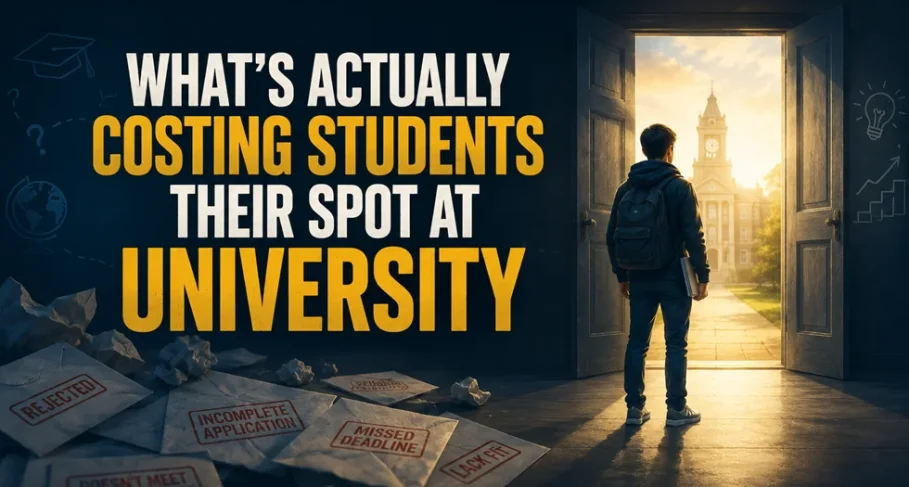
Every year, thousands of talented students get rejected not because they weren’t good enough, but because of a handful of predictable mistakes. These aren’t about grades or test scores. They’re about strategy, timing, and understanding that different countries play by completely different rules.
Here’s what the admissions committees want you to know and what applicants keep getting wrong.
Starting Too Late
The most damaging mistake is starting the process in the final year of school. By that point, you’re already behind.
For A-level students, everything starts in Year 11. That’s when you choose the subjects that will define which degrees you can even apply for. If you dream of studying engineering or economics and pick the wrong combination, you may not be eligible for your target programs at all. And once you’re in Year 12, you can’t swap subjects.
UCAS data shows that in 2025, around 17% of applicants who weren’t accepted into their first-choice UK university cited subject requirements as the reason — not grades.
Ignoring Country-Specific Expectations
“This is another trap. Students often treat the US and the UK as if they’re the same system.
In the US, universities look for well-rounded individuals. They care about leadership, volunteer work, extracurriculars even if they have nothing to do with your intended major.
In the UK, admissions tutors focus almost entirely on academic depth and subject-specific motivation. If you organised a charity event but didn’t take the required A-levels, they won’t care,” says Juliana Bazavluk, University Application Overview Consultant at Virtual International School.
According to UCAS, 82% of UK universities rank subject relevance higher than personal achievements.
The problem arises when students write the same application for every country. That doesn’t work. You have to adapt: present yourself as a future academic for the UK, and as a well-rounded leader for the US.
Mistaking Deadlines for Suggestions
Deadlines are absolute, yet surprisingly many students treat them as flexible. US early action deadlines (usually November 1-15) are not optional if you want to show real interest. Regular deadlines — typically January 1 require everything to be ready months earlier.
British applications through UCAS also have strict timing, especially for competitive courses like medicine, dentistry, or Oxford and Cambridge, which have October deadlines. Waiting until the last moment means your essay is rushed, your recommenders are busy, and your chances plummet.
Making Your Personal Statement Generic
This is where AI tools have created a new wave of rejections.
Many students use ChatGPT or similar AI to generate their personal statements. The result? Generic essays that sound exactly like thousands of others. Admissions officers read dozens of these per day. They can spot the pattern: perfect grammar, no personality, formulaic phrasing.
But the same problem occurs even without AI. Students often write one essay for multiple universities and forget to tailor it. The worst version? Forgetting to change the university name in the text.
The main statement (personal statement) can be the same for all universities: it tells your personal story and shows your uniqueness. However, many universities also ask for supplemental essays, where you explain why you chose that specific university and demonstrate understanding of its programs. Here, using the same text for multiple universities with only minor changes shows the admissions committee that you didn’t do your research. Sending an essay addressed to Harvard to Yale is not subtle — it’s an instant red flag.
A 2025 NACAC survey found that 71% of admissions officers said authenticity was the single most important factor in evaluating a personal statement more important than grammar or structure.
Applying Only to the Best Universities
It’s common for students to submit applications exclusively to Ivy League or Russell Group universities. But competition is fierce. Even outstanding candidates get rejected.
A safer strategy is to divide universities into three categories: reach schools (worth a try), target schools (where your profile fits), and safety schools (where you’re almost certain to get in, with strong programs that genuinely interest you).
In the UK, you can only apply to five universities. In the US, students typically apply to 8-10. According to NACAC data, applicants who applied to at least four institutions were significantly more likely to receive offers than those who applied to only one or two.
Choosing Universities by Ranking Alone
Students often choose universities based on rankings alone. Then they arrive and discover the campus is in a quiet town, not a big city or the class sizes are massive or there’s no practical component when they need hands-on experience.
Today, most universities offer virtual tours, online open days, and even chats with current students. Using these tools helps you decide if the university really fits and shows the admissions committee that you’ve done your homework.
Asking for Recommendations Without Building a Relationship
“Recommendation letters matter. But teachers won’t write glowing letters if they barely know you. Students need to cultivate relationships early: attend office hours, ask thoughtful questions, and show genuine interest. Then, when you ask for a recommendation later, it won’t feel forced.
A strong mix of recommended teachers who can speak to different achievements is more effective than three similar letters,” says Juliana Bazavluk, University Application Overview Consultant at Virtual International School.
According to NACAC research, personal recommendations from subject teachers have a noticeable positive effect on admissions decisions.
Weak English Scores or No Scores at All
For international students, English proficiency tests (like TOEFL) are often mandatory. But many students underestimate them. You can’t just “be good at English.” You need to prepare for the test itself — its structure, timing, and specific tasks.
Most universities require around 90 out of 120 on the TOEFL about B2 level. But without format-specific preparation, even strong English speakers can score below the required threshold.
Thinking International Education Is Unaffordable
This is a persistent myth. Many families assume they can’t afford to apply. But the reality is more nuanced.
Some universities offer generous financial aid. Others have lower tuition. Many have scholarships for international students. According to UK government data, about 30% of international students in the UK received some form of financial support in 2025–26.
In the US, while federal aid is not available to international students, universities actively offer their own grants and scholarships. A U.S. News & World Report survey found that in 2024-25, the average financial aid for international students at 20 US universities exceeded $84,000 per year. At Wesleyan University, which ranked first, it was $90,100 per student.
In Italy, many leading universities offer scholarships based on high grades, strong entrance test results, personal statements, and CVs. These can fully or partially cover tuition and sometimes provide additional living expenses. Examples include the Invest Your Talent in Italy program and Bocconi Merit Awards. The Italian Ministry of Foreign Affairs also awards grants covering tuition, health insurance, and a monthly allowance (around 900 euros per month).
In the Netherlands, the NL Scholarship offers 5,000 euros for the first year to talented non-EU students. Some universities go further: the University of Twente Scholarships cover 3,000 euros to 22,000 euros per year, the VU Amsterdam Fellowship Programme waives tuition completely, and Radboud Scholarship reduces fees to the local student level.
Hong Kong universities offer full-tuition scholarships, sometimes covering living costs as well. Government grants of around HK$80,000 are also available for outstanding international students.
In South Korea, the Global Korea Scholarship (GKS) covers full tuition, a monthly stipend (900,000 KRW), flights, and health insurance. Top technical universities like KAIST, POSTECH, and GIST often offer full scholarships and monthly allowances to high-achieving international students.
So don’t judge affordability by the sticker price alone. After grants or discounts, the final cost is often much lower than expected.
Wrap Up
Most mistakes in 2026 aren’t about a lack of talent. They’re about a lack of information, planning, or strategy. The students who succeed are those who start early, understand the different systems, and approach each application as a unique task — not a copy-paste job.
Your application isn’t a checklist. It’s a story. And the admissions committee wants to see that you know where you’re going — not just that you want to go.