
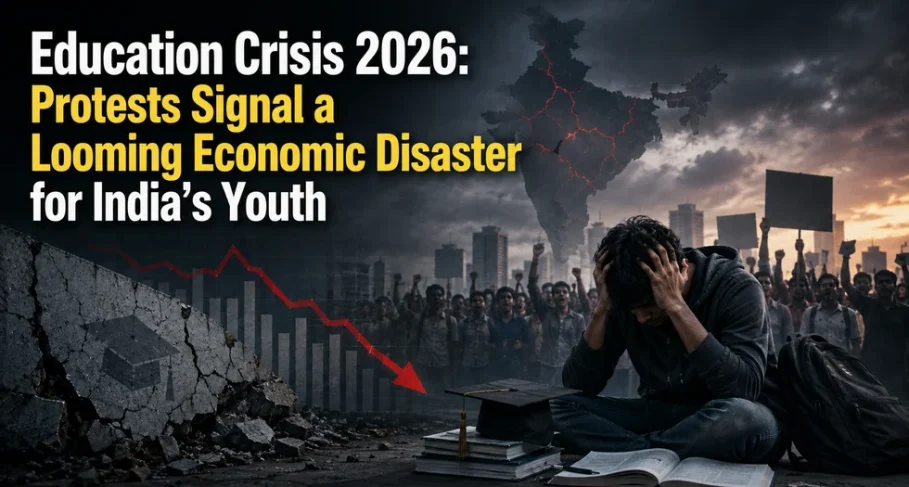
India has a demographic dividend due to its millions of young people, which is considered to ensure the country’s success in the 21st century. In 2026, the same dividend has become a rotting promise that does not look inviting. The protests sparked by the paper leak of NEET-UG 2026 show that the education system is heavily flawed, leading to further implications. Looking at the situation from the point of view of business and economy, such events are not random episodes, but rather an indicator of loss of productivity, talent wastage, and an unfavourable position on the global market.
The Beginning of the Crisis: From Leaks to Protests
The beginning of the crisis was marked by the cancellation of the NEET-UG exam, which was supposed to take place on 3rd May, 2026, due to the charges of a leak, and more than 2.28 million students were affected. Thereafter came another examination, but trust has been lost. The agitation at Jantar Mantar in Delhi is spearheaded by the Cockroach Janta Party, with opposition parties joining in. It demands the resignation of the Minister for Education, Dharmendra Pradhan and an overhaul of the system.
These agitations have brought to light the persistent problems that exist, such as regular leakages, improper re-evaluation, like the problem with the CBSE on-screen marking and poor infrastructure facilities. Competing examinations for millions are the only way out into a future of success as doctors, engineers, or even as civil servants.
Human Capital at Stake: The Demographic Dividend Under Threat
India has close to 367 million youths aged 15-29 years, with graduate unemployment hovering dangerously at 40 per cent between ages 15-25 years and 20 per cent between 25-29 years in recent surveys. The unemployment rate for youth in the 15-29 age bracket was near 15-16 per cent in early 2026. Very few end up getting employed in positions that require skills for which they have trained. The economic consequences of a delay in the flow of talent are substantial.
Any disruption to NEET and other examinations like JEE creates hurdles. Healthcare faces a problem with a doctor shortage while industry suffers from a skill shortage. Delayed semesters mean delay in entering the workforce, with lower lifetime earnings and taxation. When aggregated for a cohort, opportunity cost adds up to billions of rupees lost in annual productivity.
Public expenditure on education remains inadequate at about 4.1 per cent of GDP as a whole for centre and states, falling short of the NEP 2020 target of 6 per cent. However, the budget for 2026-27 has raised allocation for higher education by about 11 per cent to ₹557.3 billion along with skill development programs.
Coaching Industrial Complex: A Double-Edged Sword
The parallel economy to India’s education sector is the coaching industry, worth around ₹58,000 crore today, which is expected to grow to ₹1.3-1.5 lakh crore by 2028-2030. Cities like Kota attract tens of thousands of students, as households spend ₹25,000-50,000 every month for preparation.
While the industry earns profits and creates jobs, it also misplaces priorities in the process. With such a concentrated focus on rote learning for a small number of seats, for example, over 100,000 MBBS seats for millions of candidates appearing in NEET, skill development gets neglected. The 2026 scandal had caused both monetary and emotional damage due to wastage of money and stress, besides exposing loopholes in the regulations. Despite the risks involved in their reputation and the need for regulations, the coaching centres in essence expose the problems of our education system.
In business organisations, this means hiring people who would require much more retraining, which adds costs to training, hindering innovation, particularly in technological and manufacturing sectors.
Wider Economic Consequences: Investor Sentiment and Sectoral Issues
This scandal affects investor sentiment in the edtech industry and its allied sectors. Meritocratic systems of administration and operation are the basic requirements for ensuring quality education through collaboration between the private and government sectors. Investors want consistency, and scandals are bound to send warning signals in terms of governance risks and may even discourage investment altogether.
Sector-specific impacts are pronounced. With regard to the medical field, the NEET postponements pose a threat to the availability of doctors in the future, hence increasing operating costs and impacting the growth of medical tourism, which is an important source of foreign exchange. The $250+ billion engine of IT and services exports in India depends on the inflow of quality graduates; any deterioration will affect offshoring trends.
The protests themselves create costs on a short-term basis due to interrupted business activities and the suspension of education in the relevant regions. However, the real concern lies in the more long-term possibility of a generation of disaffected Gen Z individuals who could opt out of working for or starting businesses.
Policy Shortfalls and the Path to Reform
Although the 2026-27 Budget places great importance on skills, AI missions, and employability, it is pertinent to note that there hasn’t been sufficient emphasis on reforms. Initiatives such as the PMKVY have proven to be quite poor in terms of placements under their umbrella.
Action needs to be swift. Technological reforms like securing AI-monitored tests using blockchain technology to ensure transparency can help reclaim trust. Capacity building in medical and engineering colleges via incentives for the private sector and infrastructure development is imperative for overcoming bottlenecks. Incorporating skills training into the educational system by way of compulsory industry-related courses, internships, and credit systems will ensure that the students are better equipped for the requirements of the job market. The coaching industry will be controlled via quality guidelines, psychological welfare initiatives, and specific subsidies for underprivileged students so that any excesses are contained while society’s focus shifts to various professions. Last but not least, linking funding to employability and tracking of graduates along with auditing would hold institutions accountable.
Business leaders have a crucial part to play. They must advocate through industry associations, make direct investments in company academies, and work together for research parks and training centres that link education and industry demands.
Conclusion: Transforming Protest to Progress
Student protests in 2026 can be seen as a strong message about the dangers of complacency. It means that India’s young generation, eager, educated and outspoken, will not accept any more a model of governance that wastes their capabilities. From an economic perspective, the issues at stake are life and death ones. Absent a healthy, fair and transparent education environment, the demographic dividend may well turn out to be a burden leading to social instability rather than innovative growth.
Politicians, educators and businesspeople should act immediately, addressing the underlying problems in a data-driven manner and implementing meaningful reform measures. This will allow transforming protest into an instrument for achieving sustainable progress and development. Otherwise, India will suffer from slowing economic growth, losing its competitive advantage and millions of unfulfilled aspirations.