If you work in the education space, I’m sure you’re aware of the term pedagogy. But how many know about andragogy?
It’s a key term in the education field and should at least be understood by those who value learning.
Learning doesn’t stop when you leave school. It’s a lifelong process that continues with your will and desire to learn new things. Also, it is the need of time to be learning new skills every now and then to stay abreast within the community. Within every profession, things are advancing at a fast pace that requires an individual to keep updating and advancing their skill sets so that they can stay relevant with the need and demands of time.
As per infed, the term andragogy was originally formulated by a German teacher, Alexander Kapp, in 1833 (Nottingham Andragogy Group 1983: v). He used it to describe elements of Plato’s education theory. Andragogy (andr– meaning ‘man’) could be contrasted with pedagogy. It reappeared in 1921 in a report by Rosenstock in which he argued that ‘adult education required special teachers, methods, and philosophy, and he used the term andragogy to refer collectively to these special requirements.’
In this post, I’ll be explaining all related concepts of andragogy with relevant resources.
What Is Andragogy?
Malcolm Knowles’ theory of andragogy is an attempt to develop a theory specifically for adult learning. He emphasizes that adults are self-directed and expect to take responsibility for decisions. Adult learning programs must accommodate this fundamental aspect.
This is what Blake Seufert writes of andragogy: Typically the learning is very self directed [e.g. “man-leading”], hands on and not very reliant on an instructor or teacher. Often the learner doesn’t have the foundation to build upon and will need to learn other dependant skills and assess gaps in knowledge.
The term “andragogy” was first coined all the way back in 1833 by a German teacher named Alexander Knapp in an effort to categorize and describe Plato’s theory of education. However, the term is most closely associated with Malcolm Knowles, an educator who had a massive impact on the adult-learning field.
Today I'm thinking about andragogy, AKA the principles of adult learning.
This chart describes many reasons why intern year > MS4 for me. It's MUCH more joy-sparking to be seen as internally motivated & self-directed.
Vowing to see my med students the same way. pic.twitter.com/rTOMguoh9x
— Gabrielle Mayer, MD (@gabmayer) October 20, 2020
The concept is further explained with assumptions, principles, and differences between andragogy and pedagogy; explained below.
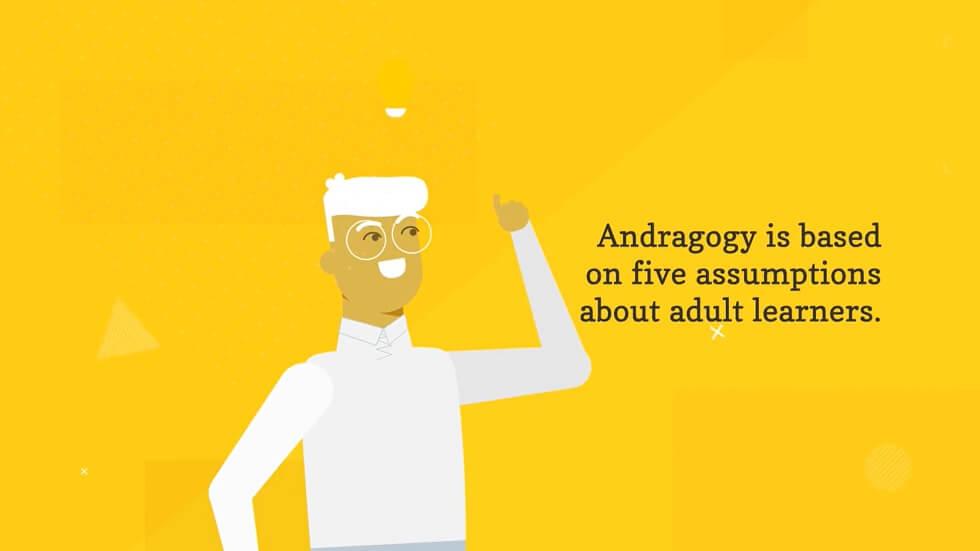
Andragogy: 5 Assumptions About Adult Learners By Malcolm Knowles
For those who are aware of andragogy, the term comes deeply associated with the name of Malcolm Knowles. These two are linked by all those who know one of these. For Knowles, the concept of andragogy is premised on 4 crucial assumptions and the fifth one was added later. These assumptions are solely dependent on the characteristics of adult learners which are visibly different than those of child learners.
The 5 assumptions are:
- Self-concept: the concept of adult learning moves from one of being a dependent personality toward one of being a self-directed human being.
- Experience: an adult learner comes with experience accumulated over years. This experience acts as a reservoir of learning.
- Readiness to learn: Since adults are aware of their development that has happened over the years, their readiness to learn is higher than that of children.
- Orientation to learning: As a person matures his time perspective changes from one of postponed application of knowledge to immediacy of application, and accordingly his orientation toward learning shifts from one of subject-centeredness to one of problem centeredness.
- Motivation to learn: As a person matures the motivation to learn is internal. (Knowles 1984:12).
What Differentiates Andragogy From Pedagogy?
In andragogy, there's instruction for adults which needs to focus more on the process and less on the content being taught. Strategies such as case studies, role playing, simulations, and self-evaluation are most useful. Instructors adopt the role of facilitator or resource rather than lecturer or grader. Contrary to this, dealing with children the pedagogy is used as per children’s preference and whatever engages them more. Here, the educator is the one with command in hand and considering all factors that impact children learning educator gets to decide the best-fit approach that would engage and interest the learner, in this chase the children.
The video above focuses on the main differences between both based on the following aspects of learning.
- Learning Behaviour
- Learners’ Experience
- Learning Orientation
- Readiness To Learn
- Motivation To Learn
Principles Of Andragogy?
I watched a lot of videos to share the one that fits the best. With different perceptions of adult learning, I came across sources that mentioned different principles. However, a few things remain the same. When speaking about adult learning certain things cannot be ignored. Some of the important points to be kept in mind are:
- Adults need to be involved in the planning and evaluation of their instruction.
- Experience (including mistakes) provides the basis for learning activities. Not just the mistakes they make while learning but the accumulated experience that their life gives them.
- Adults are most interested in learning subjects that have immediate relevance to their job or personal life. As I mentioned above, the time we live in demand a constant learning attitude and this leads to professionals getting into courses to enhance and upgrade their skills so they don’t lag behind.
- Adult learning is problem-centred rather than content-oriented. It is essential that the learning that adults are involved in leading to the solution of some existing problem. It could be either for them or a general issue. The chances are bleak that any adult is learning without the motive of solving any existing issue.
Wrapping it up, I firmly believe that knowledge of andragogy can significantly improve the adult learning experience. Just like we focus on children-oriented approaches to enrich their learning experience, we must do the same for adult learners as well.
We can see that there are some clear distinctions between how we learn as children, and later as adults. And so, this leads to the need for a tailor-cut approach as well as trained instructors to facilitate the same in appropriate ways.