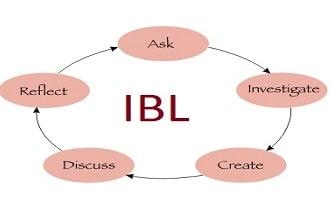
You may have heard a lot about Inquiry based learning and that, it is an active learning methodology that starts by posing questions, problems or scenarios- rather than just presenting established facts or portraying a smooth path to knowledge.
Wouldn’t you be interested to know what various research reflect about this form of learning, its realities and the challenges facing teachers to implement this type of teaching practice?
What Do Research Findings Reflect?
A research study commissioned by the Einstein Project and conducted by the St. Norbert College Survey Center to evaluate the effectiveness of the Inquiry based Science and Technology for Children (STC) in the teaching and learning of Science. The research results showed students using STC in the Einstein Project showed a 4% increase in general Science Knowledge between their pre and post-test scores compared to only 1.7% increase in general Science knowledge for non-STC students.
The concluding words of the study was that classrooms that adopt inquiry-based classrooms, it helps in producing students who are better able to perform tasks, investigate questions, classify, arrange, draw, label and describe scientific phenomena. The research also indicates that using IBL, it can also help students become more creative, more positive and more independent. This is true for all students, including those with special needs who require more individual attention during the process.
In yet another study on Inquiry based learning , conducted by Dr. Sharon Friesen of Galileo Educational Network, University of Calgary and David Scott of University of Calgary, it reflect that there is conclusive evidence that shows approaches to inquiry apply authentic pedagogy and assessments, authentic intellectual work and interactive instruction thereby dramatically improving academic achievements. Wherever there have been high levels of authentic pedagogy, it led to higher academic achievement among all students. They concluded that differences between high and low performing students decreased as students who were normally low-achieving were offered authentic pedagogy and assessments.
In classrooms where inquiry based approaches are applied, it emphasizes on interactive instruction, students discuss ideas and answers by talking and sometimes arguing with each other and with the teacher. Students work on applications or interpretations of the material to develop new and deeper understanding of a given topic. Further, students are allowed to select questions or topics that they wish to study within an instructional unit designed by the teacher.
However, often as one can see that there is potential existing in one area, yet it fails to make much of an impact because the challenges existing within a particular system make things fragile. Right now, the same is the case with adoption of Inquiry Based Learning and this is because, a standard based environment forces teachers to straddle the inquiry process. It has been seen that, most projects employ performance assessment tools, but majority of projects end up being designed more for academic coverage than exploration and invention. Such therefore results to a lack in power and depth and it proves out impossible to objectively measure the more subterranean aspects of inquiry, such as creativity and critical thinking.
Greatest of all challenges to the successful implementation of Inquiry based learning is related to its implementation. Study findings reflect, students have difficulties conducting systematic scientific investigations. Right from data gathering, analysis, interpretation to communication, and all such tasks can become a challenge if there isn’t content-area knowledge. Technology can be used to resolve such challenges, but that too isn’t the only solution for it requires both technological and curricular design strategies to resolve them rightfully. Failure to demonstrate any of the area such like motivation, accessibility of investigation techniques, background knowledge, management of extended activities and practical constraints of the learning context can prevent students from successfully engaging in meaningful investigations and therefore undermine learning.
Teachers find hurdles do cripple them from incorporating inquiry based instruction strategies into the classroom. These hurdles are in the form of- state mandated curricula and the accompanying high-stakes final exams, other constraints related to time, students expectations and abilities and also teachers fear of launching into the unknown. And such constraints are something that not only the new but even the veteran teachers too encounter while they want to start with teaching strategies well aligned with Inquiry based learning.
Teachers also cite that, there are many types of time related concerns that stand up as a hurdle for them to implement scientific inquiry in the classrooms. Teachers also lack the time to devote on preparation / designing of inquiry based activities. There is hardly any support that these teachers receive from others to develop a strategy that helps them successfully implement Inquiry based approaches in the classroom.
Thus, although outcomes of this form of learning and teaching may have been found to be great but if implementation of such practice continues to be a challenge for the teachers, it will not allow Schools and colleges to widely adopt this type of approach at a massive scale.
We would like to know what is your observation on Inquiry based learning and teaching, your views on it as a responsible stakeholder.