


Job readiness largely depends upon two major aspects or characteristics of a market – first is the demand (i.e. whether are the ample job opportunities available in the market wherein the local talent can get absorbed?), and second, is the supply (i.e. the requisite skill-levels of the local human resource available; and its alignment to the demand of the business organizations).
According to Rediff, the most pertinent & prospective career opportunities would be in the field of data analysis, decision science & web development amongst others by the year 2020. Hence, it is important for the millennials to judiciously choose their career basis the industry demands as well as their inherent skillsets & interests.
The subsequent sections would elaborate on the trending job roles which would play an important factor in the future years to come; as well as the current demand-supply gap existing amongst millennials in India.
Which are the high priority job roles available in the technical space of India
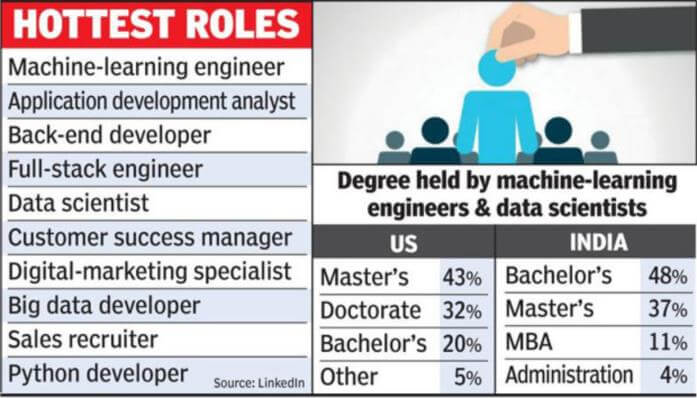
As per the survey of LinkedIn in 2018 80% of fast-growing job profiles in India are in the technical space. A few of the high-profile job trends include that of data scientist, full stack developer, back-end engineers etc.
The figure above shows the extreme levels of priority that businesses in India put on machine learning, application development (specifically Android development to cater to mobility), full stack engineer, data scientist, Python developers, and so on.
The section below would discuss on typical job profiles which could be targeted by Indian millennials in an attempt to seek a rewarding future –
- ML Engineer/Data Scientist – There is a constant upsurge in the demand of data scientist or machine learning engineers in India. This is majorly fueled by the spawn of automation & self-learning machines.
- Application Development (Android development) – Majorly driven by the fact that close to 80% of the market share in India is held by Android OS; businesses are increasingly investing in Android developers to launch their business offerings in the mobile platform. This not only includes informative web content but also commercial portals as well which conducts monetary transactions as well.
- Big Data/Python Developer – There is not much of an introduction required to the pervasiveness of Big Data as almost all businesses are directly or indirectly impacted by it. In fact the level at which businesses is able to leverage Big Data is instrumental in providing them a competitive advantage with respect to their competitors. The relative demand of Big Data technologies & development in various cities of India is highest in Bangalore which 38% followed by Hyderabad (14%), Pune (11%) & vizag which is 2%.
Demand-supply gap in the Indian job market
Now, given the high prospects and the positive sentiments driving the Indian market in the technology space, the next focal point is on the supply side of things – i.e. whether the available skillsets in India are sufficient enough to meet the demands of the industry. For technologies like REACTJS, Azure, Docker, Apache Spark, Devops there is a a surplus of talent basis actual requirement; while for technologies like CSS3, UX, Apache, JSON, Apache, JQuery there is a shortage of talent.
Now, on analyzing the various technologies mentioned above; these can be mapped to the job category ‘application development’ which is one of the hottest roles (as per LinkedIn research survey). Hence, students & prospective candidates need to work on improving their technological skills to a point that they become relevant to the advanced needs of today’s programming. The ‘mobile-first’ approach which is prevalent in current times bear testimony to the front that application development is definitely a specialized job in today’s market. Other than the application development field, there is another field wherein there is shortage of talent – data science/machine learning.
The skill gap in the field of data science is on the rise and is expected to touch as high as 140,000 by the year 2021 (Source: NASSCOM) as compared to 2018 which was 62,000. Therefore, there is huge opportunity for data science trainers (online/offline) to modify and improvise their course curriculum, modernize their training content and ensure that the skill gap is reduced to the maximum as these unfilled positions are invariably either outsourced to other countries; or these projects do not kick-start due to shortage of talent.
Role of online training platforms to address the skill gap
Given the massive opportunity while lies ahead in the future years, and the limitation in talent – the role of online training platforms becomes extremely critical to success. Online training platforms would play a substantial role not only in imparting quality and industry-relevant training to aspiring students but also guide & consult them on their career path aligned with their preferences & skillsets.
With such hypes attached to certain job profiles, students often make uninformed choices on their career; which later leads to dropouts. Hence, students should seek for expert advice from online training platforms, and exercise caution while selecting their career path.

