
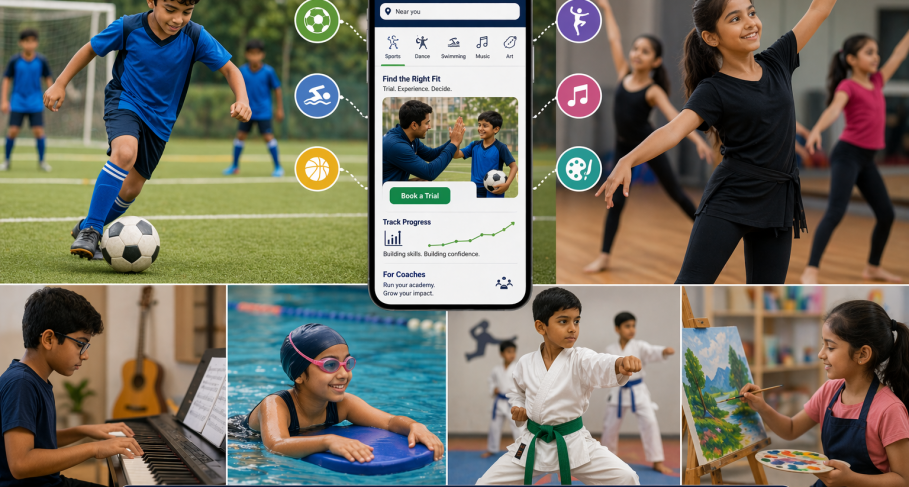
India’s children’s extracurricular activities market – spanning sports, dance, swimming, music, martial arts, art, skating, and other skill-based learning – with over 10 million active children is estimated to be a $3–3.5 billion category.
The market exists. The spending is real. The demand is active. The platforms are not. Understanding why – and what it will take to build one – requires looking beyond the TAM and into the structural nature of this category.
The Structural Tailwinds: Why This Market Is Inflecting Now
At roughly 10% penetration among the urban population, this market has significant headroom. And the conditions for a category inflection are falling into place simultaneously.
The millennial parenting shift. Millennials form the core of India’s consuming class today. Raised with traditional values but shaped by modern exposure, they learned early that being well-rounded matters as much as academic credentials. That awareness now drives spending behavior at scale. Parents today do not view sports, dance, music, or swimming as optional enrichment. They see it as essential infrastructure for their child’s development – confidence, discipline, physical literacy, social skills. This is not a trend. It is a generational rewiring of how Indian families think about what children need.
Urbanization and the gated community boom. India’s urban population has crossed 36% and is projected to reach 40% by 2030 (World Bank). But the more telling data point is gated communities. According to RedSeer, 16 million households in India’s top 50 cities lived in gated communities in 2021 – expected to reach 24 million in 2026 (a 7% CAGR), constituting 43% of all households in these cities. These gated communities alone represent $200 billion in annual consumption spend, projected to grow 2.5x in five years. More importantly, they create natural demand density – clusters of families within walkable distance, all seeking structured activities for their children. The gated community is, in many ways, the new catchment area for coaching businesses.
NEP 2020 and institutional legitimacy. The National Education Policy’s emphasis on holistic and experiential learning has given formal recognition to what parents already believed – that education extends well beyond textbooks. Schools are integrating activity-based learning into curricula, creating a reinforcing loop that normalizes extracurricular spending.
Where Scale Has Worked: The Online Distribution Playbook
Some segments of the broader children’s learning space have achieved meaningful scale – and they share a common trait: they found a way to distribute online.
Public speaking platforms are perhaps an instructive example. Children’s communication skills – public speaking, creative writing, debating, spoken English, storytelling – has quietly emerged as one of the fastest-growing segments in India’s children’s learning economy. The reason this vertical scaled is structural: communication skills can be effectively taught through a screen. A child can practice debating, storytelling, or spoken English in a live 1:1 format from home. The platform controls the supply (trained teachers), the delivery (its own live classroom), and the curriculum. The experience translates well to a digital format.
But the bulk of the children’s activities market – sport, dance, swimming, martial arts, music (especially with instruments), skating, gymnastics – is fundamentally physical. You cannot learn badminton on a Zoom call. You cannot build a child’s comfort in water through a screen. You cannot replicate the energy of a group dance class through a laptop.
These categories, which constitute the overwhelming majority of the market, resist online distribution entirely. And that is precisely where the platform gap exists.
The Disconnect: Why No Platform Has Scaled in Physical Activities
If adjacent learning categories have produced breakout companies – Classplus in tutoring, PlanetSpark in online communication skills – why has no one cracked the physical activities market for children?
Consider the landscape. Classplus, powers tutors and coaching centres with a white-labelled app – but it serves the academic tutoring segment, where the product is content delivery and test preparation. These are categories where the supply is somewhat fungible and the experience can be systematized.
Children’s physical activities are structurally different. Every coach is different. Every child’s comfort level is different. And the purchase cycle is long, trust-dependent, and driven as much by emotion as by logic.
Globally, the pattern repeats. ClassPass built a successful model for adult fitness by treating supply as interchangeable – any spin class can substitute for another. But it has never expanded into children’s activities, because in this category, supply is not interchangeable. A child who loves their football coach will play football; the same child with a different coach might want to switch to cricket.
The pattern is clear: when the experience is physical, relationship-driven, and trust-led, traditional marketplace and aggregation models hit a structural ceiling.
Why Traditional Marketplace Models Fail in This Category
The standard playbook in Indian consumer internet has been; aggregate supply, generate demand, take a commission. It works for standardized, transactional categories.
In children’s activities, this model breaks down at every layer.
Marketplaces become lead generation platforms with no LTV. The most recent example is Swiggy’s Pyng – a professional services marketplace launched in early 2025 and shut down within six months, citing unit economics challenges and low customer retention. The fundamental problem: Pyng could generate the first connection between service provider and customer, but once the relationship was established, the platform had no ongoing role. The provider and customer transacted directly, and the platform’s lifetime value collapsed to near zero.
This is the exact failure mode for any listing or lead-generation platform in children’s activities. A parent finds a coach through the platform, attends a trial, enrolls – and then the platform disappears from the equation. The parent pays the coach directly. The coach communicates via WhatsApp. The platform is left trying to re-acquire the same parent for a different activity, burning CAC repeatedly with no retention. In a category where a child may attend football classes for two years, ceding that relationship after the first touchpoint is catastrophic for economics.
The experience happens offline, beyond the platform’s view. In food delivery, the platform controls the last mile. In e-commerce, it controls fulfilment. In children’s activities, the entire experience – the coaching, the interaction, the environment – happens in a physical space that the platform does not own. Quality variance is high, feedback loops are slow, and the platform has no lever to improve outcomes.
Discovery is experiential, not informational. Over 7 million search queries are made every month by Indians looking for activity solutions. But when a parent searches for “football class near me,” what they need is far more layered than what any search result can deliver: a coach their child feels comfortable with, timings that work with school schedules, a group the child feels they belong to, and visible progress over time. The demand exists in abundance – but no listing page can convert it. Only a structured trial experience can.
What I Learnt Building in This Space
Over the last year, I have had hundreds of conversations with parents, coaches, and academy owners across sports, arts, and skill-based learning. I have also lived this as a parent navigating the same ecosystem. Some of the most important insights have reshaped how I think about this category.
Parents are buying trust, not a time slot. When a parent says they want a badminton class, what they really mean is: something close enough to be practical, a coach their child feels comfortable with, timings that work with school and sibling routines, a setup that feels safe, and some visible sense of progress over time. They are not buying a class. They are buying consistency.
Children seek belonging, not subjects. Between the ages of 4 and 12, children go by instinct. Do I feel comfortable with this coach? Do I feel part of this group? The subject itself is often a distant priority in the formative years. A child should not be penalised for wanting to switch – it is part of the journey of exploration. Discovery, for a child, is not about finding an activity. It is about finding a fit.
Coaches are exceptional at their craft but drowning in operations. Most coaches carry a clear distinction in their minds between “commercial coaching” and “competitive coaching.” Their deepest validation comes from seeing students excel. But to get there, they need functioning businesses – and most are running everything on WhatsApp groups, mental notes, and informal fee collection. Lead generation, trial conversion, attendance, fee follow-ups, parent communication, scheduling across batches and venues – operational chaos consumes their best energy. The coaches who scale are not necessarily the best teachers. They are the ones who figured out operations. That should not be the filter.
Continuity beats excitement. Parents are not looking for a flashy first experience. They want regularity and rhythm. Will the class happen on time? Will the same coach show up? Will my child stay engaged beyond the first month? A dependable ongoing experience matters infinitely more than a memorable first trial.
Progress needs to be made visible. Parents want more than attendance confirmations. They want to know if their child is improving, becoming more confident, building discipline. Progress in extracurriculars is inherently less structured than in academics – and when it is not made tangible, the parent’s default response is to stop and try something else.
What Will It Take to Build the Category-Defining Platform?
If marketplaces structurally fail in this category, what will work?
The highest-leverage intervention is not connecting parents to coaches. It is making coaches effective at everything around the coaching and delivering an elevated consumer experience.
Consider the analogy from food-tech. Zomato and Swiggy built marketplaces that own demand and fulfilment. But alongside them, companies like Petpooja built restaurant operating systems – that powers menus, billing, kitchen management, and analytics. Both are viable businesses, but they solve fundamentally different problems. One owns the transaction. The other owns the workflow.
In children’s activities, the equivalent is a platform that replaces the WhatsApp chaos with structured tools for growth, operations, and student management. That means:
Discovery that goes beyond listings. Not just “find a football class near you,” but structured trial experiences where the child and parent can evaluate fit before committing. Discovery in this category must be experiential.
Operational infrastructure for coaches. Lead management, batch scheduling, attendance tracking, fee collection, parent communication – in one place, embedded in the coach’s daily workflow. Replacing the ten different apps and manual processes that consume hours every week.
Progress visibility for parents. Structured feedback that makes development tangible. Not just “attended 12 of 15 sessions” but “showing improved consistency” or “ready for the next level.” When parents can see progress, they stay. When they cannot, they leave – regardless of how good the coaching is.
Continuity and retention systems. Automated reminders, flexible rescheduling, sibling management, seasonal batch adjustments. All the small operational details that prevent drop-offs caused by logistics and friction, not lack of interest.
The business model shifts from commission-per-transaction – where the platform loses the customer after the first interaction – to a sustained relationship where the platform becomes embedded in the coach’s daily operations. When you are the system, a coach runs their business on, you do not fight for each transaction. You earn through sustained value delivery.
The Opportunity Ahead
India’s children’s activities economy is a multi-billion-dollar market growing structurally.
The category is ready for its platform moment. The structural conditions – demand density, digital readiness, willingness to pay, and a fragmented supply side seeking better tools – are all in place. What remains is for the right approach to emerge.