The world of automation
I recently had a conversation with a someone outside of education. I asked him what he thought should change with our current education system and his reply was, “When I was in high school, most everyone took auto shop, and learned to tear down and rebuild a car. Why don’t we do that with computers, robots, and networks – the fundamental technologies of our age? Why isn’t programming required like math?”
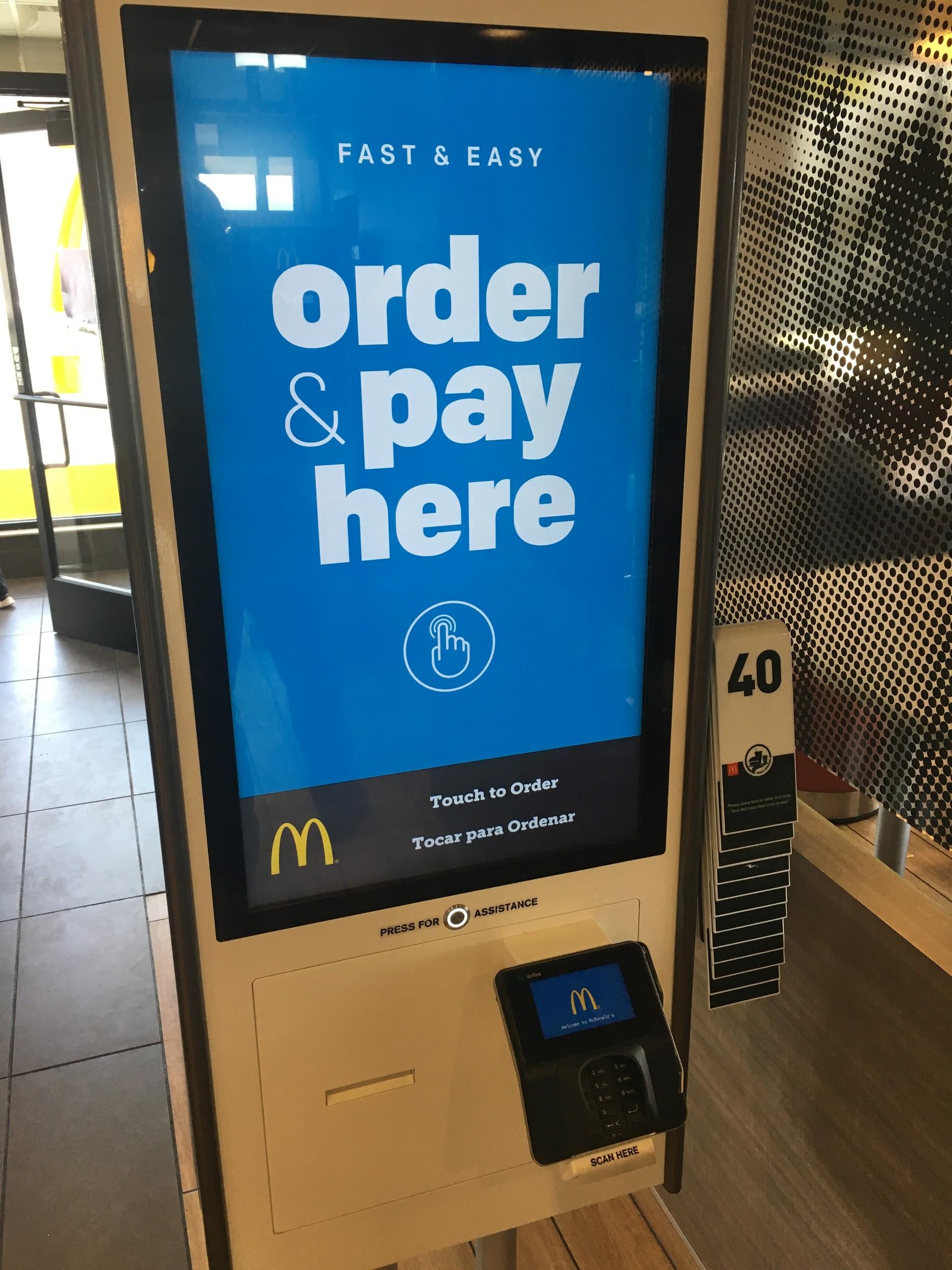
I walked into a McDonalds the other day. There were seventeen people in line ahead of me. I was standing next to a touch-screen ordering kiosks. I was intrigued by this new technology. How much faster could it be? I placed my order and watched. After the cashier had taken the fourth order, my breakfast was delivered to the counter. “That was fast, I thought. “How long will it be before everything behind that counter is automated?”
In an article in the Tampa Bay Business Journal, Hubertus Muehlhaeuser, CEO of Welbilt, was quoted, “‘I envision, within a year or two, people ordering their food by cell phone before they reach a restaurant. The order will go directly to the relevant appliance, which grabs the food, starts cooking it at the time dictated by the customer’s distance from the restaurant when they placed the order, and packages just in time when the customer arrives,.”[1] A USA Today article reported on “Flippy,” a burger robot at Cali Burger, in Pasadena, California. Flippy can cook 2000 burgers a day. According the the Bureau of Labor Statistics, there are 3.4 million jobs in the food serving and preparation industry.[2]
Consider Amazon Go. In 2017, Amazon opened its first cashier-less store in Seattle, Washington. A customer walks into the store, gathers the items she wants to purchase, and an app on her phone identifies and charges her for the items on her way out. According to the Bureau of Labor Statistics, that’s another 3.5 million jobs being replaced by automation. The Bureau has also calculated there are 3.5 million jobs in the trucking industry. These too will be lost to automation.That is over 10 million jobs that will be automated in the next five to seven years.
The top 10 most in demand jobs in 2010 did not exist in 2004[3]. In a 2016 report on the state of cybersecurity jobs by ISACA, there will be 6 million cybersecurity jobs and a global shortage of two million cybersecurity professionals by 2019[4].
The call for robotics and programming in the primary years
It is paramount that we add robotics and programming to the K-5 curriculum. It is common knowledge that teaching a foreign language in the primary grades yields a stronger understanding of
languages in general. This can be applied to programming as well. “Learning programming has similarities to learning languages, because each programming language is a different language. So exposing children to the concepts that are similar across coding languages at a young age makes it much easier for them to learn and use these skills as they progress through life,” says Lindsay Craig, founder of Questbotics, an educational robotics and programing company based in Longmont, Colorado. In addition, Mr. Craig explains that, “Technology is constantly evolving, introducing kids to the fundamentals at a young age means that they have a chance of keeping up with the advancements in the field as they grow older and start to use the tools of their chosen industry. And, advanced robotics is just plain difficult. If the skills are introduced at a young age as fun and approachable then students have a better chance of developing their abilities to reach the more difficult stages later in life.”
The interest in robotics at early ages is massive. I spoke with Dennis Kambiets, Director of Education at Robots Education. “We’ve demonstrated robotics to more than 12,000 students from grades 4-12, and we’ll average 90% of students wanting to learn robotics in middle school, and about 60% in high school, as compared to the national average of 2% for boys and .2% for girls. But most importantly, we’ve seen almost 100% interest at the primary level.” We need to feed this passion to address this dramatic drop in interest as students move from primary, to middle, and on to high school. This trend can be changed if we were to integrate robotics and programming into the K-5 curriculum.
Does this mean we are going to increase screen time for K-5 learners? Not necessarily. Questbotic’s, Lindsay Craig, has an approach to teaching robotics that starts without screen time. “At a young age I teach without using screens. That means using hands-on robots, physical activities and discussions…Working on a screen doesn’t nurture the soft skills that are so important in society and the workplace. The real world also presents hurdles that are at the core of robotics. In a controlled environment, such as inside a screen, students don’t learn how to handle the problems that arise from trying to manipulate reality using robotics. Their goals, resources and methods are also limited to the system in which they are working. The real world puts no such limitations on problem solving and dream pursuing.”
How will Robotics and programming prepare our students?
Robotics and coding provide a vehicle for teaching perseverance, problem-solving, collaboration, critical thinking, and creativity. The very act of coding a robot is an exercise in problem-solving. How does one make a robot do a particular task? Students will go through a system of trial and error to program a robot. Unless the code is written perfectly, the robot will not move – and rarely is the code written correctly the first (or second) time around. This process also teaches perseverance and critical thinking. Finally, collaboration is a skill that will be developed as students work together to make the robot perform.
In a conversation with John Blankenship, founder and owner of RobotBasic, he expressed why we need to teach coding. “Programming is one of the best ways to teach problem solving, mathematics, and analytical thinking. Programming is motivational because it can be used to address realistic and interesting problems, especially through simulations. It is a valuable teaching tool because it provides instant feedback in many situations.” I have seen this in action in one classroom that I observed. Students were tackling the difficult problem of bullying in our school by creating an application for kids to use to report bullies. They created a prototype and took it live with one classroom. This provided instant feedback on their application. They were able to use the feedback to improve the functionality of the application the very next day.
Our students will be going into what is called a “Gig” economy. This means most jobs are short term contracts and the most successful people will be able to identify problems for a businesses and then provide the solutions. Steven Reinharz, President of Robotics Assistance Devices, in Orange County, California, says, “Robotics is an open area where people can create whatever they want to solve whatever problems they see. . . it’s about creativity.” I know of one school where students are using programming to do this. They were unhappy with the number of choices on the school’s lunch menu and the amount of food being thrown out each day. Students created an application to manage pre-ordering of meals so the cafeteria knows exactly how many lunches to prepare. This type of problem-identification and problem solving enhances the skills necessary for our students to be successful in the rapidly changing job market.
Soon, we will walk into a McDonalds and see an entirely automated system; from taking an order, to flipping the burger, to getting it into the customer’s hands. But, there is still the need for people identify problems and build robots and program software to solve programs. The sooner teachers can introduce this technology the better off our students will be. The key is to understand that robotics and programming does not have to be a separate, stand-alone class. Rather, it can be used to enhance learning and problem solving in all areas of the curriculum. There are countless companies popping up that provide robotics hardware, software, curriculum, and professional development. If you would like more information on how to get robotics into the classroom, you can contact me at www.linked.com/in/stanhickory.
References:
[1] Margie Maning, “Here’s what the next generation of the fast-food industry looks like to this Tampa Bay CEO”,https://goo.gl/zVhbej, (May9, 2018).
[2] Bureau of Labor and Statistics, https://goo.gl/6HN3of (accessed June 1, 2018).
[3] “We are living in Exponential Times”, Ivy College, https://goo.gl/8ZhK4K (accessed June 1, 2018).
[4] Steve Morgan, The Cybersecurity Jobs Report: 2017 Edition, https://goo.gl/oJpkyg (May, 31, 2017).