
This website stores cookies on your computer. These cookies are used to improve your website experience and provide more personalized services to you, both on this website and through other media.
Accept
EdTechReviewEdTechReview
  • News
  • Trends
  • Insight
  • eLearning
  • Research
  • Dictionary
  • EdTech Voices
  • More
    • Data & Statistics
    • Reviews
    • AWS for Education
    • Events

    Resources

    • Infographics
    • Reports & Case Studies
    • Videos
    • Books
    • Webinar

    Needs

    • 1:1 Learning
    • 21st Century Education
    • 21st Century Leadership
    • 21st Century Learning
    • 21st Century Teaching
    • 3D Printing
    • More Tags

    For

    • Students
    • Teachers/Educators
    • Administrators
    • Entrepreneurs/Startups
    • Govt. Officials/Policymakers
    • Parents
Explore
Search
Contribute
  • Submit A Post
  • EdTech Trainers and Consultants
  • Your Campus EdTech
  • Your EdTech Product
  • Your Feedback
  • Your Love for Us
  • EdTech Product Reviews
ETR Resources
  • About
  • Mission/Vision
  • Team
  • Services
  • Testimonials
  • Authors
  • Sponsor
  • Partner
  • Advertise
  • Our Clients
  • Media Kit
  • Press Release
  • FAQ’S
Reading: Using Technology in Elementary Education
Aa
EdTechReviewEdTechReview
Aa
Search
  • News
  • Trends
  • Insight
  • eLearning
  • Reviews
  • Dictionary
  • EdTech Voices
  • Data & Statistics
  • Research
  • AWS for Education
  • Events
  • EdTech Voices
  • Tags
  • About
  • FAQ’S
  • Our Clients
  • Partner
Follow US
Home > Trend & Insight > Insight > Using Technology in Elementary Education
Insight

Using Technology in Elementary Education

kumar snehansu
kumar snehansu Published Jun 26, 2013
Share
6 Min Read
using technology in elementary education
SHARE

Yesterday while surfing on the internet, I came across a blog. This blog had a neat compilation of information on astronomy, planets, universe, etc. People had commented on the posts, and liked some. Now, what can be the wildest guess? The blog was being operated by a student of grade 7!!! These are the types of outcomes from introduction of technology right in the elementary stage.

AdvertisementWhy this Ad?

According to Collin’s Dictionary, Elementary education means “the first six to eight years of a child’s education”. This is the time where habits can be easily generated, minds molded and tracks defined. This is when a child needs the maximum freedom to think creative and also the highest level of guidance on each step. Technology intends to cater the same.

Technology is a tool and with every tool comes its advantages and disadvantages. As it is said, “Even gun was invented, just as a tool.” With proper governance and guidance of teachers, they can increase the productivity manifolds.

Why would Elementary students need technology for education?

The use of technology has been accepted in higher studies, where there is a need for research and extra study. But, for elementary students it is still a matter of debate. While on the one hand, technology makes the job of teachers easier, it can make the teacher a bit demotivated. On one side there is an increase in collaboration of students, discussions etc., on the other hand methods of teaching must be innovative.
Introducing technology in this early stage prepares the young minds for tech-friendliness, which is eventually inevitable as they grow up. During the preschool years, children should have many opportunities to explore open-ended, developmentally appropriate software programs in a playful, supportive environment. These experiences will help them to develop the basic skills needed to use technology equipment, such as opening and closing programs, saving and printing documents, and navigating the screen using a mouse. This will help children become confident in their ability to use a computer and will provide the foundational skills needed to use more advanced applications for purposeful work as they grow older.

For elementary students there are numerous interactive software which can help them be creative and self-indulged. Elementary students are more comfortable with graphics or art or drawing in their studies. They also like to have an interactive interface. The software are designed keeping these things in mind as for example,

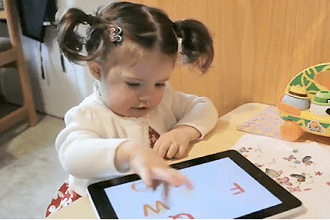
WriteOn app, lets your child practice their name, follow proper strokes for both Block and Script letters, has multiple lines so they can see their progress, sounds in both American and UK English, letter sounds, phonetic sounds, animated letter strokes, cute animal images, write in multiple colors, erase last stroke, and more. It allows children to express themselves, frees them from the fine motor demands of letter formation. For many children these tools can serve as adaptive or assistive technology to make the physical act of writing less frustrating.

Kid Pix are an excellent way to introduce children to open-ended exploration of the computer. Children’s art programs generally provide a wide range of choices for expressing ideas, from freehand drawing to the use of stamps, text, or other special effects.

Kidspiration (Inspiration Software) allows children to depict many of the ideas and concepts they are working with and put them in relation to one another pictorially. These tools allow children to create webs and other schematics that visually represent their understanding of a topic.

However, as already discussed there are a few areas worth pondering over before using technology for elementary education. The teacher has to be well versed in using technology and handling problems. The use of technology should be done to assist teaching and not just for the sake of using technology. The National Educational Technology Standards developed by the International Society for Technology in Education (ISTE) give a good idea of the knowledge and skills that children should be developing in the early years. They can serve as a guide for choosing programs and applications for children to use.

Teachers, in accordance with curriculum standards, must decide what children need to learn and do and then choose from a repertoire of teaching practices to help children reach these goals. There are considerable number of points which lead towards the positive effects of technology on children’s learning and development.
Thus, it is a huge responsibility to help the “futures” understand how to use technology in safe and enriching ways.

Img Src

TAGGED: 21st Century Teaching, Administrators, Elementary Education, Teachers/Educators, Technology in Education, Tips for Teachers/Educators
Share This Article
Facebook Twitter Whatsapp Whatsapp LinkedIn Reddit Telegram Email Copy Link
Previous Article are educators using best technology Are Educators Using The Best Technology?
Next Article Why Teachers Who Use Technology Will Replace Teachers Who Dont Why Teachers Who Use Technology Will Replace Teachers Who Don’t?
AdvertisementWhy this Ad?

Latest EdTech News To Your Inbox

Stay Connected

AdvertisementWhy this Ad?

Latest EdTech News To Your Inbox

Stay Connected

AdvertisementWhy this Ad?

You Might Also Like

Top 10 Montessori Teacher Training MTT Courses in India 2026-27 Edition
News

Top 10 Montessori Teacher Training (MTT) Courses in India: 2026-27 Edition

Sep 9, 2026
Schools Went Digital Why Is Student Transportation Still So Fragmented
Insight

Schools Went Digital. Why Is Student Transportation Still So Fragmented?

Sep 8, 2026
Top 10 Early Childhood Care and Education ECCE Courses for Teachers in India 2026-27
News

Top 10 Early Childhood Care and Education (ECCE) Courses for Teachers in India 2026-27

Sep 5, 2026
How to Build Educational Apps That Drive Real Teacher and Student Adoption in 2026
Insight

How to Build Educational Apps That Drive Real Teacher and Student Adoption in 2026

Sep 1, 2026
Why AI Lesson Planning Tools Are Only Solving Half the Problem
Insight

Why AI Lesson Planning Tools Are Only Solving Half the Problem

Aug 31, 2026
How Learning Gaps Can Be Identified Before Assessment AI-Powered Insights
Research

How Learning Gaps Can Be Identified Before Assessment (AI-Powered Insights)

Aug 28, 2026
The Future Belongs to Children Who Can Change Their Minds
Insight

The Future Belongs to Children Who Can Change Their Minds

Aug 26, 2026
Were Teaching Children for Jobs That Wont Exist Heres What We Should Teach Instead
Insight

We’re Teaching Children for Jobs That Won’t Exist, Here’s What We Should Teach Instead

Aug 15, 2026
Show More
EdTechReviewEdTechReview

H433, 2nd Floor, Vikaspuri, New Delhi, India, 110018
Phone: 011 41321030

Follow US

Copyright © EdTechReview. All Rights Reserved.

  • Home
  • Advertise
  • Event Associations
  • Press Release
  • About
  • Services
  • Contribute
  • News
  • Trend & Insight
  • Data & Statistics
  • eLearning
  • Reviews
  • Research
  • EdTech Voices
  • Dictionary
  • Tags
  • Resources
  • Events
  • Courses
  • EdTech Product for Review
  • Sponsored/Paid Post Service
  • Our Clients
  • FAQ’S
  • Contact Us
  • Important Links
  • Sitemap
  • Terms of Use
  • Privacy Policy
newsletter
Join 100K+ subscribers!

Subscribe to our weekly newsletter that brings the latest EdTech news, trends, insights, reports, interviews, etc. for educators, school leaders, entrepreneurs, investors, & others.

loader
Zero spam, Unsubscribe at any time.
Go to mobile version
Welcome Back!

Sign in to your account

Lost your password?