The way we learn has evolved over the past few years. Classrooms no longer have to be restricted to a four-wall space while learning no longer is a singular process. Students today want interactions, flexible responses, and speedy responses. This is where technology is coming in.
EdTech platforms are always seeking ways to make learning more enjoyable. Videos, gamified tests and live sessions have all helped improve the learning user experience. However, a lot of students have difficulty focusing on accessibility and personal help.
This is the place where AI voices are beginning to play a significant role. They provide a human-like experience into digital learning, which makes the learning process more natural and receptive.
What Are AI Voice Agents in EdTech?
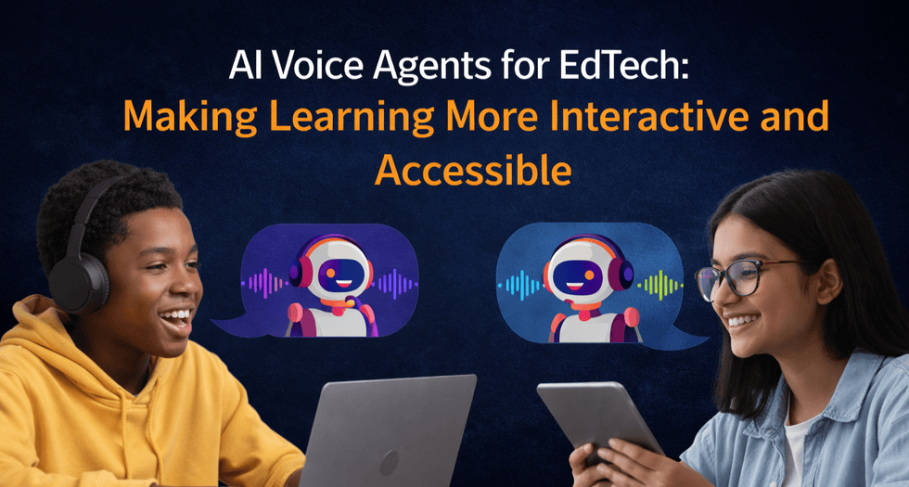
AI voice assistants are smart machines capable of understanding, processing and react to spoken words. They function as virtual tutors that can communicate with students in real-time.
Instead of reading lengthy text or watching videos that are passive learners are now able to interact with the voice. Students are able to ask questions, get explanations, and even try out conversations.
In contrast to basic voice assistants these are specifically designed to provide more interaction. They can adjust to the user’s behavior, comprehend the context of their users, and offer relevant responses that get better with time.
Why AI Voice Agents Are Gaining Attention
There’s a good reason for why EdTech companies are investing heavily in AI technology. Learning is more effective when it is personal and engaging.
Here are some of the main factors that are driving their increasing popularity:
- Students are more engaged when they talk and listen, instead of just reading.
- Voice interaction can help reduce screen fatigue, particularly when you are studying for long periods of time.
- It can accommodate various learning styles, such as auditory learners.
- Real-time responses help in learning faster as well as more effectively.
These benefits are not only theory based. Many platforms have already experienced greater completion rates and higher satisfaction of students after incorporating features that use voice.
Making Learning More Interactive
One of the greatest challenges associated with online education is keeping students interested and involved with activity. Many register for classes but do not complete them, leading them to abandon these efforts all together.
Artificial Intelligent voice agents offer one solution by engaging students directly. Instead of passively viewing content, students actively take part in discussions.
Children learning English could take advantage of AI agents that improve pronunciation while giving real-time feedback, while students learning code could pose questions while working through problems and receive step-by-step directions from AI agents.
Interacting this way helps learners build trust while keeping them interested for extended periods.
Improving Accessibility for Every Learner
Accessibility is an important issue in the field of education. Every student is not taught in the same manner and not all students have the same resources.
AI voice agents aid in bridging this gap in a variety of ways:
- They assist students with visual impairments through the conversion of texts into spoken.
- They assist students struggling in reading by presenting concepts in a way that is spoken.
- They allow hands-free learning which is beneficial for multi-tasking learners.
- They help make education more accessible for those with different abilities.
In many areas, particularly in areas where literacy levels aren’t the same the use of voice-based learning can significantly improve the quality of life. It makes complex subjects easier to comprehend and makes them more accessible.
Real-World Use Cases in EdTech
AI voice assistants are employed in various areas of the educational system. The use of AI voice agents is practical and expanding rapidly.
A few common examples of use are:
- Virtual tutors who provide answers to questions and explain subjects in real-time.
- Platforms for language learning that permit the practice of conversation.
- Exam tools for preparation which simulate oral exams and interviews.
- Student support systems handle questions about schedules, courses and course advancement.
These examples show that the technology of voice isn’t just an added-on feature. It’s becoming a central component of the modern learning platforms.
The Technology Behind AI Voice Agents
The efficiency in AI voice agents stems from the use of a variety of technologies together. Speech recognition and natural language processing and text-to speech systems are all essential to.
They recognize spoken words and process it to understand the meaning and then generate human-like responses. In time, they gain knowledge from their interactions and improve their accuracy.
Platforms looking to incorporate this feature often consider methods like the AI voice agent that allows instant communication, automate responses, and provide easier learning experiences that do not add to the complexity of users.
This type of integration can allow EdTech businesses to increase support while keeping the personal contact.
Benefits for Educators and Platforms
AI voice agents aren’t just beneficial to students. They also provide clear benefits for teachers and platform owners.
- Teachers can cut down on their time through automation of repetitive questions.
- Platforms are able to provide 24/7 support without requiring more staff.
- Learning analytics are improved when voice interactions give greater insight.
- The rate of retention and engagement in courses improve.
For EdTech companies this translates to better results and more satisfied customers, without significantly affecting operational expenses.
Challenges to Consider
Although AI voice agents provide a variety of benefits, there are certain challenges to overcome.
The accuracy of a speech can be affected by background noise, accents or unclear speech. Continuous improvement is necessary to deal with various user groups efficiently.
Privacy is an additional factor. Because voice data is highly sensitive platforms need to ensure adequate security for data as well as compliance with the laws.
In the end, there is a necessity of a thoughtful implementation. Simply adding features for voice isn’t enough. The user experience should be seamless as well as relevant and beneficial for students.
The Future of AI Voice in Education
Future of EdTech appears more personal and conversational. When AI voice agents improve their capabilities, they’ll become more natural and easy to use.
We can anticipate higher-end features like emotion-based understanding, live translation and a more personalized approach. Learning will not feel like an activity but more of a conversation with a guide.
In the long term, AI voice agents can assist in making quality education available to a wider range of people. This is especially crucial in areas where traditional learning resources are scarce.
Conclusion
AI voice agents have revolutionized the ways we view online learning. They bring accessibility, interaction and personalization in an easy but powerful manner.
Students benefit from greater engagement and better understanding. for educators as well as platforms this means more support that is scalable and better outcomes.
With technology continuing to advance and improve, voice-based learning is likely to be a common feature in EdTech. The focus will not only be on the delivery of educational content, but instead in creating engaging learning experiences that are truly connected with the users.
FAQs
Q1. What Is AI Voice Agent Technology (EVAT) In EdTech?
AI voice agents provide students with a way to access learning platforms using speech interaction. They can answer queries, explain topics and guide learners in real time.
Q2. How do AI voice agents enhance learning?
AI voice agents make learning more interactive by engaging students through conversations instead of passive reading, helping students remain engaged with topics better and gain deeper understanding.
Q3. Can AI voice agents provide accessibility services?
Yes. AI voice agents assist learners who experience visual or reading impairment by providing spoken explanations and hands-free interaction.
Q4. Can AI voice agents replace teachers?
No. Their purpose is to complement teachers rather than replace them, providing routine assistance while teachers focus on providing deeper guidance.
Q5. What can AI voice agents bring to education?
In terms of AI voice agents in education, the future includes more natural conversations, improved personalization, wider adoption across platforms and making education more accessible to everyone.