
This website stores cookies on your computer. These cookies are used to improve your website experience and provide more personalized services to you, both on this website and through other media.
Accept
EdTechReviewEdTechReview
  • News
  • Trends
  • Insight
  • eLearning
  • Research
  • Dictionary
  • EdTech Voices
  • More
    • Data & Statistics
    • Reviews
    • AWS for Education
    • Events

    Resources

    • Infographics
    • Reports & Case Studies
    • Videos
    • Books
    • Webinar

    Needs

    • 1:1 Learning
    • 21st Century Education
    • 21st Century Leadership
    • 21st Century Learning
    • 21st Century Teaching
    • 3D Printing
    • More Tags

    For

    • Students
    • Teachers/Educators
    • Administrators
    • Entrepreneurs/Startups
    • Govt. Officials/Policymakers
    • Parents
Explore
Search
Contribute
  • Submit A Post
  • EdTech Trainers and Consultants
  • Your Campus EdTech
  • Your EdTech Product
  • Your Feedback
  • Your Love for Us
  • EdTech Product Reviews
ETR Resources
  • About
  • Mission/Vision
  • Team
  • Services
  • Testimonials
  • Authors
  • Sponsor
  • Partner
  • Advertise
  • Our Clients
  • Media Kit
  • Press Release
  • FAQ’S
Reading: “Green Schools” Use EdTech to Save the Environment
Aa
EdTechReviewEdTechReview
Aa
Search
  • News
  • Trends
  • Insight
  • eLearning
  • Reviews
  • Dictionary
  • EdTech Voices
  • Data & Statistics
  • Research
  • AWS for Education
  • Events
  • EdTech Voices
  • Tags
  • About
  • FAQ’S
  • Our Clients
  • Partner
Follow US
Home > Trend & Insight > Trends > “Green Schools” Use EdTech to Save the Environment
Trends

“Green Schools” Use EdTech to Save the Environment

Na’ama Y. Rosenberg
Na’ama Y. Rosenberg Published Apr 28, 2017
Share
5 Min Read
Green Schools Use EdTech to Save the Environment
“Green Schools” Use EdTech to Save the Environment
SHARE

With the heightened focus on global environmental issues and the increasing pressure on the worldwide community to conserve our natural resources, there has been a growing push and focus for schools and businesses to “go green”.

AdvertisementWhy this Ad?

This has led districts to encourage schools to reduce the amount of paper they use as much as possible, a philosophy that ecologists call “reducing your carbon footprint.”

This emphasis on ecological responsibility has stymied school districts around the country, as schools have always traditionally relied a lot upon paper. Between textbooks, note taking, quizzes, tests and the memos, curricula, and professional development, it is challenging to imagine how a school could function and still reduce their carbon footprint. According to the website Recycle Now Schools, paper waste for primary school is about 99 lbs per student, per academic year. This amounts to an average of 300 tons of paper that gets wasted every year per school. That number refers to schools just in the United States, and just the Primary school level. This is an egregious misuse of natural resources. 

This issue is of real and global concern. How are we to encourage recycling and instill in our students the responsibility to the earth, while we are blatantly wasteful of its resources? We must model best practices for them, by instituting policies of “going green” within our own buildings first.  Fortunately, advancements in educational technology have made a reduction in paper use possible.

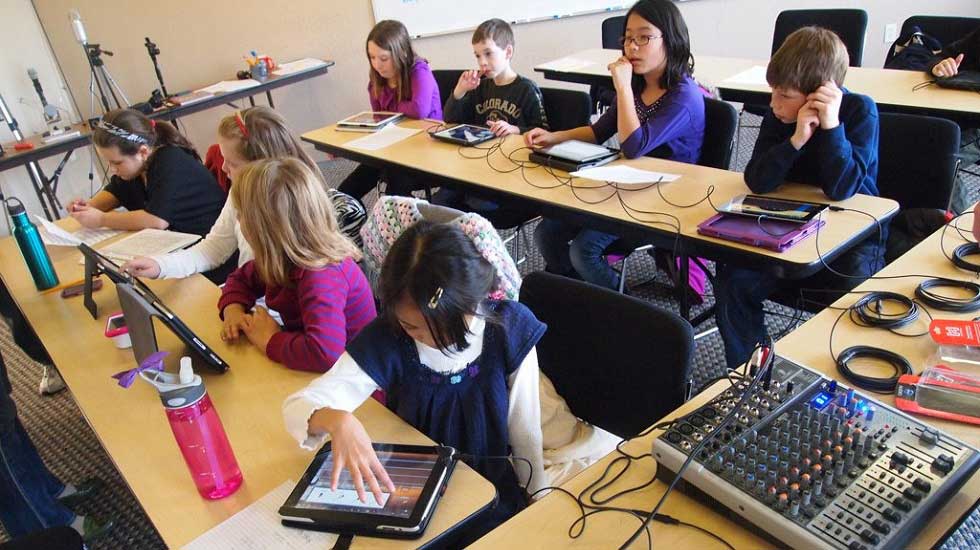
One major consumption point of paper is in traditional textbooks – an issue that is easily resolved. I was part of a pilot program in our middle school where myself and a social studies teacher wrote our own virtual, interactive textbooks. It was structured so each chapter was compiled separately, with built in summaries, homework assignments, concept reviews and assessments. The social studies interactive textbook contained pictures that the teacher had taken herself on vacation at some of the locations being covered, such as the Acropolis in Greece and the Colosseum in Rome. As the class progressed through the units of study, each new chapter was pushed out to their tablets, which made the transfer easier to manage and did not take up too much memory. The ELA textbook had writing prompts, essays and quizzes built in, which could be written and submitted right from the tablet computers.

The results of this year-long program were astounding. Not only did we save the school money on textbooks; not only did we reduce our carbon footprint by approximately 39,600 lbs. of paper for that year; but the hallways were cleaner and the lockers were less cluttered! An unanticipated side effect of this program was an 100% improvement in the executive functioning skills of the entire grade in terms of bringing their materials needed to class.

Another benefit of the program was the enthusiasm with which the students approached their work – they were constantly anticipating their next class and assignment. Parents appreciated that there was one less heavy textbook for students to drag back and forth, and possibly lose. Since the students loved using their tablets, there were no “I lost my homework” excuses offered, as the tablets were always at hand. In fact, the only challenge we faced was how to facilitate the students charging up their tablets so they kept a charge until the end of the school day! In keeping with the philosophy of our new environmentally friendly mandate, we even designed solar powered charging stations to help the students’ power up.

Converting paper textbooks to online versions is just one example of how schools can make the switch to sustainability without sacrificing quality. Many school districts have embraced the 21st century/blended learning model of integrating technology into the classroom.  Administrators should prioritize and encourage efforts that support waste reduction through educational technology. It is time to shift the paradigm towards more “green” ecologically friendly environments. The future of our students depends on it.
Img Src

TAGGED: Administrators, Green School, Teachers/Educators, Technology in Classroom, Technology in Education, Tips and How-Tos, Tips for Administrators, Tips for Teachers/Educators
Share This Article
Facebook Twitter Whatsapp Whatsapp LinkedIn Reddit Telegram Email Copy Link
Previous Article Two-Teacher System - New Model for the Education & Training Market in China ‘Two-Teacher System’ – New Model for the Education & Training Market in China?
Next Article LyncBiz Signs MOU with Globarena to Tap the E-learning Market in India LyncBiz Signs MOU with Globarena to Tap the E-learning Market in India
AdvertisementWhy this Ad?

Latest EdTech News To Your Inbox

Stay Connected

AdvertisementWhy this Ad?

Latest EdTech News To Your Inbox

Stay Connected

AdvertisementWhy this Ad?

You Might Also Like

Top 10 Montessori Teacher Training MTT Courses in India 2026-27 Edition
News

Top 10 Montessori Teacher Training (MTT) Courses in India: 2026-27 Edition

Sep 9, 2026
Top 10 Early Childhood Care and Education ECCE Courses for Teachers in India 2026-27
News

Top 10 Early Childhood Care and Education (ECCE) Courses for Teachers in India 2026-27

Sep 5, 2026
QR Codes for Interactive Learning in the Classroom
Trends

QR Codes for Interactive Learning in the Classroom

Sep 3, 2026
How to Build Educational Apps That Drive Real Teacher and Student Adoption in 2026
Insight

How to Build Educational Apps That Drive Real Teacher and Student Adoption in 2026

Sep 1, 2026
Why AI Lesson Planning Tools Are Only Solving Half the Problem
Insight

Why AI Lesson Planning Tools Are Only Solving Half the Problem

Aug 31, 2026
How Learning Gaps Can Be Identified Before Assessment AI-Powered Insights
Research

How Learning Gaps Can Be Identified Before Assessment (AI-Powered Insights)

Aug 28, 2026
Bringing Interactive Smart Boards to Small-Town and Rural Classrooms in India
Insight

Bringing Interactive Smart Boards to Small-Town and Rural Classrooms in India: A Practical Guide for Better Digital Learning

Aug 6, 2026
The Proxy Attendance Problem No One Talks About Until Its Too Late
Insight

The Proxy Attendance Problem No One Talks About Until It’s Too Late

Jul 22, 2026
Show More
EdTechReviewEdTechReview

H433, 2nd Floor, Vikaspuri, New Delhi, India, 110018
Phone: 011 41321030

Follow US

Copyright © EdTechReview. All Rights Reserved.

  • Home
  • Advertise
  • Event Associations
  • Press Release
  • About
  • Services
  • Contribute
  • News
  • Trend & Insight
  • Data & Statistics
  • eLearning
  • Reviews
  • Research
  • EdTech Voices
  • Dictionary
  • Tags
  • Resources
  • Events
  • Courses
  • EdTech Product for Review
  • Sponsored/Paid Post Service
  • Our Clients
  • FAQ’S
  • Contact Us
  • Important Links
  • Sitemap
  • Terms of Use
  • Privacy Policy
newsletter
Join 100K+ subscribers!

Subscribe to our weekly newsletter that brings the latest EdTech news, trends, insights, reports, interviews, etc. for educators, school leaders, entrepreneurs, investors, & others.

loader
Zero spam, Unsubscribe at any time.
Go to mobile version
Welcome Back!

Sign in to your account

Lost your password?