“The key for businesses is to explain their needs crisply, as they often do in the US with community colleges – tailoring curricula to specific tasks and knowledge areas. It gets a lot more complicated when the student needs to learn higher-order thinking skills such as creativity, collaboration, etc., and character qualities such as ethics and leadership.” — Charles Fadel
Employers’ complaints that new college graduates aren’t ready for the workplace has become a common headline. Charles Fadel, Founder of the Center for Curriculum Redesign, believes solving the problem means changing what competencies we assess in students that “would prepare them for employment.”
The world of business, driven by rapid technological innovation, continues to change dramatically, creating new jobs that didn’t exist a decade ago while eradicating other jobs that can be easily be automated. The skills that employers need are changing; so how do we measure what we should in order to meet the needs of students and industry?
“A system like Northeastern University’s Department of Cooperative Education and Career Development, in which students alternate semesters of study and full-time work in their chosen field, is a great example of the type of partnership that can exist and complement existing education,” says Fadel, who also notes that “apprenticeships have been the norm and provide a trained pipeline to industries” in Germanic countries.
The spotlight until now has been on government and educational institutions to focus on equipping young people for employment. But what about business leaders? How can business leaders partner with schools and students to create workplace-ready young people? Charles Fadel joins us in The Global Search for Education for Part 2 of our discussion on a new vision for assessment.

“Portfolios, though they take more effort to review, provide more meaningful information about students’ critical thinking, meta-learning, and other competencies difficult to capture with conventional testing.” — Charles Fadel
Charles, how do you suggest leading US Colleges partner with US business leaders to create a curriculum that will ensure students succeed once they enter the workforce?
The key for businesses is to explain their needs crisply, as they often do in the US with community colleges – tailoring curricula to specific tasks and knowledge areas. It gets a lot more complicated when the student needs to learn higher-order thinking skills such as creativity, collaboration, etc., and character qualities such as ethics and leadership.
One way to tackle this issue is by switching away from quantitative tests of performance entirely, and to focus on a different type of evidence of learning. Portfolios, though they take more effort to review, provide more meaningful information about students’ critical thinking, meta-learning, and other competencies difficult to capture with conventional testing. The other option is to bring testing into a new frontier, in which students’ competencies are assessed in an authentic way, the tasks are meaningful, and the back end of the program works off of an informed learning model based on learning sciences research to integrate the collected data into not only a summative ranking, but useful formative information.

“The other option is to bring testing into a new frontier, in which students’ competencies are assessed in an authentic way, the tasks are meaningful, and the back end of the program works off of an informed learning model based on learning sciences research to integrate the collected data into not only a summative ranking, but useful formative information.” — Charles Fadel
What is the impact of the current predominant assessment systems on the preparedness of college graduates for the current and future demands of the labor market? Can and should business leaders who can’t find skilled workers be more disruptive with US Colleges about the way they assess students?
Current assessment systems do not reflect the demands of the labor market, so their effect is mainly a distraction from coursework (which may or may not be relevant to the labor market). By forcing teachers to focus on what is on the test, administrators are pulling students away from relevant work that would prepare them for employment, and toward more scholastic and narrow skills such as test-taking, the particulars of grammar and algebra, and so on.
Business leaders who can’t find skilled workers should be innovative with complementing existing educational programs and working more closely with colleges that are leading the way – for instance:
- Arizona State University: Students pay when they complete courses successfully.
- Northeastern University: Long-standing policy of cooperative education and experiential learning
- University of Wisconsin: Competency-based degrees targeted to adult learners.
Southern New Hampshire University: Competency-based degree program in partnership with employers. - NSF-ATE community colleges: Programs focused on the education of technicians for the high-technology fields

“Business leaders who can’t find skilled workers should be innovative with complementing existing educational programs and working more closely with colleges that are leading the way.” — Charles Fadel
Is there a more formal way that businesses can influence the way assessment is done?
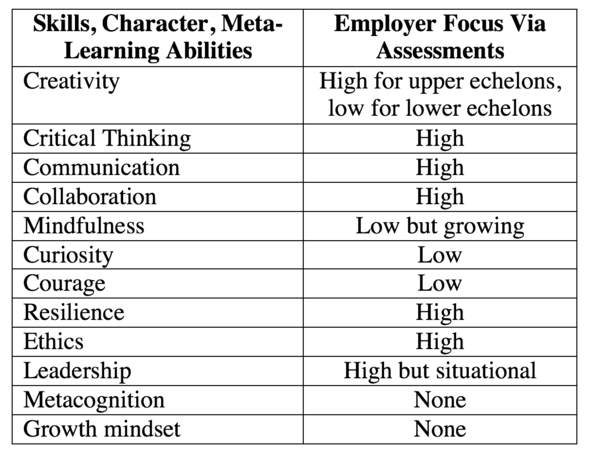
In its report, “Workforce assessments – What do we Actually measure?”, the Assessment Research Consortium has highlighted all the various ways businesses presently assess their employees, and the emphasis they put (or not) on various competencies.

Because of the difference in motivations and legal constraints, employer testing has proceeded on a different track than scholastic assessment. In general, there is more emphasis on personality testing. This is largely due to the fact that personality testing is non-discriminatory and therefore can be freely deployed without legal issues. There are well-developed correlations (though they are distressingly modest) between certain personality archetypes and success in certain occupations, and these form the basis of personality screening tests.
Government is focused on how to create new jobs but should policymakers be even more focused on closing the skills gap you’ve identified?
The presidential debates did mention that students were unprepared to enter the workforce, but employer needs were not mentioned because that framing is less evocative. Access and affordability seem like more fundamental issues because if students cannot get to college then they definitely won’t be prepared. The problem is that if we continue to only discuss access and affordability until a majority of Americans go to college, and only then address the problem that colleges haven’t been preparing students effectively this whole time, that would be a tragic waste of effort. Both questions need to be faced simultaneously, even though the first one seems more fundamental. They are a system and it is not enough to focus on one bottleneck if there is another one down the line that is already known. Why increase the supply of the wrong “product”?
Thank you Charles!
This article first appeared here.