


Each student stepping into the school compound is not a clean slate. He carries his home within.
Largely students’ behavior in the classroom is a repetition of responses he learned from home. His parents, siblings and other significant family members give him primary lessons in interpersonal relationships. Those lessons persist and the student spills it out in the classroom.
For instance, parent-child conflicts may undermine students’ willingness to respect authority. Misbehavior in the classroom might be a reaction to the psychological control the parents exerted on the student. Resentment over the mother’s lack of empathy may carry over as indifference to the class teacher. Overambitious parents pressurizing the child to score high marks might be killing the joy of learning and student may swallow classroom learning as bitter medicine. Too much pampering at home might give the child the impetus to flaunt his self-centered, egoistic, destructive tendencies.
Yet, an alcoholic parent has that impact to sow the seeds of violence in his offspring. Alcoholics by their very act convey the implicit message for violating moral standards rather than complying with them. We can see that students who often misbehave and indulge in peer violence usually hail from families with a low socio-economic status where parental conflicts, poverty, and alcoholism is a daily concern. Such children struggle a lot to develop necessary social skills.
EMPATHY A PROFESSIONAL NECESSITY
Individual communication between a teacher and a student matters a lot in the academic performance and the school life of student. While communicating with a particular student an educator must be able to see the home the student carries within him. This is the prime requirement for all child-centered teaching practices. Then only can a teacher treat each child as a unique entity. The uniqueness of a student, largely, is a contribution of his home.
The fact is, quality and texture of teacher-student interaction is purely a choice made by the teacher. A teacher can interact with a student as if he is “just a student”, came to the school to complete his course. But when the teacher is ready to push the mandatory boundaries and look into the personal and family background of the student the teacher decides to be more empathetic.
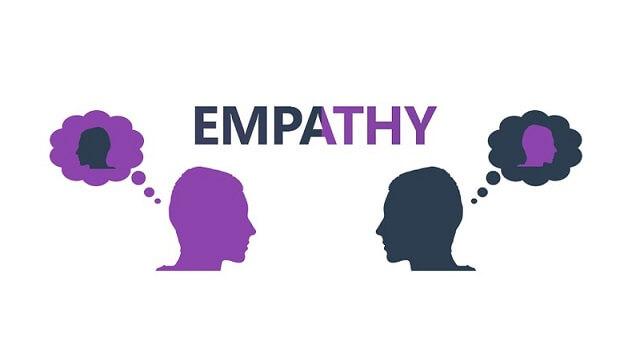
On looking at the face of the student the information collected about the student’s family environment, his personal qualities, and his socio-economic status unfurls in the mind of the teacher spontaneously, and influences her responses to the student, we can say that teacher knows how to be empathetic. But while looking at the face of the student the first thing that comes to the mind of the teacher is the score or grade the student got in the past examination the teacher is a person with very narrow professional objectives.
Empathy, as we know, is the ability to perceive the situation from some other’s point of view. Ability to put one’s leg in other’s shoes. To some extent, every human being is endowed with this ability. And it is this ability which gives the human being the title of a social being. But a common man’s ability to empathize–it is not sufficient for effectiveness in teaching. Consciously planned upgrading of teacher empathy is a professional necessity.
LEVELS OF EMPATHY
In teacher-student relationships, partial understanding is more dangerous than no understanding. Statistical data collected from the students gives a blueprint for the teacher to study the student. It will contribute only minimally to the level of understanding of the teacher about the student.
Studying the psycho-social nature of the home of the student clears all the clutters in teacher empathy. Empathy, however sincere it might be will never find its way to effective teacher-student interactions if the teacher hasn’t an in-depth understanding of the domestic ambiance of the student. When teacher empathy is not in the right amount and quality both the teacher and student will miss bonding at an emotional level during their communications. They will be like two souls standing at different bank s of the same river. The teacher will fail to touch the emotions of the student. Child-centered teaching will remain a myth.
There are three levels of understanding a student; a teacher is free to enter any one of them
- Peripheral layer (mandatory): collect the statistical information and details of the socio-economic status of the student.
- Secondary layer(academic ; optional): Understanding parental attitudes and aspirations about the education of the child, parental readiness for educational involvement, awareness of parents about the importance of parental educational involvement and available parental resources for the same
- Tertiary layer (whole child; optional): Understanding whole child by probing into students’ past life, the kind of family experiences he has gone through, his relationship with parents, personal interests and aptitudes., family atmosphere as perceived by the student and its fit with his inclinations and innate tendencies, etc..and a lot more.
In most educational systems the first layer is mandatory which the teacher must execute as a part of understanding the student. There are teachers who use it as a fixed framework to view the student throughout the academic year. During their interactions with the student, only the statistical data pops up in the mind of the teacher. Dynamic and active interaction with the student is impossible with the help of this information. Willingness to go beyond this… it is a choice.
Teachers who wish to exercise the right kind of empathy spontaneously draw their attention towards the deeper layers of understanding the child. Empathy exercised over the peripheral layer of understanding is not any empathy at all. Empathy grows with understanding. Empathy as quality cannot be induced from outside. It stems from within, from a desire to reach out…… Its the genuine interest in the student which catalyzes the expansion of teacher empathy…It is a choice
TEACHERS OF TODAY AND YESTERDAY
Teachers of bygone era practiced even home visiting as part of understanding the student’s background. No doubt there was a certain chemistry that prompted the parental community and the society as a whole to view teachers as somebody with the power to guide the rest of the society forward. Trust of students and parents drew its sustenance from the genuine empathetic behavior exhibited by the teaching community. Teacher empathy and parental trust nurtured each other.
But as commercialization invaded the educational system classrooms have become venues to produce brains for the prospective job markets. Teachers willingly repudiate the whole-child approach and the main focus is on the examination. In this state of things, empathy is not needed. In examination-oriented systems, teachers are not supposed to involve in all aspects of student life but only in those aspects in which score in the examination is at stake, needs special attention from teachers.
There is a mammoth difference between teaching a student knowing only about his previous/present intellectual performance and teaching the student by knowing the whole child– his life, interests, feelings, home environment, persona etc. The former approach in teaching is easier and the later is easy only for the teacher who is willing to reach out and nurture genuine interest in her students. It is a choice.
