
For much of its history, enrollment lived in a single building. It was the domain of admissions officers and recruiters, measured by application counts, deposit deadlines, and first-day “starts.” If students showed up in August, institutions celebrated. What happened after that largely belonged to someone else.
That model no longer reflects reality. Enrollment strategy has moved out of the admissions office and into cabinet-level conversations, budget planning sessions, and academic strategy meetings. Presidents, provosts, and chief financial officers have always tracked enrollment closely. What has changed is the degree to which it now determines financial sustainability and strategic flexibility, and what that means for everyone connected to the learning ecosystem, from edtech developers building tools for these institutions to policymakers shaping workforce pipelines.
The shift is not cosmetic. It reflects a structural change in how institutions must think about growth and relevance in a volatile market, and it raises a larger question about how enrollment now shapes decisions across the entire campus.
Key Takeaways:
- Enrollment strategy has expanded beyond admissions to become a cabinet-level priority that influences institutional finances, planning, and long-term strategy.
- Changing demographics and learner expectations are pushing institutions to shift from a volume mindset to a portfolio mindset focused on serving diverse student populations.
- Integrated data and shared infrastructure allow enrollment to function as a planning tool that connects recruitment, academic programs, and student success.
- Modern enrollment strategy now spans the full student lifecycle—from inquiry to completion and lifelong engagement—linking institutional growth with student outcomes.
Why Enrollment Now Shapes Everything
Demographic contraction, rising student acquisition costs, shifting learner expectations, and intensifying competition have changed the stakes. Higher education leadership teams increasingly recognize that enrollment outcomes influence far more than incoming class size. They shape revenue predictability, faculty workload, program viability, and long-term institutional identity.
Most institutions can no longer depend on a single traditional pipeline. The fastest-growing learner populations today do not resemble the historical majority. Adult learners, career changers, degree completers, and working professionals are reshaping demand at nearly every credential level.
When the market changes, strategy must change with it. This requires a move from a volume mindset to a portfolio mindset. Instead of asking how to enroll more students, institutions are asking which learners they are best positioned to serve and how programs, delivery models, and support systems must evolve to meet those learners where they are.
What makes this shift possible is that institutions can now see enrollment’s ripple effects more clearly than ever before.
Enrollment as a Planning Tool, Not a Pipeline
Institutions now have greater insight into how recruitment activity, marketing engagement, program demand, and student behavior connect. When leaders can see those relationships in a shared data environment, enrollment serves as a planning instrument that determines institutional strategy.
It informs which programs grow and which contract. It influences hiring decisions, shapes investment in online and hybrid delivery models, and reframes leadership and digital transformation conversations around evidence instead of intuition.
At this point, enrollment cannot live in a silo.
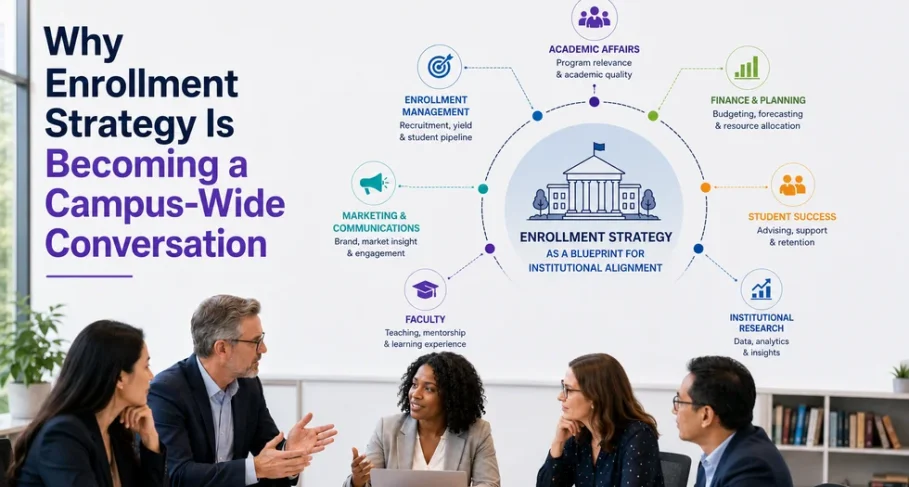
Institutions that treat enrollment as a cabinet-level strategy expand the work beyond recruitment, redesigning their management model so enrollment is integrated with academic planning, student support, and financial forecasting. Innovation and digital transformation, in this context, advance structural alignment across the institution.
What Shared Responsibility Actually Means
Shared responsibility for enrollment is often misunderstood. It does not mean distributing tasks more widely or asking faculty to attend additional open houses. It means aligning strategy across units.
Academic leaders shape program relevance and value, marketing communicates differentiation, student support teams influence persistence, and enrollment leaders facilitate the journey from inquiry through completion. Alignment occurs when each team understands how its work influences both institutional growth and student success.
Many institutions struggle with visibility. Departments often operate with partial information, separate systems, or metrics that do not connect. Collaboration then depends on meetings and goodwill rather than shared insight.
Integrated infrastructure changes that dynamic. When recruitment activity, student behavior, market signals, and outcome indicators are visible across teams, collaboration becomes operational. Leaders can see how many students are entering the funnel and how they are progressing once enrolled. Enrollment decisions can inform academic strategy in real time.
Expanding the Definition of Enrollment
The portfolio shift is only part of the story. If enrollment now shapes institutional strategy, it must also extend beyond recruitment alone.
For years, success was measured at the start of the term. If students arrived on day one, admissions had done its job. Today’s most forward-thinking institutions recognize that a student who starts but does not persist represents a breakdown in alignment across recruitment, support, and academic delivery.
Enrollment strategy is increasingly viewed as a lifecycle responsibility. It begins with first inquiry and extends through retention, completion, and even alumni engagement. Institutions are building lifelong learning partnerships rather than transactional relationships. When enrollment strategy is aligned with student success from the outset, institutions cultivate deeper loyalty and sustained engagement long after graduation.
Institutions are now using advanced data, like predictive analytics, to understand who is most likely to enroll and thrive. Early signals about academic risk or disengagement can prompt coordinated intervention from advising, faculty, and support services. That connection between enrollment intelligence and persistence strategy is a hallmark of emerging higher education thought leadership.
When institutions connect enrollment strategy with persistence intelligence, they stop thinking in terms of starts and begin thinking in terms of trajectories. Growth becomes measured not only in headcount but also in momentum toward completion and career outcomes.
Innovation Without Losing Humanity
A common concern surfaces whenever technology enters the conversation: Will innovation make the student experience less personal? In my experience, the opposite is true when systems are implemented thoughtfully.
Data allows institutions to see patterns, anticipate needs, and coordinate responses before students have to advocate for themselves. Faculty and staff spend less time searching for information and more time mentoring, guiding, and encouraging. Technology, in this context, equips human connection.
Early in my career, personalization meant remembering a student’s name and perhaps one detail from their application. Today, institutions can understand far more about a learner’s goals, concerns, and potential barriers. When that insight is shared across admissions, advising, and faculty teams, planning conversations begin from real understanding. In that way, empathy becomes operational, and institutional alignment becomes achievable at scale.
Enrollment as the Foundation for Higher Education’s Vision for the Future
Enrollment strategy has become a campus-wide conversation because the stakes have changed. Growth, sustainability, student success, and institutional relevance are now tightly interconnected. When enrollment is approached as a shared strategy, it clarifies priorities across the institution and strengthens coordination in moments of uncertainty.
But the implications of this shift extend beyond any single campus. For edtech founders, it signals where institutions are investing and what kinds of tools actually move the needle. For policymakers, it highlights how enrollment intelligence connects to workforce outcomes and economic mobility. For educators at every level, it reframes student success as a systemic responsibility, not a finish line crossed on the first day of class.
Higher education leadership in this era requires more than effective recruitment. It requires designing systems, roles, and decisions around a shared understanding of the learners an institution intends to serve. Enrollment, once contained within a single building, now shapes how entire institutions—and the broader ecosystems around them—define their future.